Memory Reconstruction Errors eBook
Explains how human memory rewrites itself, creatin
Explains how human memory rewrites itself, creating false details with each recall.
Formats
Free sample
Chapter 1: The Impossible Pocketknife...--–- Think back to your earliest childhood memory. Really try. Perhaps it is a birthday party where you blew out candles on a cake shaped like a cartoon character. Maybe it is a family vacation to a beach, the sun warming your face, your father’s hand wrapped around yours. Or perhaps it is something simpler: sitting on a kitchen floor, the smell of cookies baking, the sound of your grandmother humming a song you have not heard in decades.
Hold that memory in your mind. Notice how vivid it feels. Notice the confidence you have that this event actually happened, exactly as you are now seeing it.Now, I am going to ask you a question that might feel unsettling: How many of those details are real? Not how many feel real—how many are actually, verifiably, true?If you are like most people, your answer will be some version of “all of them, of course.” You were there. You remember it.
What else could there be?This instinct—that memory is a faithful recording of what happened—is one of the most intuitive and most wrong beliefs about the human mind. You have lived your entire life assuming that your memories are photographs, video files, or diary entries stored safely in the vault of your brain, waiting to be retrieved exactly as they were deposited. This assumption feels unshakable because it is reinforced every single day. You remember where you parked your car this morning, and you walk to that spot and find it there. You remember your mother’s phone number, and you dial it and she answers.
You remember that you have a meeting at two o’clock, and you arrive and your colleagues are waiting. These small successes create a powerful illusion: that memory works like a camera.But here is the truth that cognitive science has established over the past century, a truth so counterintuitive that it took decades for researchers to fully accept it: your memory is not a camera. It is not a video recorder. It is not a hard drive. Your memory is a storyteller—and like all storytellers, it revises, embellishes, trims, and invents.
Every time you remember something, you are not playing back a recording. You are rebuilding the past from fragments, filling in gaps with guesses, updating old memories with new information, and often adding details that never happened at all. The memory that feels so vivid and true in your mind right now is, to a surprising degree, a fiction.This chapter is the foundation of everything that follows in this book. Before we can understand the specific errors that memory makes—the misinformation effect, the imagination inflation, the flashbulb myth, the social contagion, the recovered memory wars, the eyewitness failures—we must first dismantle the illusion that memory is a faithful recording. We must confront the uncomfortable possibility that the childhood memory you just called to mind has been rewritten, perhaps many times, and that some of its most vivid details may be complete fabrications that your brain added years after the fact.
This is not a fringe theory. It is the consensus of modern cognitive psychology, supported by over a century of experiments, case studies, and neuroimaging data.The Video Camera Model: Why We Believe It Before we can understand how memory actually works, we need to understand why we are so convinced it works differently. The Video Camera Model of memory is not a formal scientific theory; it is a folk belief, an intuition that feels so obvious that it rarely gets questioned. According to this model, memory operates in three tidy stages. First, encoding: your senses record an event, like a camera lens capturing light.
Second, storage: that recording is filed away in your brain, untouched and unchanged, like a video saved to a hard drive. Third, retrieval: when you want to remember, you search for the file and play it back. If the playback is fuzzy or incomplete, that means the original recording was poor or the file has degraded, like a worn VHS tape.This model is deeply appealing for several reasons. First, it matches our subjective experience. When you remember something, it feels like you are watching a mental movie.
You see images, hear sounds, sometimes even feel textures or smells. The subjective experience of remembering is perceptual—it engages the same sensory brain regions that were active during the original event. This perceptual quality creates the strong intuition that you are re-experiencing rather than reconstructing.Second, the Video Camera Model is reinforced by our successes. As noted earlier, you usually remember where you parked your car. You usually remember your mother’s phone number.
You usually remember your appointments. These successful retrievals happen dozens or hundreds of times per day, creating a powerful confirmation bias. The failures—the times you confidently remember something that turns out to be wrong—are rarer and often dismissed as anomalies or signs of a “bad memory.”Third, the Video Camera Model is culturally reinforced. We speak of “photographic memory” as a superpower. We tell children to “pay attention so you remember.” We treat confident witnesses in court as credible witnesses.
The legal system, the education system, and our personal relationships all assume that memory is essentially reliable, and that errors are exceptions rather than rules.But the Video Camera Model is wrong. It is not just slightly inaccurate; it is fundamentally, catastrophically wrong. And the evidence for this has been accumulating for nearly a century.The Man Who Started It All: Frederic Bartlett In 1932, a British psychologist named Frederic Bartlett published a book called Remembering: A Study in Experimental and Social Psychology. It was not a bestseller. It did not make headlines.
But within academic psychology, it set off a revolution that is still unfolding today. Bartlett did something deceptively simple: he asked people to remember things, and then he looked closely at what they actually did.Bartlett’s most famous experiment used a story called “The War of the Ghosts.” This was a traditional Native American folk tale, which Bartlett chose because its content would be unfamiliar to his British participants. The story goes something like this: two young men from a village go canoeing on a river. They hear war cries and think they are enemies, so they run to the shore and hide. A war canoe appears, and a ghost invites one of the men to join a battle.
The man refuses. The ghost says, “If you do not come, I will shoot you.” The man goes, fights, and is wounded. He returns to his village, tells the story, and then dies. The narrator concludes: “Something black came out of his mouth. His face became contorted.
The people jumped up and cried. He was dead.”Bartlett read this story to his participants and then asked them to recall it at various intervals: minutes later, hours later, days later, months later, even years later. He was not interested in whether they remembered perfectly. He already knew they would not. He was interested in how they changed the story.The pattern was striking and consistent.
Almost immediately, participants began to reshape the story to fit their own cultural expectations. The unfamiliar “canoes” became “boats.” The…
This is the end of the free sample. Get the eBook to keep going. Buy now
About this book
Details
- Author
- Scroggins Andrea
- Publisher
- SamEnrico
- Language
- English
- Genre
- Non-Fiction, True Crime, Cognitive Psychology
- Released
- 2026-06-06
- Pages (approx.)
- 157
- Available as
- eBook, Audiobook

Read better in the ZLOADR app
Your eBooks on your phone or tablet. Sign in with your SamEnrico account and start reading.
More by Scroggins Andrea
 Blood Pressure Brain HealthScroggins Andrea$11.99
 Yosemite National Park VanishedScroggins Andrea$11.99
 Sleep Smoking Cessation AidScroggins Andrea$11.99
 Method of Loci For SpeechesScroggins Andrea$11.99
 Paleo Budget Grocery GuideScroggins Andrea$11.99
 Imposter and Fear LinkScroggins Andrea$11.99
 Cobalt Vitamin B12 LinkScroggins Andrea$11.99
 The Bloodied Sands of Kalinga: Ashoka's RedemptionScroggins Andrea$11.99
 The Vanishing Witness: A South African Syndicate's Ghost in the UKScroggins Andrea$11.99
 How to Produce Soy Milk MakersScroggins Andrea$11.99
 How to Produce Frosted GlassScroggins Andrea$11.99
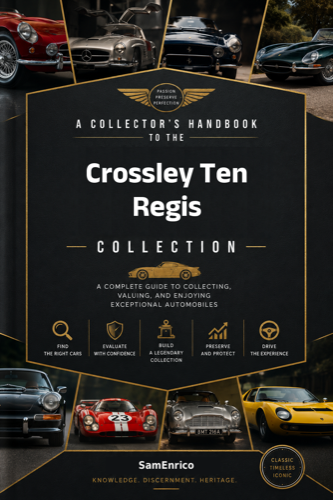 A Collector's Handbook to the Crossley Ten RegisScroggins Andrea$11.99