
Non-FictionSelf-HelpPerforming Arts
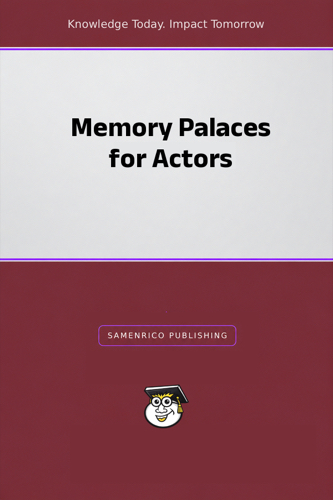
Memory Palaces for Actors eBook
Store scripts, blocking, and character arcs using
by Mcgee Judy
Store scripts, blocking, and character arcs using extended loci.
Formats
Free sample
Chapter 1: The Trap of Rote...--I remember the first time I dried on stage. Not the flutter of a forgotten word—the kind where a gentle prompt from your scene partner saves you. I mean the full, yawning, white-hot abyss. I was playing Trofimov in The Cherry Orchard, mid-monologue about human progress, and at the exact moment I reached for the line “All of Russia is our garden,” my mind produced nothing. Not the wrong word.
Not a partial phrase. Absolute zero. I stood there for what felt like three minutes (my stage manager later said it was eleven seconds) while my scene partner, playing Madame Ranevskaya, looked at me with a mixture of genuine character concern and barely concealed actor panic. The audience shifted in their seats. I could hear someone cough.
And then, because the brain is a cruel survival machine, it supplied not the line but a complete, high-definition memory of the beige carpet in my third-grade classroom.That was the moment I stopped believing that “learning lines” was a matter of repetition.If you are an actor, you have felt something like this. Perhaps not the full abyss, but the edge of it. That queasy moment when you realize you are no longer listening to your partner—you are waiting for your cue like a trapdoor. You are not inhabiting the character. You are not discovering.
You are reciting. And the recitation feels thin, brittle, and one sneeze away from collapse.Here is the central argument of this book, and it begins in this first chapter with a claim that will either relieve you or outrage you: Your difficulty memorizing lines is not a defect of your memory. It is a defect of your method.Actors are trained to believe that memorization is a grind. That you sit in a chair with a yellow highlighter, read the same fifteen lines forty-seven times, and eventually—through sheer attrition—the words stick. This approach is called rote repetition.
It is the dominant paradigm in actor training, and it is a catastrophe.Rote repetition treats the script as if it were a phone number: a meaningless string of digits to be burned into the prefrontal cortex through brute force. But the human brain did not evolve to remember phone numbers. It evolved to remember places. To remember paths through the forest. To remember which berry bush is safe and which one made your cousin vomit for three days.
Your hippocampus—that seahorse-shaped structure buried deep in your temporal lobe—is not a flashcard machine. It is a GPS. A navigation device. A spatial map that has been refined over three hundred million years of evolutionary pressure.When you ask the brain to memorize lines through rote repetition, you are asking your prefrontal cortex (the “executive function” center, which is evolutionarily young, metabolically expensive, and easily exhausted) to do work that your hippocampus could do for free. And when you step onto a stage under hot lights, with an audience breathing in the dark and a scene partner who changed their delivery because they had a different espresso that morning, what happens?
The prefrontal cortex—already tired, already overworked—panics. It folds. And you dry.The problem is not that you have a bad memory. The problem is that you are using the wrong memory system.This chapter will introduce you to the three pillars of actor memory—Loci, Imagery, and Motion—and will fundamentally reframe what it means to “learn” a script. By the end of this chapter, you will understand why walking through your apartment while muttering lines is a better rehearsal technique than sitting at a desk, why your worst performances happen when you know your lines “too well,” and why the most important step in preparation is the one you have been skipping: building the architecture before you ever speak a word aloud.The Neuroscience Lie That Theater Schools Keep Telling Let me be blunt.
Most acting programs teach memorization the same way they teach breathing: by not teaching it at all. They assume that “learning lines” is a private, mechanical chore that happens between rehearsals, like doing your laundry. The director says “be off-book by Friday,” and you go home and read the script until your eyes blur. No one ever asks how you will do this. No one ever suggests that there might be a faster, more reliable, more creative method.And yet, the neuroscience of memory has been settled for decades.The hippocampus is your brain’s spatial and episodic memory center.
It is responsible for navigation, for remembering where you parked your car, for recalling the route you took on vacation three years ago. The hippocampus is ancient, efficient, and incredibly resilient under stress. Soldiers under fire can still find their way back to base. People having panic attacks can still find the exit door. The hippocampus does not freeze.The prefrontal cortex (PFC) is your brain’s working memory center.
It holds the phone number you just looked up, the grocery list you are reciting in the car, the line you are trying to remember while the audience waits. The PFC is evolutionarily new, fragile, and the first system to shut down under pressure. When you experience stage fright, your PFC is literally reducing blood flow. It is preparing for a survival threat by abandoning higher cognition.Now, here is the cruel irony: rote repetition trains the prefrontal cortex. You are, in effect, strengthening the very system that will abandon you the moment you need it most.A study published in Neuron (Maguire et al., 2003) compared the brain activity of memory athletes—people who can memorize the order of ten decks of cards—to control subjects.
The memory athletes showed significantly less prefrontal cortex activation during memorization tasks. Instead, they showed heightened activity in the hippocampus and in spatial navigation regions. They were not “trying harder.” They were thinking differently. They were converting abstract information (cards, numbers, words) into spatial journeys.Actors are, without knowing it, trying to be memory athletes with one hand tied behind their backs. You have the same hippocampus.
You have the same capacity for spatial memory. But you have been trained to ignore it.The Three Pillars of Actor Memory Every memory palace—whether you are memorizing a grocery list or the third act of Hamlet—rests on three foundational elements. I call them the Three Pillars. They are simple, but they are not obvious. And most actors, even very good ones, use only one of them.Pillar One: Loci (Places)Loci (pronounced LO-sigh; singular: locus) is the Latin word for “places.” In the memory tradition dating back to Simonides of Ceos in 477 BCE, a locus is a physical location within a mental building where you “place” an image that represents something you want to remember.For an actor, loci are the architecture of your scene.
Every line, every beat, every emotional shift, every piece of blocking can be anchored to a specific location in your memory palace. The front door. The kitchen table. The window. The bookshelf.
The hallway closet. These are not metaphors. They are real, vivid, sensory-rich locations that your hippocampus already knows how to…
This is the end of the free sample. Get the eBook to keep going. Buy now
About this book
Details
- Author
- Mcgee Judy
- Publisher
- SamEnrico
- Language
- English
- Genre
- Non-Fiction, Self-Help, Performing Arts
- Released
- 2026-06-06
- Pages (approx.)
- 153
- Available as
- eBook, Audiobook

Read better in the ZLOADR app
Your eBooks on your phone or tablet. Sign in with your SamEnrico account and start reading.
More by Mcgee Judy
 The Thesis Writer's AnxietyMcgee Judy$11.99
 Self Regulation EQ Skills HandbookMcgee Judy$11.99
 Mindfulness Meditation for Seniors GuideMcgee Judy$11.99
 Drug Dependency AssessmentMcgee Judy$11.99
 Trauma Dream Journal WorkbookMcgee Judy$11.99
 Palace for ChessMcgee Judy$11.99
 Self Worth And AddictionMcgee Judy$11.99
 Metta For Your EmotionsMcgee Judy$11.99
 The Gold Heist of Mansa Musa: The Empire That Outsmarted the WorldMcgee Judy$11.99
 Operation Midnight Climax: The CIA's Secret Mind Control LabMcgee Judy$11.99
 Love in the Shadow of the Ziggurat: The Forbidden Bond of Ishtar and TammuzMcgee Judy$11.99
 The Mineral Guide to CorderoiteMcgee Judy$11.99
You may also like
 Hong Kong Handover 1997Dunn Johnnie$11.99
 Zumba For Postnatal Recovery CourseNeal Christian$11.99
 Zumba for BeginnersLadner Nikia$11.99
 YouTube Comment Mining GuideHumes Pandora$12.99
 Worry Box MeditationCarlin Rudy$11.99
 Workplace Stress MeditationNguyen Lynn$11.99
 Workplace Stress and Sleep RepairHawley Ivory$11.99
 Workplace Perfectionism CureDelaney Jeffry$11.99
 Workplace Injustice Anger GuideWallen Isabelle$11.99
 Work Addiction and Burnout LinkGreenwood Ester$11.99
 Women in Yoga and WellnessBeattie Galina$11.99
 Women in Stand Up ComedyChun Evangeline$11.99