
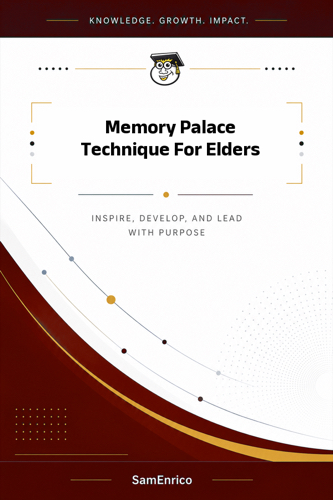
Memory Palace Technique For Elders eBook
Adapt ancient spatial memory method for aging brai
Adapt ancient spatial memory method for aging brains, using familiar home layouts to store information.
Formats
Free sample
Chapter 1: The Strength You Already Own--–- By the time you finish this chapter, you will have done something most people believe is impossible after sixty. You will have memorized a list of five unrelated items in under two minutes, and you will recall them tomorrow, next week, and next month. This is not a trick. It is not a puzzle or a brain game. It is a transfer of power from a part of your brain that remains world-class to other parts that have simply gotten rusty from disuse.You have been told a lie about your aging brain.
The lie is subtle, well-intentioned, and everywhere. It appears in pharmaceutical commercials showing sad older adults staring out rainy windows. It appears in worried conversations with adult children who say, “It’s okay, Dad, you’re just getting older.” It appears in the very language we use: senior moment, brain fog, losing your edge. The lie is this: that memory decline is inevitable, uniform, and irreversible.The truth is far more interesting.Your brain at seventy is not your brain at thirty, but it is also not simply a worse version. It is a different version.
Some systems slow down. Word retrieval takes a fraction of a second longer. Processing speed — the time between seeing a face and remembering a name — increases slightly. But other systems grow stronger. Pattern recognition improves.
Emotional regulation becomes more precise. And most important for this book, spatial memory — the brain’s ability to navigate familiar environments — remains exceptionally robust throughout life, often improving with decades of experience.You have lived in your home for years, perhaps decades. You know exactly where the coffee maker sits relative to the sink. You know how many steps from the front door to the armchair where you read. You know which floorboard creaks and which cabinet holds the good silver.
That knowledge is not trivial. It is the foundation of a 2,500-year-old memory system that memory athletes use to memorize entire decks of cards, and that you will use to remember names, medications, appointments, and the stories your grandchildren want to hear.This chapter has one job: to convince you that your memory is not broken, to introduce the single most important concept in this book, and to give you your first win before you turn the page. By the end, you will have built your first Memory Palace — not in some imaginary castle, but in the kitchen you know better than any room on earth.The Story They Always Tell (And Why It Matters For You)Every book about memory palaces begins with the same story. You deserve to hear it, but with a different ending than usual.In 477 BCE, a Greek poet named Simonides of Ceos attended a banquet in Thessaly. He recited a lyric poem in honor of his host, a wealthy nobleman named Scopas.
After the performance, Simonides was called outside to meet with two young men who wanted to speak with him. While he was gone, the roof of the banquet hall collapsed, crushing everyone inside. The bodies were mangled beyond recognition. No family member could identify their dead.Simonides stood in the rubble and did something remarkable. He closed his eyes and walked backward through the wreckage in his mind.
He remembered where each guest had been sitting. He identified every body.The traditional telling of this story ends with a moral: Simonides invented the Method of Loci because he noticed that spatial memory is powerful. And that is true. But the traditional telling misses the point entirely for you, the older reader. The traditional telling says: look at this young poet with his extraordinary memory.
The telling you need says: look at what your brain already does every single day without you even trying.You do not need a collapsed banquet hall to prove that your brain maps space brilliantly. You prove it every morning when you walk from your bedroom to the kitchen without bumping into furniture. You prove it when you reach for the coffee mug in the exact cabinet where it belongs. You prove it when you navigate to the bathroom in the dark. Your spatial memory is not merely functional.
It is elite. It has been trained by thousands of repetitions over decades.The Method of Loci — memory palace technique — does not ask you to build a new skill from nothing. It asks you to borrow an existing elite skill — spatial navigation — and lend it to a weaker skill — word recall, name retrieval, prospective memory. This is called the Strength Transfer model, and it is the central idea of this entire book.Most memory guides are written for young people trying to impress their friends. Those guides start with fantasy locations — imaginary castles, fictional streets, elaborate palaces that exist only in the mind.
They assume you have the cognitive energy to build new spatial maps from scratch. That assumption is wrong for most older adults, not because you lack ability, but because you already have something better.You already own the most effective memory palace ever built: your home.Why Your Home Is Better Than Any Imaginary Castle Imagine for a moment that I asked you to memorize a list of twenty random words. You could try to repeat them over and over — rote rehearsal — and you would likely remember five or six. You could try to make a story out of them, which might get you to ten or twelve. But with a Memory Palace, you can reliably remember all twenty.The reason is simple: your brain has a near-infinite capacity for spatial information and a very limited capacity for arbitrary lists.
When you attach information to locations you already know, you are not really memorizing the information. You are hanging it on hooks that already exist.Your home is the most densely packed set of spatial hooks you will ever own. Every room, every piece of furniture, every light switch, every doorknob is a potential locus (the Latin word for "place," plural loci). You do not need to memorize these locations. You already know them.
You have walked past your living room sofa ten thousand times. You have opened your refrigerator forty thousand times. That repetition is not boredom. It is training.There is a second reason your home is superior to imaginary locations, and this one is specifically for older brains. Research on aging and memory consistently shows that familiar environments reduce cognitive load.
When you are in a place you know well, your brain does not need to spend energy on orientation, threat detection, or navigation. That energy is freed for other tasks — like remembering the name of the person you just met.In contrast, an imaginary palace forces your brain to do two difficult things at once: maintain a fictional spatial map and store new information on it. That is possible for young memory athletes who practice for hours a day. It is unnecessarily difficult for you. You have better things to do with your cognitive energy.So here is the promise of this book, stated clearly: every single technique we teach will use a real location in your home, your yard, your…
This is the end of the free sample. Get the eBook to keep going. Buy now
About this book
Details
- Author
- Catalano Stacee
- Publisher
- SamEnrico
- Language
- English
- Genre
- Non-Fiction, Self-Help, Mnemonics
- Released
- 2026-06-08
- Pages (approx.)
- 144
- Available as
- eBook, Audiobook

Read better in the ZLOADR app
Your eBooks on your phone or tablet. Sign in with your SamEnrico account and start reading.
More by Catalano Stacee
 Mud Volcano RelaxationCatalano Stacee$11.99
 Veterans Alcohol Recovery GuideCatalano Stacee$11.99
 Project Lifecycle Stages GuideCatalano Stacee$11.99
 The Parent Me Time Scheduling GuideCatalano Stacee$11.99
 The Last Stand of the Ming: Wu Sangui and the Fall of the Great WallCatalano Stacee$11.99
 Understanding Non-hodgkin LymphomaCatalano Stacee$17.99
 Receiving Team LeadCatalano Stacee$11.99
 3M Manufacturing SWOTCatalano Stacee$12.99
 College Essay Humor HandbookCatalano Stacee$12.99
 How to Become a Centrifugal SpinnerCatalano Stacee$11.99
You may also like
 Hong Kong Handover 1997Dunn Johnnie$11.99
 Zumba For Postnatal Recovery CourseNeal Christian$11.99
 Zumba for BeginnersLadner Nikia$11.99
 YouTube Comment Mining GuideHumes Pandora$12.99
 Worry Box MeditationCarlin Rudy$11.99
 Workplace Stress MeditationNguyen Lynn$11.99
 Workplace Stress and Sleep RepairHawley Ivory$11.99
 Workplace Perfectionism CureDelaney Jeffry$11.99
 Workplace Injustice Anger GuideWallen Isabelle$11.99
 Work Addiction and Burnout LinkGreenwood Ester$11.99
 Women in Yoga and WellnessBeattie Galina$11.99
 Women in Stand Up ComedyChun Evangeline$11.99