
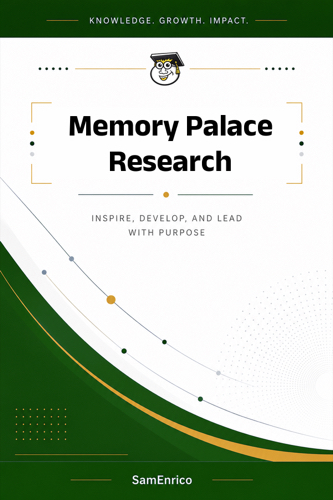
Free sample
Chapter 1: The Fallen Banquet Hall--–- The night the roof collapsed on Simonides of Ceos, something extraordinary was born from the wreckage. Not a new philosophy, not a new weapon, not a new empire—but a simple, almost childlike realization about how the human mind finds its way through darkness. According to the Roman orator Cicero, who recorded the story centuries later, the Greek poet had been invited to recite a victory ode at a nobleman's banquet in Thessaly. The hall was crowded with athletes, politicians, and merchants, all drunk on wine and ambition. Simonides performed his poem, collected half his fee, and was told that two young men were waiting outside to speak with him.
He stepped into the courtyard. Behind him, the roof caved in. The bodies were crushed beyond recognition. No family member could identify the dead. But Simonides, standing among the rubble, closed his eyes and discovered something that would echo across two thousand years: he could name every victim by visualizing exactly where each had been sitting.This is not a legend about poetry or tragedy.
It is a legend about space. What Simonides supposedly discovered—and what Greek orators, Roman senators, medieval monks, Renaissance mystics, modern neuroscientists, and world memory champions have all confirmed—is that the human brain is exquisitely, almost preternaturally, wired to remember locations. We forget names. We forget dates. We forget what we ate for breakfast three days ago.
But we do not forget the layout of our childhood home. We do not forget the path from the front door to the kitchen. We do not forget which chair we sat in during an argument, where we parked the car this morning, or which window faces the sunrise. Location is the scaffolding of memory. Everything else is decoration.The Most Ancient Trick in the Book The Method of Loci—from the Latin locus, meaning place or location—is the oldest formal mnemonic technique in Western history.
It predates the Roman Empire. It predates the birth of Christ. It was old when Cicero was young, and Cicero was murdered in 43 BCE. The technique is deceptively simple: you take a familiar physical space, mentally walk through it, and attach the things you want to remember to specific spots along the way. The spots become hooks.
The hooks hold the memories. And because the space is already burned into your neural circuitry, retrieving the information is as effortless as walking from your bedroom to your front door.But simplicity is not triviality. The Method of Loci works because it hijacks one of the most powerful, most ancient, most survival-critical systems in the mammalian brain: spatial navigation. Long before humans had language, writing, or mathematics, they had to remember where the water was, where the predators lurked, and which path led home. The brain that forgot a location was the brain that died.
Evolution therefore sculpted a neural architecture that prioritizes space above almost everything else. The Method of Loci takes that evolutionary gift and repurposes it for grocery lists, medical textbooks, legal arguments, and decks of playing cards.This book is called Memory Palace Research because the term "palace" captures the grandeur of what is possible. A palace is not a shack. It is not a single room. A palace has corridors, courtyards, staircases, galleries, and chambers.
It can be expanded, renovated, decorated, and passed down through generations. The same is true of a well-constructed memory. The same is true of a mind trained in the art of loci. What Simonides discovered in a collapsed banquet hall has been refined, tested, and validated across cultures and centuries. And now, in the twenty-first century, neuroscience has finally caught up with the ancients.What This Book Is and Who It Is For You are holding a guide that synthesizes the best of what the top ten books on memory palaces have to offer.
Drawing from the historical detective work of Frances Yates (The Art of Memory), the journalistic immersion of Joshua Foer (Moonwalking with Einstein), the anthropological discoveries of Lynne Kelly (Memory Craft), the practical systems of Dominic O'Brien and Ed Cooke, and the cognitive science of Daniel Schacter and Richard Restak, this volume aims to be the definitive resource for anyone who wants to understand and apply the Method of Loci.But "definitive" does not mean "encyclopedic in a dusty, academic sense." It means comprehensive, practical, and grounded in research. Each chapter of this book serves a specific purpose. Chapter 2 traces the journey of the memory palace through medieval monasteries and Renaissance theaters. Chapter 3 explains the neuroscience—place cells, grid cells, the hippocampus, and the famous London cabbies study. Chapter 4 teaches you how to build your first simple palace.
Chapter 5 turns abstract information into unforgettable imagery. Chapter 6 scales up to massive amounts of data. Chapter 7 troubleshoots the seven ways memory fails. Chapter 8 distinguishes static palaces from dynamic journeys. Chapter 9 applies the method to medicine, law, history, and languages.
Chapter 10 explores virtual reality, augmented reality, and artificial intelligence as new frontiers. Chapter 11 widens the lens to cultural memory traditions—Aboriginal songlines, Native American medicine wheels, African griots. And Chapter 12 confronts the limits, the ethics, and the infinite potential of trained memory.This book is for the student drowning in flashcards. It is for the professional who cannot afford to forget a client's name. It is for the aging adult who wants to keep their mind sharp.
It is for the competitive memorizer aiming for a national title. And it is for the curious reader who simply wants to understand why a technique invented two thousand years ago still works better than most modern study methods. You do not need a photographic memory. You do not need to be a visual thinker. You do not need to be young or gifted.
You only need to be willing to walk through a familiar building—first in your imagination, and then, eventually, through the architecture of your own expanded mind.Why You Have Never Heard This Before (Or Why It Didn't Stick)If the Method of Loci is so powerful, why isn't everyone using it? The answer is both sad and hopeful. The printing press, for all its gifts, made internal memory seem obsolete. Why memorize when you can consult a book? Why train your mind when you can outsource recall to paper, and then to typewriters, and then to computers, and now to the infinite library in your pocket?
The industrial revolution valued external storage over internal discipline. Schools taught repetition, not visualization. Rote learning became synonymous with rigor, even though it is the least efficient form of retention. The ancient art of memory retreated to the margins—surviving in the traditions of competitive mnemonists, in the secret societies of Renaissance hermeticists, in the silent practices of a few dedicated scholars.But the margins are returning to the center. Neuroscience has validated what the Greeks knew intuitively.
The internet has made information abundant, which paradoxically makes the ability to remember valuable again—because knowing how to find a fact is not the same as having it at your mental fingertips. And a generation of memory athletes, from Ed Cooke to Joshua Foer to the current world champions, has…
This is the end of the free sample. Get the eBook to keep going. Buy now
About this book
Details
- Author
- Fox Heidi
- Publisher
- SamEnrico
- Language
- English
- Genre
- research, Self-Help / Science
- Released
- 2026-06-06
- Pages (approx.)
- 134
- Available as
- eBook, Audiobook

Read better in the ZLOADR app
Your eBooks on your phone or tablet. Sign in with your SamEnrico account and start reading.
More by Fox Heidi
 Loci for Science FormulasFox Heidi$11.99
 Social Skills EQ Enhancement CourseFox Heidi$11.99
 Combat PTSD NightmaresFox Heidi$11.99
 Chronic Illness Couple GuideFox Heidi$11.99
 Sleep Hypnosis MeditationFox Heidi$11.99
 The Science Lab Stress GuideFox Heidi$11.99
 Metta For Your Inner ChildFox Heidi$11.99
 Self Worth And Toxic ShameFox Heidi$11.99
 The Tower of the Gods: Enki's Abzu and the Birth of CivilizationFox Heidi$11.99
 The Carolingian Codex: Charlemagne's Great Book HeistFox Heidi$11.99
 Pill Poppers: The OxyContin Empire That Hooked AmericaFox Heidi$11.99
 How to Start a Hobby in Handwriting AnalysisFox Heidi$11.99
You may also like
 Scientific Research On TM GuideMartens Nathanial$11.99
 Research Proposal Methodology Section MasteryPauley Debroah$11.99
 Research Proposal Appendix CompilationRaines Tyisha$11.99
 Academic Researcher Distraction GuideFord Virgil$11.99
 TM Research and ScienceCovert Nicki$11.99
 Social Anxiety Research ReviewRoberge Cole$11.99
 Research Proposal Significance Section GuideBock Tory$12.99
 Research Proposal Reviewer PsychologyLugo Tawanda$11.99
 Research Proposal Research Questions DesignLara Robbi$11.99
 Research Proposal References and CitationsPatten Shanice$11.99
 Research Proposal Mixed Methods DesignCameron Omega$11.99
 Research Proposal Data Management PlanAnderson Roberto$12.99