
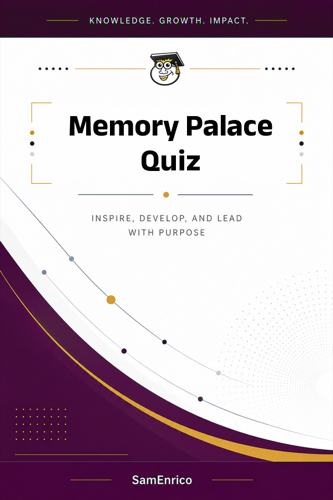
Non-FictionSelf-Help / Assessment
Memory Palace Quiz eBook
undefined
by Pina Danille
undefined
Formats
Free sample
Chapter 1: The Great Forgetting--Maya stared at her final exam score, her hands trembling. She had scored a 98% on the practice test just three days ago. Today, she had failed. Not barely failed—failed with a 47%. The essay questions had asked for specific dates, key figures, and causal relationships.
She knew she had studied those facts. She had reviewed her flashcards for twelve hours over the weekend. She had highlighted every important sentence in the textbook. So why, when the blank page stared back at her, did her mind produce nothing but static?Maya is not alone. Every semester, millions of students walk into examination halls carrying the illusion of preparedness.
They have spent hours with digital flashcards, rereading chapters, and highlighting passages. They feel confident. They feel ready. And then the test asks a question that requires them to produce an answer from nothing—not recognize it from four options—and the scaffolding collapses.This is the Great Forgetting. And it is not a failure of effort.
It is a failure of method.The Recognition Trap Your brain has two fundamentally different ways of knowing something. The first is recognition. Recognition is what happens when you see a face in a crowd and know you have seen it before, even if you cannot recall the person's name. Recognition is multiple-choice tests. Recognition is the feeling of familiarity when you reread a highlighted passage.
Recognition is easy. Recognition is cheap. And recognition is the primary way most people study.The second is recall. Recall is what happens when you produce a fact from nothing—when someone asks, "What is the capital of Bolivia?" and you say "Sucre" without seeing it written anywhere. Recall is essay exams.
Recall is pub trivia. Recall is real conversations. Recall is hard. Recall is expensive. And recall is almost never practiced by students.Here is the painful truth that separates effective learners from ineffective ones: Passing a multiple-choice test proves nothing about your ability to recall information under pressure.
Maya scored 98% on her practice multiple-choice exam because she had trained her brain to recognize correct answers among distractors. But her final exam required recall. She had never practiced recall. So she failed.The recognition-recall gap is not a minor distinction. It is a chasm.
A 2012 study by Karpicke and Roediger III found that students who repeatedly studied flashcards (recognition practice) performed 50% worse on recall tests than students who spent the same amount of time testing themselves (recall practice). The students who used flashcards felt more confident. They were also more wrong.Why Digital Flashcards Fail Digital flashcards—Anki, Quizlet, Study Blue, and their dozens of imitators—have become the default study tool for a generation. They offer spaced repetition, algorithmically optimized review schedules, and the satisfying swipe of a correct answer. They are also, for most learners, a trap.The problem is not the algorithm.
The problem is the interface. When you flip a digital flashcard, you are looking at a small rectangle of light. That rectangle has no location. It exists nowhere in space. Your brain, however, evolved to remember locations with extraordinary precision.
You can close your eyes right now and navigate to your childhood bedroom. You can point to where the lamp sat. You can describe the pattern on the curtains. That spatial map is stored in your hippocampus, a structure that neuroscientists have shown is specifically optimized for wayfinding.A digital flashcard has no home in your hippocampus. It floats in a void.
When you try to retrieve a fact that you learned on a screen, your brain has nowhere to go. There is no path. There is no landmark. There is only the desperate search through a fog of vaguely familiar information.The late neuroscientist Eleanor Maguire proved this definitively in her famous study of London taxi drivers. She found that the posterior hippocampus—the region responsible for spatial memory—was significantly larger in cabbies than in control subjects.
More importantly, the size increase correlated directly with years of experience navigating London's impossible streets. The taxi drivers had physically remodeled their brains through spatial practice. They had built what she called a "cognitive map" of the city.Your study materials—your facts, your dates, your formulas—need a cognitive map. Digital flashcards do not provide one. Memory palaces do.The Traditional Memory Palace: Storage Without Retrieval If you have heard of memory palaces before, you have probably heard the story of Simonides of Ceos.
In 477 BCE, Simonides attended a banquet. He delivered a poem. He stepped outside. Behind him, the banquet hall collapsed, crushing every guest. The bodies were unrecognizable.
But Simonides closed his eyes, visualized where each guest had been sitting, and identified every victim by name. This is the first documented use of the Method of Loci—the memory palace.For two thousand five hundred years, memory palaces have been used to memorize speeches, legal arguments, and epic poems. Roman orators built palaces to hold the points of their courtroom arguments. Medieval scholars stored the entire Bible in mental cathedrals. Joshua Foer, in his bestselling Moonwalking with Einstein, described using memory palaces to memorize decks of playing cards and win the US Memory Championship.Here is what most books will not tell you: The traditional memory palace is excellent for storage and terrible for cued recall under time pressure.Why?
Because a traditional memory palace is passive. You walk through it. You see images. You recognize them. But when someone asks you a specific question—"What year was the Magna Carta signed?"—you have to walk through your entire palace to find the answer.
You might start at Locus 1, Locus 2, Locus 3, and finally reach Locus 4 where the date is stored. In a memorization competition, you have unlimited time. On a quiz, you have seconds.Traditional memory palaces also lack question prompts. You store the answer, but you do not store the question. So when the test asks, "What was the primary cause of World War I?" your palace might show you a trench, a gas mask, and a map of Europe—but which one is the primary cause?
You recognize all of them. You recall none of them specifically.The Great Forgetting, then, is not merely a failure to remember. It is a failure to design memories for the way quizzes actually work.The Quiz Palace: A New Architecture This book introduces a fundamentally different structure: the Quiz Palace.A Quiz Palace is not a storage unit. It is a retrieval engine. Every element is designed not to help you recognize information but to help you produce it on demand, under time pressure, without cues.The modification is simple but profound.
In a traditional memory palace, each locus contains an image representing the answer. In a Quiz Palace, each locus contains:A visualized question prompt (a floating speech bubble, a quiz show host holding a cue card, a neon question mark)An image representing the answer (built using the SANC system introduced in Chapter 4)A spatial anchor that connects the question to the answer in a way that can be traversed in under two seconds This changes everything. When you see the question prompt, your brain does not have to walk…
This is the end of the free sample. Get the eBook to keep going. Buy now
About this book
Details
- Author
- Pina Danille
- Publisher
- SamEnrico
- Language
- English
- Genre
- Non-Fiction, Self-Help / Assessment
- Released
- 2026-06-06
- Pages (approx.)
- 137
- Available as
- eBook, Audiobook

Read better in the ZLOADR app
Your eBooks on your phone or tablet. Sign in with your SamEnrico account and start reading.
More by Pina Danille
 Stress Eating and Partner SupportPina Danille$11.99
 The Sleep Sanctuary MethodPina Danille$11.99
 Self Worth And CodependencyPina Danille$11.99
 Anxiety EQ Reduction GuidePina Danille$11.99
 The Nursing Student BurnoutPina Danille$11.99
 Peg System for Pi DigitsPina Danille$11.99
 Medical Trauma DreamsPina Danille$11.99
 Metta For RegretPina Danille$11.99
 The Celestial Weaver and the Storm God: A Love Forged in Silk and ThunderPina Danille$11.99
 The Duke and the Dancer: A Royal ScandalPina Danille$11.99
 Tezcatlipoca’s Shadow War: The Jaguar’s GambitPina Danille$11.99
 Growing EhretiaPina Danille$11.99
You may also like
 Hong Kong Handover 1997Dunn Johnnie$11.99
 Zumba For Postnatal Recovery CourseNeal Christian$11.99
 Zumba for BeginnersLadner Nikia$11.99
 YouTube Comment Mining GuideHumes Pandora$12.99
 Worry Box MeditationCarlin Rudy$11.99
 Workplace Stress MeditationNguyen Lynn$11.99
 Workplace Stress and Sleep RepairHawley Ivory$11.99
 Workplace Perfectionism CureDelaney Jeffry$11.99
 Workplace Injustice Anger GuideWallen Isabelle$11.99
 Work Addiction and Burnout LinkGreenwood Ester$11.99
 Women in Yoga and WellnessBeattie Galina$11.99
 Women in Stand Up ComedyChun Evangeline$11.99