
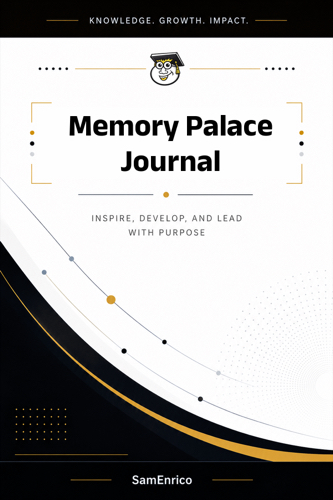
Non-FictionSelf-HelpMemory Journaling
Memory Palace Journal eBook
Track your palace creations and recalls with this
Track your palace creations and recalls with this guided workbook.
Formats
Free sample
Chapter 1: Your Mind's Hidden Map...--–- Before you build a single memory palace, before you sketch a single locus, before you even decide what you want to remember, you must first understand the terrain you are working with. That terrain is your own mind, and it is far stranger and more powerful than any computer ever built. The human brain contains approximately 86 billion neurons, each connected to thousands of others, forming a network so complex that even the most advanced supercomputers cannot simulate it. Every time you remember something, you are not retrieving a file from a hard drive. You are rebuilding a pattern of neural activation, reassembling fragments of sensation, emotion, and meaning into a coherent whole.
And here is the most important fact you will learn in this entire journal: your brain is already a master architect of memory. It just does not speak the language of spreadsheets, bullet points, or flashcards. It speaks the language of space, movement, and emotion.The Hidden Architecture You Already Possess Think about the layout of your current home. Do not visualize it as a blueprint or a diagram. Just close your eyes for a moment and feel it.
Where is the front door relative to your bedroom? How many steps does it take to walk from the kitchen to the bathroom? What is the sound of the floorboard that creaks near the stairs? Now open your eyes. You almost certainly succeeded.
You could probably draw a rough sketch of your home's floorplan with your eyes still closed. You could navigate from your bedroom to the kitchen in complete darkness without bumping into furniture. This ability is called spatial memory, and it is virtually perfect in every healthy human being.Neuroscientists have discovered that spatial memory is stored in the hippocampus, a small, seahorse-shaped structure deep within your brain. The hippocampus contains place cells and grid cells that fire in specific patterns whenever you occupy a specific location. When you walk through your living room, a unique combination of neurons fires to mark your position relative to the couch, the coffee table, the television, and the windows.
These cells are so precise that researchers can predict where a rat is in a maze simply by looking at which hippocampal neurons are active. The same is true for you. Your brain is constantly building and updating a detailed map of every space you have ever inhabited.Now try a different experiment. Close your eyes and try to remember the capital of North Dakota. Did you know it?
Perhaps you did, but almost certainly with more effort and less certainty than the floorplan of your home. This is symbolic memory, and it is fragile. Unlike spatial memory, which evolved over hundreds of millions of years to help mammals find food, escape predators, and navigate complex environments, symbolic memory is a recent and shallow adaptation. The human brain did not evolve to remember arbitrary symbols. It evolved to remember places, routes, threats, and opportunities.The Method of Loci—the ancient technique of memory palaces—bridges this evolutionary gap.
It takes symbolic information that your brain is poorly equipped to retain and converts it into spatial information that your brain is exquisitely equipped to retain. You take a fact, turn it into a vivid image, and place that image somewhere inside your mental map. Later, when you mentally walk through that space, you encounter the image and retrieve the fact. This is not a metaphor. Functional MRI studies have shown that when world memory champions use the Method of Loci, their posterior parietal cortex—a region associated with spatial navigation—activates far more intensely than in control subjects.
They are literally navigating through mental space, not retrieving symbols from a file cabinet.But here is where most beginners go wrong. They assume that any location will work. They build their first palace using their current apartment, their office cubicle, or their daily commute route. These locations are often generic, visually monotonous, and emotionally neutral. The result is a palace that feels flimsy and forgettable.
The reader becomes frustrated, concludes that the method does not work, and abandons the practice. The problem is not the method. The problem is the raw material.The Principle of High Definition Locations A High Definition location is one that satisfies three critical conditions. Without these three conditions, your memory palace will be built on sand.The first condition is visual distinctiveness. Each locus—the individual storage spots within a palace—must have unique features that your brain can easily distinguish.
A hallway with six identical doors is a poor palace because your brain will confuse door number three with door number five. A garden path with a distinctive statue, a broken bench, a birdbath covered in moss, a rose bush with thorns, and a rusty iron gate is an excellent palace because each locus has its own character, its own shape, its own texture. Your brain loves variety. It uses unique visual features as anchors for memory.The second condition is sensory richness beyond sight. The best palaces evoke smells, sounds, textures, and even tastes.
When you remember your grandmother's kitchen, you do not just see it. You smell the bread baking in the oven. You hear the creak of the floorboard near the refrigerator. You feel the cool linoleum under your bare feet. You taste the cherry pie she always made for your birthday.
That multisensory encoding creates redundant neural pathways, making your memories far more durable than if you had relied on sight alone. A fact stored in a silent, odorless, textureless space is a fact that will fade by morning.The third condition, and by far the most powerful, is emotional weight. Emotional arousal triggers the release of norepinephrine and cortisol, hormones that enhance memory consolidation. When you feel something strongly, your brain stamps that experience with a "do not delete" flag. This is why you remember exactly where you were on September 11, 2001, but you cannot remember what you had for lunch three Tuesdays ago.
The emotional event triggered a hormonal cascade that locked the memory into long-term storage. A fact stored in an emotionally charged location is significantly more likely to survive the night than a fact stored in a neutral one.Dominic O'Brien, eight-time World Memory Champion, wrote extensively in How to Develop a Brilliant Memory about the importance of emotional engagement. He noted that his most durable palaces were always built from locations that mattered to him personally—his childhood home, his university campus, his favorite walking trail. Lynne Kelly, in Memory Craft, took this further by documenting how indigenous cultures around the world embed their entire knowledge systems into emotionally significant landscapes. The Songlines of Australian aboriginals, the sacred geography of the Navajo, the pilgrimage routes of medieval Europe—all of these are memory palaces at civilizational scale, built from land that carries stories, taboos, rituals, and emotional weight.You do not need a cathedral or a continent.
You need ten distinct, sensorially rich, emotionally charged spots in a location that you know perfectly. This chapter will help you find them.Why Most Memory Books Fail Their Readers Before you begin the journaling exercises…
This is the end of the free sample. Get the eBook to keep going. Buy now
About this book
Details
- Author
- Jewett Rosalee
- Publisher
- SamEnrico
- Language
- English
- Genre
- Non-Fiction, Self-Help, Memory Journaling
- Released
- 2026-06-10
- Pages (approx.)
- 127
- Available as
- eBook, Audiobook

Read better in the ZLOADR app
Your eBooks on your phone or tablet. Sign in with your SamEnrico account and start reading.
More by Jewett Rosalee
 Body Scan for JealousyJewett Rosalee$11.99
 LBO Due Diligence ChecklistJewett Rosalee$11.99
 Half Marathon Training PlanJewett Rosalee$11.99
 Reconstruction Software ToolsJewett Rosalee$11.99
 Habit Tracker MethodJewett Rosalee$11.99
 Self Hypnosis for Anxiety SleepJewett Rosalee$11.99
 Empathy for First RespondersJewett Rosalee$11.99
 The Banker’s Betrayal: The First Canadian Insider Trading ScandalJewett Rosalee$11.99
 The Djinn of the Empty Quarter: A Sultan's BargainJewett Rosalee$11.99
 How to Produce Cymbal and Drum CasesJewett Rosalee$11.99
 Sibling Bonus Points GuideJewett Rosalee$12.99
 One Page Marketing Playbook for CoachesJewett Rosalee$12.99
You may also like
 Hong Kong Handover 1997Dunn Johnnie$11.99
 Zumba For Postnatal Recovery CourseNeal Christian$11.99
 Zumba for BeginnersLadner Nikia$11.99
 YouTube Comment Mining GuideHumes Pandora$12.99
 Worry Box MeditationCarlin Rudy$11.99
 Workplace Stress MeditationNguyen Lynn$11.99
 Workplace Stress and Sleep RepairHawley Ivory$11.99
 Workplace Perfectionism CureDelaney Jeffry$11.99
 Workplace Injustice Anger GuideWallen Isabelle$11.99
 Work Addiction and Burnout LinkGreenwood Ester$11.99
 Women in Yoga and WellnessBeattie Galina$11.99
 Women in Stand Up ComedyChun Evangeline$11.99