
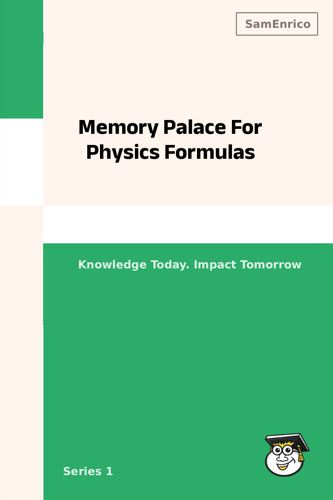
Memory Palace For Physics Formulas Audiobook
Organize equations and principles in virtual labor
Organize equations and principles in virtual laboratory.
Formats
Free sample
Chapter 1: The Crumbling Blackboard--–- The examination hall was silent except for the frantic scratching of pens. Sunlight slanted through high windows, illuminating dust motes that danced above two hundred bowed heads. At the back of the room, a student named Maria stared at her physics paper. Her palms were damp. Her heart hammered against her ribs.
Question one stared back at her, innocent and devastating: *"A car accelerates uniformly from rest to 20 m/s in 5 seconds. Calculate the distance traveled."*She knew she had seen this problem before. She had copied the SUVAT equations fifty times. She had highlighted them in three colors. She had recited them under her breath on the bus: v equals u plus a t.
s equals u t plus half a t squared. But now, under pressure, the symbols blurred together like wet ink. Was it v = u + at or s = vt - ½at²? Did the formula for distance require the average velocity or the final velocity? Her mind was a wall of fog.
She wrote something, anything, and moved on. By the end of the exam, she had guessed at half the answers. Walking out, she felt not exhaustion but something worse: a quiet humiliation. She had worked hard. Why had her memory betrayed her?Maria is not real, but her experience is universal.
Thousands of physics students around the world sit for exams every semester with the same hollow feeling: I studied for hours, but the formulas just wouldn't stay in my head. This book is written for every student who has ever stared at a blackboard crammed with forty equations and wondered if their brain was simply broken. It is not broken. You have merely been using the wrong tool for the job.The Great Illusion of Rote Memorization We are taught from an early age that repetition creates memory. Say the multiplication tables enough times, and they stick.
Repeat the capital of Vermont until it becomes automatic. This method works passably for simple, isolated facts. But for complex, relational, symbolic information like physics formulas, rote repetition is not just inefficient—it is actively self-defeating.Let us understand why. When you repeat a formula like F = ma fifty times, you are engaging your phonological loop—a component of working memory that handles verbal and auditory information. This loop is evolutionarily young and severely limited.
Cognitive psychologist George Miller famously observed in 1956 that the average person can hold only about seven (plus or minus…
This is the end of the free sample. Get the Audiobook to keep going. Buy now
About this book
Details
- Author
- Pinckney Johna
- Publisher
- SamEnrico
- Language
- English
- Genre
- Non-Fiction, Self-Help, Physics
- Released
- 2026-06-07
- Pages (approx.)
- 158
- Available as
- eBook, Audiobook

Listen in the VoxFlicks app
Audiobooks and audio dramas wherever you go. Sign in with your SamEnrico account and press play.
More by Pinckney Johna
 Widow Social Isolation HelpPinckney Johna$11.99
 Reconstruction of Elder Abuse DeathsPinckney Johna$11.99
 Inaccessible Playground CrusaderPinckney Johna$11.99
 Imposter Visibility GuidePinckney Johna$11.99
 Intention Setting Before ListeningPinckney Johna$11.99
 Pomodoro for LawyersPinckney Johna$11.99
 The Nightingale of Healing: Florence Nightingale's Medical RevolutionPinckney Johna$11.99
 Tangaroa's Wrath: The Birth of the First ReefPinckney Johna$11.99
 How to Produce Portable Water Filters and PurifiersPinckney Johna$11.99
 Mastering The Erector SpinaePinckney Johna$11.99
 How to Start a Comminution Plant for Effluent Treatment Business (Beginners Guide)Pinckney Johna$11.99
 How to Produce Dress ShoesPinckney Johna$11.99
You may also like
 Hong Kong Handover 1997Dunn Johnnie$11.99
 Zumba For Postnatal Recovery CourseNeal Christian$11.99
 Zumba for BeginnersLadner Nikia$11.99
 YouTube Comment Mining GuideHumes Pandora$12.99
 Worry Box MeditationCarlin Rudy$11.99
 Workplace Stress MeditationNguyen Lynn$11.99
 Workplace Stress and Sleep RepairHawley Ivory$11.99
 Workplace Perfectionism CureDelaney Jeffry$11.99
 Workplace Injustice Anger GuideWallen Isabelle$11.99
 Work Addiction and Burnout LinkGreenwood Ester$11.99
 Women in Yoga and WellnessBeattie Galina$11.99
 Women in Stand Up ComedyChun Evangeline$11.99