
Non-FictionSelf-HelpSocial Memory
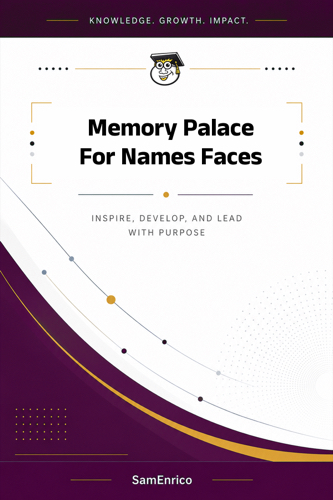
Memory Palace For Names Faces eBook
Places facial features in palace rooms to never fo
Places facial features in palace rooms to never forget a name again.
Formats
Free sample
Chapter 1: The 5-Second Heist...--–- You have just committed a crime. Do not check your pockets. Do not look for witnesses. The crime happened entirely inside your own skull, and the victim was a name. The handshake was firm.
The eye contact was warm. You repeated the name back perfectly: "Nice to meet you, David." You even added a compliment about his jacket. And then, exactly five seconds later—as you turned to introduce David to your colleague Sarah—the name evaporated. Not faded. Not blurred.
Evaporated. What remained was a smooth, featureless void where "David" used to be. Your mouth opened. Your brain offered alternatives: Daniel? Derek?
Something with a D? Sarah waited. David smiled patiently. And you, a perfectly intelligent adult with a fully functional hippocampus, were reduced to muttering, "I'm so sorry—I just had it."This scene repeats itself millions of times every single day, in boardrooms and bedrooms, at cocktail parties and parent-teacher conferences. It is not a failure of intelligence.
It is not a sign of early dementia. It is not evidence that you "don't care enough." It is the 5-Second Heist, and it is the most predictable cognitive crime in human history. The good news is that the thief has a name, a method, and a weakness. Once you understand all three, you will never be robbed again.The Anatomy of a Forgetting Let us slow down the tape. You meet David.
You hear his name. You repeat it. You shake his hand. Four seconds pass. You turn to Sarah.
The name is gone. What happened in those four seconds?The answer lies in a psychological phenomenon known as the Next-in-Line Effect, first documented by researchers in the 1970s and subsequently replicated in dozens of studies. The effect is brutally simple: when people know they are about to take a turn in a conversation or introduction, their working memory resources shift dramatically away from listening and toward preparing their own response. You are not forgetting David's name because your memory is bad. You are forgetting David's name because your brain, in those critical seconds, was busy rehearsing your own name, your own handshake, your own opening line.
David's name never stood a chance.Think of working memory as a small table. On that table, you can hold roughly four to seven discrete items at once—a phone number, a face, a name, an emotion. When you are introduced to someone new, the table immediately receives several items: the person's face, their name, their handshake pressure, their approximate age, their clothing, the room temperature, the background noise, and your own anxiety about the interaction. That is already too much. Then the Next-in-Line Effect adds a massive new item: your own upcoming performance.
Something has to fall off the table. What falls? The newest, least-rehearsed, most abstract item. The name. Every time.This is not a metaphor.
Neuroimaging studies have shown that during the moment of introduction, the prefrontal cortex (responsible for working memory and social monitoring) shows increased activity, but the hippocampus (responsible for encoding new names into long-term memory) shows decreased activity when the subject is anticipating their own turn to speak. Your brain literally deprioritizes encoding someone else's name in favor of preparing your own social performance. The system is working exactly as evolution designed it—and evolution did not care about David.The Real Cost of a Forgotten Name It is tempting to dismiss forgetting as a minor social embarrassment, a shrug and an "I'm terrible with names." But the cumulative cost is staggering. Let us count the ways.First, the professional cost. In a 2012 study of business professionals conducted by the University of Texas, respondents reported that they were 47 percent less likely to trust a colleague who forgot their name after an introduction.
Trust, the bedrock of all business relationships, erodes in seconds. A forgotten name signals disinterest, incompetence, or self-absorption—whether or not any of those are true. Sales professionals know this intimately: the ability to remember a prospect's name correlates directly with closing rates. One insurance company tracked 5,000 sales calls and found that agents who used the prospect's name twice within the first sixty seconds were 32 percent more likely to schedule a follow-up meeting. Forgetting the name altogether dropped the rate to 4 percent.Second, the social cost.
Friendship researchers have identified a phenomenon called "the name-loop of shame." When Person A forgets Person B's name after a previous introduction, Person B begins to question whether Person A ever valued the connection. This is not paranoia; it is pattern recognition. Humans are exquisitely sensitive to being remembered. Studies of social cognition show that being remembered by name activates the same neural reward circuits as receiving money or food. Being forgotten activates the anterior cingulate cortex—the same region associated with physical pain.
You are not just forgetting a string of syllables. You are causing someone a small, measurable pang of social pain.Third, the intrapersonal cost. Every forgotten name confirms a story you tell yourself: "I have a bad memory." "I'm just not good with people." "It's genetic—my father was the same way." These stories harden into identity. Once you believe you are someone who forgets names, you stop trying. Why prepare for a test you know you will fail?
The anticipation of forgetting becomes a self-fulfilling prophecy. You approach introductions with low-grade dread, which triggers the Next-in-Line Effect, which guarantees forgetting, which confirms the dread. Round and round.The Myth of the "Bad Memory"Let us now drive a stake through the heart of the most destructive lie in this entire domain. The lie is this: some people have good memories, and some people have bad memories, and there is not much you can do about it.This is false. It is not merely false; it is the opposite of the truth.The human brain contains approximately 86 billion neurons, each connected to up to 10,000 other neurons.
The total number of possible neural connections is greater than the number of atoms in the universe. Your brain is not a bucket that can be full or empty. It is not a muscle that can be weak or strong in any simple sense. It is a pattern-matching machine that has been optimized by 300 million years of evolution for exactly one task: navigating complex, changing environments. You do not have a bad memory.
You have an excellent memory that has been trained on the wrong data.Consider this. Can you remember the floor plan of your childhood home? Can you walk from your bedroom to the kitchen in your mind, turning left at the bathroom, passing the coat closet, stepping over the creaky floorboard? Of course you can. You have not lived there in years, but the spatial map is burned into your hippocampus with near-photographic precision.
Can you remember the face of your third-grade teacher? The smell of your grandmother's car? The way the light hit your bedroom wall at 4 PM in July? Yes. Yes.
Yes.But can you remember the name of the person you met at a party three weeks ago? Probably not. The difference is not in the capacity of your memory. The difference is in the…
This is the end of the free sample. Get the eBook to keep going. Buy now
About this book
Details
- Author
- Rafferty Arnoldo
- Publisher
- SamEnrico
- Language
- English
- Genre
- Non-Fiction, Self-Help, Social Memory
- Released
- 2026-06-08
- Pages (approx.)
- 129
- Available as
- eBook, Audiobook

Read better in the ZLOADR app
Your eBooks on your phone or tablet. Sign in with your SamEnrico account and start reading.
More by Rafferty Arnoldo
 Keto Intermittent Fasting PairingRafferty Arnoldo$11.99
 Cholesterol Cognitive AgingRafferty Arnoldo$11.99
 Water Soluble Vitamins GuideRafferty Arnoldo$11.99
 Stillbirth Recovery GuideRafferty Arnoldo$11.99
 Fear of Failure and ADHDRafferty Arnoldo$11.99
 Cinnamon Stick Craving ToolRafferty Arnoldo$11.99
 Cross Race Effect StudyRafferty Arnoldo$11.99
 The Corsair and the Canon: Andrea Doria’s Naval RevolutionRafferty Arnoldo$11.99
 The Divine Healers of Ancient Egypt: Black Physicians Who Shaped MedicineRafferty Arnoldo$11.99
 A Collector's Handbook to the Daf 33Rafferty Arnoldo$11.99
 How to Produce Flecked GlazeRafferty Arnoldo$11.99
 Gift Tax Annual Exclusion UpdateRafferty Arnoldo$12.99
You may also like
 Hong Kong Handover 1997Dunn Johnnie$11.99
 Zumba For Postnatal Recovery CourseNeal Christian$11.99
 Zumba for BeginnersLadner Nikia$11.99
 YouTube Comment Mining GuideHumes Pandora$12.99
 Worry Box MeditationCarlin Rudy$11.99
 Workplace Stress MeditationNguyen Lynn$11.99
 Workplace Stress and Sleep RepairHawley Ivory$11.99
 Workplace Perfectionism CureDelaney Jeffry$11.99
 Workplace Injustice Anger GuideWallen Isabelle$11.99
 Work Addiction and Burnout LinkGreenwood Ester$11.99
 Women in Yoga and WellnessBeattie Galina$11.99
 Women in Stand Up ComedyChun Evangeline$11.99