
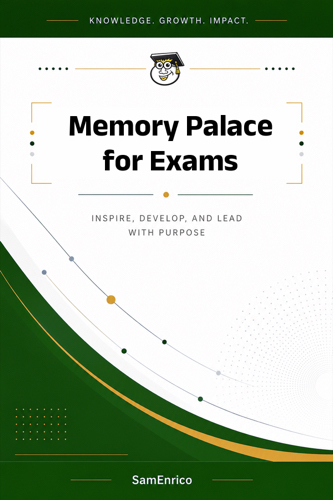
Non-FictionSelf-HelpTest Preparation
Memory Palace for Exams eBook
Store entire textbooks in mental locations for ope
Store entire textbooks in mental locations for open book recall.
Formats
Free sample
Chapter 1: The Empty Desk Paradox...--Imagine walking into an examination hall. Your palms are damp. The clock ticks audibly from the wall. You sit down, place your pen on the desk, and reach into your bag for the textbook you have spent two hundred hours reading. But the bag is empty.
You left the book at home. Panic rises like hot steam. Now imagine the opposite. You have no textbook. No notes.
No highlights. The desk is completely bare except for your pen and a single blank sheet of paper. Yet you feel calm. Because you know—with absolute certainty—that every single answer is already inside your head, organized, indexed, and waiting for you to call it forward. You close your eyes for ten seconds, see a familiar hallway in your mind, open a specific door, and there it is: the exact paragraph, the precise formula, the perfect date.
You smile. Then you begin writing.This book is the bridge between those two imaginings. The first scenario is the reality for most students. The second scenario is the reality for anyone who masters the technique you are about to learn. But before we build a single mental room or encode a single fact, we must confront a disturbing truth about how you have been studying.
That truth is what this chapter calls the Empty Desk Paradox.The paradox is simple yet devastating. When you study using conventional methods—cramming, re-reading, highlighting, underlining, summarizing, watching review videos—you are training your brain to recognize information, not to recall it. Recognition feels like learning. You read a paragraph, understand it, nod your head, and think, "I know this." But recognition is a trick. It is the cognitive equivalent of looking at a multiple-choice answer and thinking, "That looks familiar." The problem is that most exams are not multiple-choice.
Even when they are, the difference between recognition and recall is the difference between knowing your neighbor's face when you see it and describing that face from memory to a police sketch artist. One is passive. The other is active. One feels easy. The other is where exams are won.Here is the evidence that should terrify every student who relies on re-reading.
In a landmark study published in the journal Memory & Cognition, researchers asked students to read a passage of text. One group read it once. Another group read it four times. A third group read it once and then practiced recalling it from memory without looking. When tested one week later, the group that read the passage four times remembered less than the group that read it once and recalled it once.
Four times the effort produced worse results. Why? Because re-reading creates fluency. The text becomes familiar. Your brain mistakes that familiarity for mastery.
But familiarity is not retrievability. You can be intimately familiar with the face of a famous actor without being able to describe their nose shape, eye color, and jawline from memory. That is the illusion of knowing. It is the most expensive illusion in education because it costs you time, confidence, and grades.The Empty Desk Paradox has a second layer, and this one cuts even deeper. Suppose you are allowed to bring your textbook into the exam.
Open book. Unlimited access. Surely that solves the problem, right? Wrong. The paradox continues.
When students take open-book exams, they perform only marginally better than closed-book exams—and sometimes worse. Why? Because the time pressure remains. You still have to find the answer among six hundred pages. You still have to recognize which chapter, which diagram, which footnote contains the relevant information.
You still have to interpret, synthesize, and apply. Having the physical book on your desk does not mean having the knowledge in your head. The book is a library. You still need a librarian. That librarian is your memory.
And if your memory is disorganized, the open book is just a pile of paper.The title of this book promises a solution to both layers of the paradox. A memory palace is not a metaphor. It is a literal technique, over two thousand years old, that transforms your spatial memory into a searchable database of facts, formulas, dates, definitions, and entire textbook chapters. The technique works because it aligns with how your brain evolved to remember. You do not need to become a genius.
You do not need to have a photographic memory. You do not need to be young, or gifted, or lucky. You need only to understand one principle: your brain already knows how to navigate a building. The trick is to fill that building with knowledge instead of furniture.But before you can fill a building, you must understand why the building works. That is the purpose of this chapter.
We will explore the neuroscience of spatial memory, debunk the most destructive myths about how memory works, and introduce the three core principles that will govern every technique in this book. By the end of this chapter, you will have completed your first memory exercise—not a practice run, but a real encoding of real information that you will remember tomorrow, next week, and next month without any additional review. And you will do it in less than ten minutes.The Myth of the Bad Memory Let us begin with a story. In 2005, a man known in scientific literature as EP suffered a devastating brain injury. A viral infection destroyed his hippocampus—the seahorse-shaped structure deep in the brain that is responsible for forming new long-term memories.
After the injury, EP could not remember anything for more than thirty seconds. He could not recognize his own reflection in a mirror. He could not remember that he had just eaten breakfast. He was, by every clinical measure, a man with no memory. Yet EP could navigate his childhood home perfectly.
He could walk from the front door to the kitchen, around the corner to the living room, up the stairs to his old bedroom—all without hesitation. He could draw a map of the neighborhood where he grew up, complete with street names, landmarks, and shortcuts. EP had no memory for facts, no memory for events, no memory for faces. But his spatial memory was intact. The brain structures that encode locations, routes, and physical environments are so ancient, so fundamental to survival, that they can survive damage that destroys everything else.EP's case is not an anomaly.
It is a window into a deeper truth. Your brain has at least two fundamentally different memory systems. One system, called declarative memory, handles facts, events, names, dates, and textbook knowledge. This system is relatively weak. It requires repetition, attention, and emotional salience to function.
The other system, called spatial memory, handles locations, routes, landmarks, and physical navigation. This system is extraordinarily powerful. It is automatic, durable, and virtually unlimited in capacity. You do not need to practice remembering the layout of your home. You simply know it.
You have never studied the path from your bed to your bathroom. You just walk it.Here is the insight that changes everything. The two systems are not separate. They communicate constantly. When you remember an event, you often…
This is the end of the free sample. Get the eBook to keep going. Buy now
About this book
Details
- Author
- Scanlon Dominique
- Publisher
- SamEnrico
- Language
- English
- Genre
- Non-Fiction, Self-Help, Test Preparation
- Released
- 2026-06-09
- Pages (approx.)
- 148
- Available as
- eBook, Audiobook

Read better in the ZLOADR app
Your eBooks on your phone or tablet. Sign in with your SamEnrico account and start reading.
More by Scanlon Dominique
 Liking Factor TechniquesScanlon Dominique$11.99
 Green Smoothie Morning GuideScanlon Dominique$11.99
 Career Success Comparison TrapScanlon Dominique$11.99
 Cold Burn Frostbite CareScanlon Dominique$11.99
 Low Impact HIIT WorkoutsScanlon Dominique$11.99
 Imposter Syndrome TriggersScanlon Dominique$11.99
 EQ for NeurodivergentScanlon Dominique$11.99
 Iron and Ice: The Life of Sandford FlemingScanlon Dominique$11.99
 The Dragon’s Shadow: Europe’s Triad Serial KillerScanlon Dominique$11.99
 How to Produce Saris and LehengasScanlon Dominique$11.99
 How to Produce Fishing Rod Holders and Storage RacksScanlon Dominique$11.99
 Google Scrum for Hypergrowth TeamsScanlon Dominique$12.99
You may also like
 Hong Kong Handover 1997Dunn Johnnie$11.99
 Zumba For Postnatal Recovery CourseNeal Christian$11.99
 Zumba for BeginnersLadner Nikia$11.99
 YouTube Comment Mining GuideHumes Pandora$12.99
 Worry Box MeditationCarlin Rudy$11.99
 Workplace Stress MeditationNguyen Lynn$11.99
 Workplace Stress and Sleep RepairHawley Ivory$11.99
 Workplace Perfectionism CureDelaney Jeffry$11.99
 Workplace Injustice Anger GuideWallen Isabelle$11.99
 Work Addiction and Burnout LinkGreenwood Ester$11.99
 Women in Yoga and WellnessBeattie Galina$11.99
 Women in Stand Up ComedyChun Evangeline$11.99