
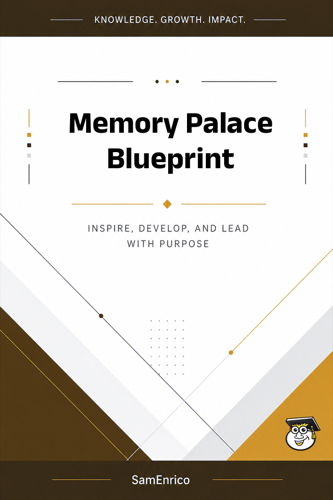
Non-FictionSelf-HelpMemory Training
Memory Palace Blueprint eBook
Design your first memory palace with rooms and ima
Design your first memory palace with rooms and imagery to store 100 items.
Formats
Free sample
Chapter 1: The Memory Lie--–- You are about to discover something that will make you angry. Not because it is difficult or painful, but because no one told you sooner. For your entire life, you have believed something false about your own brain. You have been told – by teachers, by parents, by well-meaning articles and perhaps by your own frustrated inner voice – that some people simply have “good memories” and others do not. That memory is a genetic lottery.
That you are either born with a steel trap or a leaky sieve.That is a lie.The truth is far more interesting, far more useful, and far more liberating. You do not have a bad memory. You have an untrained one. There is a profound difference between the two, and understanding that difference is the first step toward building something extraordinary: your first memory palace.This book is not a collection of tricks or hacks. It is a construction manual for one of the most powerful mental tools ever devised – a tool used for over two thousand years by orators, scholars, scientists, and world memory champions.
And despite its grand name and ancient pedigree, building your first memory palace is surprisingly simple. You already have everything you need. You already use the underlying system every single day without realizing it. The only missing piece is awareness.Let me prove it to you.The Grocery Store Experiment Close your eyes for a moment. Picture the entrance to the grocery store you visit most often.
What do you see when you first walk in? The automatic doors? The shopping carts stacked in a row? The produce section immediately to the left or right? Notice how effortlessly you can summon these images.
You did not try to memorize the layout of that store. You did not use flashcards or repetition. You simply walked through it a few times, and your brain – without any conscious effort – built a detailed spatial map.Now answer this: Where are the bananas? The milk? The bread aisle?
You know without thinking.That is your brain doing what it evolved to do. Before humans had written language, before we had books or smartphones or calendars, we had places. We had caves, rivers, trees, and paths. Our survival depended on remembering which berries were poisonous, where the water source was, and which trail led home safely. The brain that could not remember spatial locations did not pass on its genes.
You are the descendant of exceptional spatial memorizers.The Method of Loci – the formal name for the memory palace technique – exploits this ancient hardware. It takes the brain’s native ability to navigate space and repurposes it for anything you want to remember: speeches, numbers, names, exam material, to‑do lists, even entire books.And yet, most people never learn this. They spend years struggling with rote repetition, flashcard apps, and sticky notes, never realizing that the solution was already inside their head, waiting to be redirected.Why 100 Items? The Architecture of Achievable Goals Every successful memory palace has three components: locations, images, and a path. This book will teach you to build all three from scratch.
But before we dive into construction, we need a target. A goal that is ambitious enough to matter but structured enough to feel possible.That goal is 100 items.Not 1,000. Not 10,000. One hundred. Here is why that number changes everything.First, 100 items breaks down cleanly into 10 groups of 10.
Ten rooms. Ten stations per room. One hundred hooks. This is not arbitrary. Cognitive psychology research shows that humans chunk information most effectively in groups of three to five items, with larger structures built from those chunks.
The 10×10 structure gives you a manageable macro‑level (10 rooms) and a repeatable micro‑level (10 stations). You never have to think about “100.” You only have to think about “one room, ten stations.”Second, 100 items is the threshold where the memory palace stops feeling like a party trick and starts feeling like a superpower. Memorizing your grocery list of 20 items is mildly impressive. Memorizing 100 random digits, or 100 vocabulary words, or the entire outline of a 60‑minute presentation – that changes how you see yourself. That is the point where you internalize, truly and permanently, that you are not a person with a bad memory.Third, 100 items is the minimum viable scale for real‑world applications.
A typical lecture contains 50 to 80 discrete facts. A business presentation has 30 to 50 key points. A chapter of a textbook might have 100 terms. By building a palace for 100 items, you are building a tool that can handle actual professional and academic demands.Throughout this book, you will hear from real people who have done exactly this. A medical student who memorized 117 bone names in a single afternoon.
An entrepreneur who stored his entire investor pitch – 94 slides, 94 bullet points – without notes. A parent who turned their weekly shopping list into a five‑minute mental walkthrough. These are not memory athletes with extraordinary gifts. They are ordinary people who learned one simple skill: how to turn information into location.The 2,500‑Year History You Never Knew The memory palace technique is ancient, but it is not mystical. The earliest written description comes from a Roman rhetorician named Cicero, who told a story about the poet Simonides of Ceos.
Around 500 BCE, Simonides attended a banquet. He stepped outside briefly, and while he was gone, the roof collapsed, crushing everyone inside. The bodies were so mangled that family members could not identify their loved ones. But Simonides found that he could remember exactly where each guest had been sitting. He walked through the ruined hall in his mind, and the positions of the bodies came back to him.From this tragedy, Simonides realized a principle that would shape Western memory training for millennia: location is the key to recall.
If you place images of what you want to remember along a familiar path, you can retrieve them simply by walking that path again in your mind.The Greeks and Romans took this discovery and ran with it. Orators memorized speeches that lasted hours by placing each section of the argument in a different room of an imaginary villa. Scholars stored entire libraries in their heads. The technique was so fundamental to classical education that it was considered simply “the art of memory” – not a special trick, but a basic skill.Then the printing press arrived. Books became cheap.
External memory (paper, and later screens) replaced internal memory. The art of memory, once essential, became obscure. Today, most people have never heard of it. And that is a tragedy, because we need it more than ever. We swim in information but struggle to retain it.
We have infinite external storage and shrinking internal recall.The memory palace is the antidote. It is not about competing with your smartphone. It is about building a relationship with your own mind that feels capable, reliable, and even joyful.The Five Core Principles You Will Master Before we end this chapter, let me lay out the five principles that govern every successful memory palace. These principles will appear again and again throughout the book, but understanding them now will make everything that follows feel intuitive rather than foreign.Principle One: Location…
This is the end of the free sample. Get the eBook to keep going. Buy now
About this book
Details
- Author
- Ferrer Granville
- Publisher
- SamEnrico
- Language
- English
- Genre
- Non-Fiction, Self-Help, Memory Training
- Released
- 2026-06-07
- Pages (approx.)
- 114
- Available as
- eBook, Audiobook

Read better in the ZLOADR app
Your eBooks on your phone or tablet. Sign in with your SamEnrico account and start reading.
More by Ferrer Granville
 The Six Thinking Hats In TeamsFerrer Granville$11.99
 Meth Recovery for MomsFerrer Granville$11.99
 The Gacy Case BookshelfFerrer Granville$11.99
 Antwerp Heist Escape RouteFerrer Granville$11.99
 Endometriosis Period PainFerrer Granville$11.99
 Quit Smoking Support Group GuideFerrer Granville$11.99
 RLS Clinical Trials FinderFerrer Granville$11.99
 Retirement Asset Beneficiary ReviewFerrer Granville$11.99
 The Last Dance of the Ice Princess: Tonya Harding’s Unbreakable WillFerrer Granville$11.99
 The Golden Soles of Axum: Crafting the First Global Trade EmpireFerrer Granville$11.99
 Pompeii’s Last Strategist: The Forgotten Genius of Pliny the ElderFerrer Granville$11.99
 Starbucks Community Response GuideFerrer Granville$12.99
You may also like
 Hong Kong Handover 1997Dunn Johnnie$11.99
 Zumba For Postnatal Recovery CourseNeal Christian$11.99
 Zumba for BeginnersLadner Nikia$11.99
 YouTube Comment Mining GuideHumes Pandora$12.99
 Worry Box MeditationCarlin Rudy$11.99
 Workplace Stress MeditationNguyen Lynn$11.99
 Workplace Stress and Sleep RepairHawley Ivory$11.99
 Workplace Perfectionism CureDelaney Jeffry$11.99
 Workplace Injustice Anger GuideWallen Isabelle$11.99
 Work Addiction and Burnout LinkGreenwood Ester$11.99
 Women in Yoga and WellnessBeattie Galina$11.99
 Women in Stand Up ComedyChun Evangeline$11.99