
Non-FictionSelf-HelpPositive Psychology
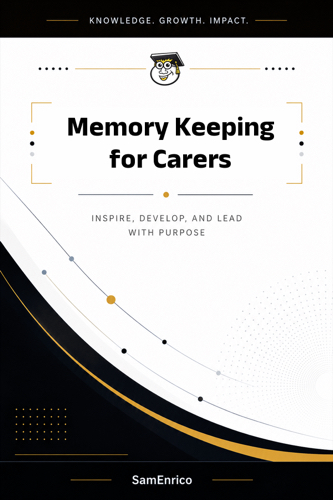
Memory Keeping for Carers eBook
Preserving joyful moments to counterbalance daily
by Bruns Danae
Preserving joyful moments to counterbalance daily struggles.
Formats
Free sample
Chapter 1: The Cortisol Trap--–- You remember the fall. You remember the scream. You remember the look on their face when they didn’t recognize you. You remember the exhaustion of the third wake-up, the cold coffee, the argument about the medication, the guilt that followed the argument, and the way your shoulders stayed up by your ears for the rest of the day. You remember all of that with the clarity of high-definition video.But the quiet moment?
The one where they squeezed your hand for no reason? The ten seconds of sunlight on their face that made them look peaceful? The one laugh that escaped in the middle of the chaos? You have to strain to recall it. And even when you do, it feels faded—like a photograph left too long in the sun.That is not your fault.
It is not a character flaw. It is not proof that you are a pessimist or a failure or a bad caregiver. It is your brain doing exactly what it evolved to do: survive.This book exists because of one brutal, beautiful, and non-negotiable fact about the human nervous system. Your brain is wired to prioritize threat over reward. For a caregiver living in a state of chronic low-grade alert, this means the amygdala—the brain’s smoke detector—floods your system with cortisol every single time something goes wrong.
A fall. A refusal. A moment of confusion. A door slammed. A name forgotten for the hundredth time.
Each event triggers the same ancient alarm system that kept our ancestors from being eaten by predators.Cortisol does one thing exceptionally well. It etches negative memories into long-term storage. It acts like emotional cement. The more cortisol you produce during an event, the more vividly you will remember that event. This is why you can replay the worst moments of your caregiving journey on a loop, complete with sensory details—the smell of the hospital room, the texture of the carpet you stared at while waiting for the doctor, the exact pitch of their voice when they said something cruel that the disease put in their mouth.Meanwhile, positive moments produce a different chemical: dopamine.
Dopamine is the neurotransmitter of reward, pleasure, and connection. A shared smile. A quiet hand squeeze. A moment when they said your name correctly. A laugh that came out of nowhere.
Dopamine feels wonderful in the moment. But it is chemically fragile. Unlike the cement of cortisol, dopamine is water-soluble. It washes away easily. The next spike of cortisol—and there is always a next spike—can erase the dopamine high in minutes.This is the neurobiology of numbness.
And it explains why caregivers don’t just feel exhausted. They feel hollow. They feel like all the good moments are slipping through their fingers while the bad moments are bolted to the floor.THE LOVE-HATE DYNAMIC: YOU ARE NOT BROKENLet’s name something that most caregiving books dance around but never say directly. You can love the person and hate the journey. You can be utterly devoted to your parent, your spouse, your child, your partner—and still despise the disease, the task, the role, or the particular Tuesday you are trapped in.
You can wish the situation would end without wishing the person would end. You can fantasize about driving away forever and then burst into tears at the thought of their face.This is not hypocrisy. This is the love-hate dynamic. And it is normal.The problem is that caregivers are rarely given permission to hold both truths at the same time. The cultural script says that good caregivers are selfless, patient, and grateful for every moment.
That script is a lie. It produces guilt. And guilt is a secondary emotion—it attaches itself to primary emotions like rage, boredom, resentment, and exhaustion, then twists them into shame. You feel angry, then guilty for feeling angry. You feel bored, then guilty for feeling bored.
You feel a flash of resentment, then spend the next three hours punishing yourself for being a bad person.The guilt does not help your loved one. The guilt does not improve your care. The guilt only accelerates burnout by adding a second layer of emotional weight on top of an already crushing load.So let’s be clear from the very first chapter of this book. You are allowed to be furious. You are allowed to be exhausted.
You are allowed to wish, in your darkest moment, that you had never become a caregiver. Those thoughts do not make you a monster. They make you a human being in an impossible situation.The question is not how to eliminate those thoughts. The question is what to do with them so they don’t destroy you.THE UNIVERSITY OF IOWA STUDY: WHAT ACTUALLY WORKSIn the 1980s, psychologist James Pennebaker at the University of Iowa conducted a landmark study on expressive writing. He asked participants to write for fifteen minutes a day about traumatic events.
Some were instructed to simply vent—to pour out their emotions without structure. Others were instructed to write about the facts and their feelings, but also to search for meaning—to try to understand the event and its place in their life story.The results were surprising. Simple venting did not help. In some cases, it made people feel worse. Their cortisol levels remained elevated.
Their physical health markers did not improve. They were essentially rehearsing their pain without resolution.But the group that combined venting with meaning-making showed dramatic improvements. Their cortisol dropped. Their immune function improved. They made fewer visits to the doctor.
They reported feeling more in control of their lives. The key was not just expressing emotion—it was moving through emotion toward a new understanding.Pennebaker’s study has been replicated hundreds of times. The finding is robust. Writing reduces stress only when the writing shifts from pure catharsis to active reframing. In other words, you cannot just scream into the page.
You have to scream, and then find something that matters on the other side of the scream.This is the neurological foundation of everything this book will teach you. You will have a place for the screaming. You will have a place for the rage, the resentment, the dark fantasies, and the ugly thoughts. That place is called the Red Journal, and you will learn about it in Chapter 2. But you will also have a place for meaning.
A place where you capture the micro-moments of joy, connection, resilience, and even dark humor that keep you alive. That place is called the Gold Journal.And between them, you will build a ritual—a 60-second transition that tells your nervous system: The venting is done. Now we extract fuel.MEMORY KEEPING IS NOT SCRAPBOOKINGBefore we go any further, we need to destroy a misconception. When most people hear the phrase “memory keeping,” they think of scrapbooks. They think of整齐 photo albums, decorative stickers, color-coded captions, and afternoons spent carefully arranging memorabilia.
They think of something that requires time, energy, creativity, and a certain baseline of peace.If you are a caregiver, you have none of those things. You do…
This is the end of the free sample. Get the eBook to keep going. Buy now
About this book
Details
- Author
- Bruns Danae
- Publisher
- SamEnrico
- Language
- English
- Genre
- Non-Fiction, Self-Help, Positive Psychology
- Released
- 2026-06-11
- Pages (approx.)
- 142
- Available as
- eBook, Audiobook

Read better in the ZLOADR app
Your eBooks on your phone or tablet. Sign in with your SamEnrico account and start reading.
More by Bruns Danae
 Loneliness And Music ConnectionBruns Danae$11.99
 Menstrual Libido ChangesBruns Danae$11.99
 Follow Up After Networking GuideBruns Danae$11.99
 Pinterest Bullet Journal PressureBruns Danae$11.99
 The Concrete Utopia: How Barcelona Reinvented Urban LivingBruns Danae$11.99
 Ghost Fleet: The Untold Story of the USS Scorpion's Last MissionBruns Danae$11.99
 Understanding Dysraphism Cleft Lip Palate Limb Reduction DefectsBruns Danae$17.99
 How to Start a Paper Novelties Business (Beginners Guide)Bruns Danae$11.99
 Co Founder Failure StoriesBruns Danae$12.99
 Explainer Voiceover Home StudioBruns Danae$12.99
 Culinary SupervisorBruns Danae$11.99
You may also like
 Hong Kong Handover 1997Dunn Johnnie$11.99
 Zumba For Postnatal Recovery CourseNeal Christian$11.99
 Zumba for BeginnersLadner Nikia$11.99
 YouTube Comment Mining GuideHumes Pandora$12.99
 Worry Box MeditationCarlin Rudy$11.99
 Workplace Stress MeditationNguyen Lynn$11.99
 Workplace Stress and Sleep RepairHawley Ivory$11.99
 Workplace Perfectionism CureDelaney Jeffry$11.99
 Workplace Injustice Anger GuideWallen Isabelle$11.99
 Work Addiction and Burnout LinkGreenwood Ester$11.99
 Women in Yoga and WellnessBeattie Galina$11.99
 Women in Stand Up ComedyChun Evangeline$11.99