
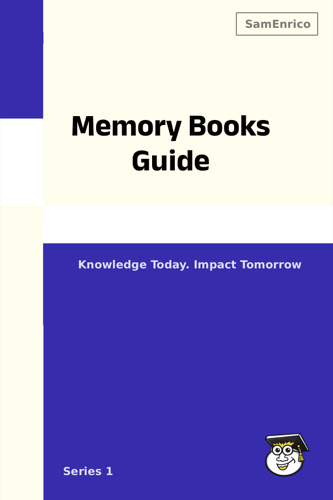
Memory Books Guide eBook
undefined
undefined
Formats
Free sample
Chapter 1: The Forgetting Paradox--–- You are about to discover something that will permanently change how you think about your own mind. It is not a trick, not a supplement, not a brain-training app, and not a promise of a photographic memory that will make you a savant overnight. It is, instead, something far more useful: the truth that you do not actually have a bad memory. You have an untrained one. These two statements are not the same, and the distinction between them is the difference between a lifetime of frustrating forgetfulness and a lifetime of reliable, impressive recall.Let us begin with a simple experiment.
Try to remember what you had for breakfast three days ago. If you are like most people, you will pause, search your mental files, and perhaps come up with a vague answer. Now try to remember the layout of the kitchen in the house you grew up in. Where was the refrigerator? Which direction did the door swing?
Where did your family keep the silverware? Most people can answer these questions with startling accuracy, even if they have not lived in that house for decades. Here is the paradox: your brain has no trouble storing massive amounts of detailed, complex, sensory-rich information for decades, yet it struggles to remember a three-item to-do list from ten minutes ago. The problem is not storage. The problem is retrieval.This chapter dismantles the most damaging myth in the world of self-improvement: the idea of a genetically "bad memory." You have likely heard people say, "I was never good at memorizing things," or "I have a terrible memory for names," as if memory were a fixed trait like eye color or height.
This is false. Decades of cognitive science, neuroscience, and competitive memory research have proven that memory is a skill—a trainable, malleable, improvable skill—not an inherited destiny. The path to mastering your memory begins not with memorizing anything, but with understanding how memory actually works. Once you understand the machinery, you can learn to operate it.The Three Pillars of Every Memory Every single act of remembering, from recalling where you parked your car to reciting a Shakespeare sonnet, depends on three distinct processes. Think of them as the legs of a stool.
If any one leg is weak, the stool collapses. Most people have never heard of these three processes, and that is why most people believe they have a "bad memory" when, in fact, they are simply neglecting one or two of these pillars.The first pillar is Encoding. Encoding is the act of taking information into your brain through your senses. When you hear a person say their name, that sound wave hitting your eardrum is the beginning of encoding. When you read a sentence in a textbook, the light reflecting off the page into your retina is encoding.
Encoding is the front door of memory. If you do not encode something properly, it cannot be stored, and it certainly cannot be retrieved later. Here is the problem: most people encode poorly because they encode passively. They listen to a lecture while checking their phone. They meet someone new while thinking about what they are going to say next.
They read the same paragraph three times while their mind wanders to tomorrow's to-do list. Poor encoding is the single most common cause of forgetting, and the good news is that it is also the easiest to fix.The second pillar is Storage. Storage is the maintenance of information over time. Once a memory has been encoded, your brain must somehow preserve it. For decades, neuroscientists believed that memories were stored in specific locations in the brain, like files in a cabinet.
We now know that this is incorrect. Memories are stored as patterns of connections between neurons, distributed across networks in the brain. Every time you remember something, you are literally reconstructing that pattern from scattered pieces. Storage itself is rarely the problem. Human brains have an astonishing capacity for storage.
Current estimates suggest that the average human brain can store approximately 2.5 petabytes of information—roughly the equivalent of three million hours of television shows. You are not running out of space. You never will.The third pillar is Retrieval. Retrieval is the act of pulling information back into conscious awareness when you need it. This is where most people feel their memory fails them.
You know that you know the answer. It is on the tip of your tongue. You studied it last night. But when you need it, the information does not come. This is not a storage failure.
The information is still in your brain. It is a retrieval failure—the neural pathway to that information has become overgrown or blocked, like a path in a forest that has not been walked in a while. The good news is that retrieval is a skill that can be trained. In fact, every mnemonic technique you will learn in this book is, at its core, a retrieval aid. Memory palaces, link methods, peg systems—all of them are tools designed to give you reliable pathways back to the information you have stored.Understanding these three pillars immediately reframes every memory failure you have ever experienced.
When you forget someone's name seconds after hearing it, you likely failed at encoding—you were not actually paying attention. When you cannot remember a fact from a textbook you read yesterday, you likely failed at retrieval—the information is there, but the path is overgrown. When you struggle to recall a childhood memory, you may be experiencing a combination of all three. The solution is never to blame your genetics or your age. The solution is to identify which pillar failed and strengthen it.The Neuroscience in One Page You do not need a degree in neuroscience to improve your memory, but understanding a few key concepts will give you immense motivation and direction.
Let us focus on two structures: the hippocampus and the concept of neuroplasticity.The hippocampus is a small, seahorse-shaped structure buried deep in the temporal lobe of your brain. Think of it as your brain's "save button." When you experience something new, the hippocampus is responsible for binding together all the different pieces of that experience—the sights, sounds, emotions, and context—into a single memory trace. Then, over time, usually during sleep, the hippocampus helps transfer that memory to the neocortex for long-term storage. Damage to the hippocampus results in an inability to form new memories, a condition famously studied in the patient Henry Molaison, who could not remember any event that occurred after his surgery in 1953. The hippocampus is essential, and the good news is that you can strengthen it through use.
Every time you deliberately practice recalling information, you are giving your hippocampus a workout.Neuroplasticity is the second concept, and it is arguably the most important discovery in neuroscience in the last century. For hundreds of years, scientists believed that the adult brain was fixed and immutable—that after a certain age, you could only lose neurons, never gain them, and that the connections between neurons were permanent. This is completely wrong. Neuroplasticity is the brain's lifelong ability…
This is the end of the free sample. Get the eBook to keep going. Buy now
About this book
Details
- Author
- Goldsmith Herma
- Publisher
- SamEnrico
- Language
- English
- Genre
- Non-Fiction, Self-Help
- Released
- 2026-06-08
- Pages (approx.)
- 147
- Available as
- eBook, Audiobook

Read better in the ZLOADR app
Your eBooks on your phone or tablet. Sign in with your SamEnrico account and start reading.
More by Goldsmith Herma
 The Monk Morning ProtocolGoldsmith Herma$11.99
 B12 Deficiency HandbookGoldsmith Herma$11.99
 Depreciation of Rental ImprovementsGoldsmith Herma$11.99
 Stuck Grief Self Help GuideGoldsmith Herma$11.99
 The Beach Visualization GuideGoldsmith Herma$11.99
 NVC For MediationGoldsmith Herma$11.99
 Immigrant Event Planning SuccessGoldsmith Herma$11.99
 Creative Block IncubationGoldsmith Herma$11.99
 The Great Thaw: How a Single Glacier Changed the WorldGoldsmith Herma$11.99
 The Dragon Tamer of Wawel Hill: A Knight’s Lost MentorGoldsmith Herma$11.99
 The Trollwife’s Last Stand: A Saga of Stone and SorrowGoldsmith Herma$11.99
 How to Start a Condensed Milk Business (Beginners Guide)Goldsmith Herma$11.99
You may also like
 Hong Kong Handover 1997Dunn Johnnie$11.99
 Zumba For Postnatal Recovery CourseNeal Christian$11.99
 Zumba for BeginnersLadner Nikia$11.99
 YouTube Comment Mining GuideHumes Pandora$12.99
 Worry Box MeditationCarlin Rudy$11.99
 Workplace Stress MeditationNguyen Lynn$11.99
 Workplace Stress and Sleep RepairHawley Ivory$11.99
 Workplace Perfectionism CureDelaney Jeffry$11.99
 Workplace Injustice Anger GuideWallen Isabelle$11.99
 Work Addiction and Burnout LinkGreenwood Ester$11.99
 Women in Yoga and WellnessBeattie Galina$11.99
 Women in Stand Up ComedyChun Evangeline$11.99