
Non-FictionHealth & WellnessHormone Supplement
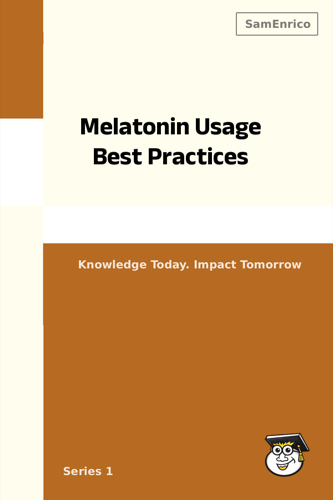
Melatonin Usage Best Practices eBook
Take 0.5 to 5 mg one hour before bed, short term o
by Tuttle Elba
Take 0.5 to 5 mg one hour before bed, short term only for jet lag or shift work.
Formats
Free sample
Chapter 1: The Melatonin Lie--–- The first time I bought melatonin, I stood in the supplement aisle for twenty minutes, confused. Bottles labeled 1 mg, 3 mg, 5 mg, 10 mg, even 12 mg. Gummies shaped like little moons. Tablets that promised “rapid release.” Capsules claiming “extended sleep support.” A brand called “Sleep Well Ultra” that contained 10 mg of melatonin plus a proprietary blend of herbs I couldn’t pronounce. I had jet lag from a flight from New York to London, my brain felt like wet cotton, and I just wanted to sleep.
I grabbed the 10 mg gummies because, in the absence of any real information, I assumed more was better. That night I took two gummies—20 mg total—and fell asleep within thirty minutes. I also woke up four hours later with my heart pounding, drenched in sweat, and haunted by a nightmare in which I was being chased through an airport by a suitcase with teeth. The next day I was groggier than before. The day after that, still foggy.
I had taken a massive dose of a hormone I didn’t understand, and I paid for it with two lost days.That experience, repeated by millions of people every year, is the reason this book exists. Melatonin is the most misunderstood, misused, and over-the-counter supplement in America. In 2022 alone, Americans spent over 2 billion dollars on melatonin. That is more than they spent on all other sleep supplements combined. It is sold in gas stations, grocery stores, airport kiosks, and online retailers with zero prescription required and, more troublingly, zero standardized education about how to use it correctly.
The supplement industry markets melatonin as a natural, harmless, side-effect-free sleeping pill. It is none of those things.This chapter will dismantle the melatonin lie piece by piece. You will learn what melatonin actually is (a hormone, not a sedative), what it actually does (signals timing, not sleep), and why the supplement industry has systematically misled you into believing that higher doses are better. You will also learn the single most important rule of this entire book—a rule that every subsequent chapter will reinforce, but which deserves to be stated here, plainly and without qualification: Melatonin is effective only for jet lag and shift work, at doses between 0.5 and 5 mg, taken exactly one hour before the desired bedtime, for no more than five to seven consecutive days. Everything else is marketing.
Everything else is misuse. And most of it is harmless only until it isn’t.The Hormone You Didn't Know You Were Taking Let us begin with a definition that will save you years of confusion. Melatonin is not a plant extract. It is not a vitamin. It is not a herbal sedative like valerian root or chamomile.
Melatonin is a hormone. Specifically, it is a hormone produced by the pineal gland, a tiny pinecone-shaped organ buried deep in the center of your brain. The pineal gland was once called the “third eye” by philosophers and mystics because of its location and its responsiveness to light. That description is not entirely metaphorical. The pineal gland receives direct signals from the retina about ambient light levels, and it responds by regulating melatonin production.Here is how it works.
When the sun sets and darkness falls, a cascade of neural signals travels from your eyes to a master clock in your brain called the suprachiasmatic nucleus (SCN). The SCN, which contains approximately twenty thousand neurons, is your body’s circadian pacemaker. It keeps time with remarkable precision, ticking through cycles of approximately twenty-four hours and eleven minutes. Every morning, exposure to sunlight resets that clock, keeping it synchronized with the external world. When the SCN detects darkness, it signals the pineal gland to begin producing melatonin.
Melatonin levels rise gradually, peaking in the middle of the night, then falling as morning approaches. By the time you wake, melatonin is barely detectable in your bloodstream.This daily rhythm is called dim-light melatonin onset, or DLMO for short. DLMO is the single most reliable biological marker of your internal clock. It is the moment when your brain decides, “It is now biologically night.” And here is the critical insight that most people never learn: melatonin does not cause sleep. Sleep is a complex neurological state involving dozens of neurotransmitters, brain regions, and physiological systems.
Melatonin does not initiate sleep, does not deepen sleep, and does not prolong sleep. What melatonin does is signal the timing of sleep. It tells your brain, “The sun has set. Prepare for rest.” It lowers core body temperature slightly. It reduces alertness gradually.
It opens a window of opportunity for sleep to occur. But if you have insomnia—if your brain is racing with anxiety or your circadian rhythm is already aligned—taking melatonin will do almost nothing. You might as well take a sugar pill.This distinction between a sleep initiator and a timing signal is the most important concept in this book. A sedative like zolpidem (Ambien) or diphenhydramine (Benadryl) directly depresses the central nervous system. It forces sleep, regardless of your circadian timing.
That is why those drugs work even when you take them at the wrong time of day. Melatonin does nothing of the sort. If you take melatonin at 3 PM, when your brain is producing none of its own, you will not become sleepy. You might feel slightly different—some people report mild dizziness or changes in body temperature—but you will not fall asleep unless you were already primed for sleep. Melatonin is not a switch that turns on sleep.
It is a signal that tells your brain, “Night has arrived.” And that signal only matters when your brain needs to know what time it is.The Supplement Industry's Billion-Dollar Deception If melatonin is only a timing signal, why do so many people believe it is a sleeping pill? The answer is marketing. In 1995, the New England Journal of Medicine published a small study showing that melatonin reduced the time it took to fall asleep by a few minutes in elderly insomniacs. Within weeks, supplement companies began selling melatonin as “the natural sleep solution.” Headlines declared melatonin the cure for insomnia, jet lag, aging-related sleep problems, and even cancer. (The cancer claim came from early research on melatonin’s antioxidant properties, which was real but wildly overextended.) By 2000, melatonin was a household name.The marketing strategy was genius.
First, call it “natural.” People trust natural. Second, imply that it replaces prescription sleeping pills without the side effects. Third, make it available over the counter so anyone can buy it. Fourth—and this is the masterstroke—sell it in ever-increasing doses. The logic, which the industry never stated explicitly but which consumers absorbed unconsciously, was: if 1 mg is good, 5 mg must be better, and 10 mg must be even better.
This logic is completely false, dangerously so, but it makes money. A bottle of 120 gummies at 10 mg each costs more than a bottle of 60 tablets at 1 mg each. Higher doses mean more product sold per customer. The industry has no incentive to tell you that 0.5 mg often works better than 10 mg. In fact, they have every incentive to hide that truth.Let me show you the data.
In 2001, a landmark study published in the journal Chronobiology International compared phase-shifting effects of different melatonin doses. Participants received…
This is the end of the free sample. Get the eBook to keep going. Buy now
About this book
Details
- Author
- Tuttle Elba
- Publisher
- SamEnrico
- Language
- English
- Genre
- Non-Fiction, Health & Wellness, Hormone Supplement
- Released
- 2026-06-07
- Pages (approx.)
- 142
- Available as
- eBook, Audiobook

Read better in the ZLOADR app
Your eBooks on your phone or tablet. Sign in with your SamEnrico account and start reading.
More by Tuttle Elba
 Meditation for SeniorsTuttle Elba$11.99
 Gut Health for Chronic FatigueTuttle Elba$11.99
 Meditation For SciaticaTuttle Elba$11.99
 Ironclads at Hampton Roads: The Naval War That Could Have Changed the UnionTuttle Elba$11.99
 How to Start a Architrave Made of Plastic Business (Beginners Guide)Tuttle Elba$11.99
 Financial Systems AnalystTuttle Elba$11.99
 US Real Estate Holding LLC for Non ResidentsTuttle Elba$12.99
 How to Produce Bumper StickersTuttle Elba$11.99
You may also like
 Hong Kong Handover 1997Dunn Johnnie$11.99
 Zumba For Postnatal Recovery CourseNeal Christian$11.99
 Zumba for BeginnersLadner Nikia$11.99
 YouTube Comment Mining GuideHumes Pandora$12.99
 Worry Box MeditationCarlin Rudy$11.99
 Workplace Stress MeditationNguyen Lynn$11.99
 Workplace Stress and Sleep RepairHawley Ivory$11.99
 Workplace Perfectionism CureDelaney Jeffry$11.99
 Workplace Injustice Anger GuideWallen Isabelle$11.99
 Work Addiction and Burnout LinkGreenwood Ester$11.99
 Women in Yoga and WellnessBeattie Galina$11.99
 Women in Stand Up ComedyChun Evangeline$11.99