
Non-FictionBusiness BriefMeetingsVoting
Meeting Voting System Guide eBook
Use fist of five or thumbs up for rapid team conse
by Ducharme Hye
Use fist of five or thumbs up for rapid team consensus.
Formats
Free sample
Chapter 1: The Alignment Lie--–- Every team has felt it. The clock reads 3:47 PM. A decision that should have taken ten minutes has consumed ninety. Eight people sit around a table—or stare into a grid of Zoom faces—each waiting for someone else to blink. Someone says, “I think we’re getting close.” Someone else says, “I just want to make sure we’ve considered all the options.” The project manager’s jaw tightens.
The newest team member has stopped making eye contact. The senior engineer, who checked out twenty minutes ago, is now visibly reading email on a second monitor.This is the alignment lie. And it is killing your team’s velocity, morale, and psychological safety.The alignment lie is the well‑intentioned but deeply flawed belief that a good decision requires everyone to agree. Not just consent. Not just support.
Not just “I can live with it.” Actual, enthusiastic, unqualified agreement. The kind of agreement that feels warm and inclusive but is, in practice, a recipe for paralysis, resentment, and decisions that please no one.I have watched this play out in hundreds of teams across forty industries. Software engineers at a Series B startup spending three hours debating whether to use a comma or a semicolon in an API response format. Hospital administrators arguing for an entire afternoon over which shade of blue to use on a patient discharge form. A product team so afraid of disagreeing with their vice president that they unanimously approved a feature roadmap they all knew would fail—and then watched it fail, exactly as predicted, six months later.The alignment lie feels safe because it feels democratic.
But democracy does not require unanimity. No functional democracy has ever required unanimity. The United States Congress requires a simple majority. The United Nations Security Council requires nine of fifteen votes, with five permanent members holding veto power—and even that system is famously gridlocked. The only organizations that truly require unanimity are juries in criminal trials (and even then, many states have moved away from strict unanimity) and, bizarrely, many corporate meetings where no law requires it at all.Why do teams fall into the alignment lie?
Because they confuse two entirely different things: agreement and alignment.Agreement means every person thinks the decision is the best possible choice. Alignment means every person is willing to support the decision publicly and execute it effectively, even if they would have chosen differently. Agreement is rare, expensive, and often unnecessary. Alignment is common, achievable, and sufficient for almost every team decision.The most successful teams I have worked with do not seek agreement. They seek what veteran facilitators call consent: the absence of reasoned, veto‑level objections.
Consent does not require enthusiasm. It does not require everyone to love the idea. It only requires that no one believes the decision will cause demonstrable harm to the team, the product, or the customer.This distinction is not academic. It is the difference between a team that moves and a team that stalls.The Real Cost of Slow Decisions When I ask leaders to calculate the cost of slow decisions, they typically think in terms of time. “We spent four hours in that meeting” is a common lament.
But four hours is not the real cost. The real cost is what those four hours displaced. The feature that was not built. The customer email that went unanswered. The strategic planning that was postponed.
The sleep that was lost. The family dinner that was missed.Research published in the Harvard Business Review found that executives spend nearly twenty‑three hours per week in meetings—and that number has increased by more than twelve percent since the shift to remote work. Of those twenty‑three hours, participants rated nearly half as “unproductive.” The single biggest predictor of unproductive meetings? Decisions that took too long relative to their importance.But time is only the visible cost. The hidden costs are far more damaging.The Psychological Toll of Endless Debate When a team cannot reach a decision, the most engaged members experience something close to grief.
They have invested emotional energy. They have advocated for a position they believe in. And then, after hours of discussion, they are asked to abandon that position not because they were convinced, but because the team ran out of time.This produces a phenomenon that organizational psychologists call decision fatigue with residual resentment. Unlike simple fatigue, which dissipates with rest, residual resentment accumulates. Every slow, painful decision adds a thin layer of frustration.
Over time, the layers harden into cynicism. The team stops believing that their input matters. They stop speaking up. They become what I call the silent consensus—a group that appears to agree because no one has the energy to fight anymore.The silent consensus is more dangerous than open conflict. Open conflict has energy.
Open conflict reveals where people actually stand. The silent consensus hides everything. Decisions pass with no visible opposition, then fail in execution because the people who “agreed” never actually bought in. They simply stopped fighting.I once consulted for a financial services company whose product team had not finished a sprint on time in eight months. When I observed their sprint planning meeting, I saw why.
The product owner would propose a sprint goal. The developers would nod. The Scrum Master would ask, “Any objections?” Silence. “Great, let’s proceed.” Then, two days into the sprint, the developers would discover that they had never actually agreed on how to implement the work. They had just stopped objecting.When I introduced Fist of Five voting to that team, the first vote revealed that three of the six developers were at a two—significant concerns they had been too exhausted to voice.
One developer was at a one—major objections they had assumed were obvious to everyone. Only two developers were at a four or five. The product owner was shocked. “You all said you agreed,” he said. They hadn’t agreed.
They had simply stopped disagreeing out loud.Where the Alignment Lie Comes From The alignment lie does not emerge from nowhere. It is taught, reinforced, and rewarded by organizational cultures that mistake silence for consent and conflict for dysfunction.The Misreading of Consensus Many leaders have encountered the word “consensus” in management books, facilitation training, or team charters. Somewhere along the way, the definition shifted. In its original meaning, from Latin consentire (to feel together), consensus simply meant that the group had reached a collective sense of direction. It did not require unanimity.
It required that no one had a veto‑level objection.But in corporate practice, “consensus” has been stretched to mean “everyone agrees enthusiastically.” This is a corruption of the term. The sociologist David G. Myers, in his work on group dynamics, notes that true consensus is actually a continuum. At one end is a unanimous vote. At the other end is a decision made over the objections of a minority who choose not to block.
Most healthy team decisions fall somewhere in the middle.The alignment lie treats the far end of the continuum—unanimous enthusiasm—as the only acceptable outcome. This is mathematically absurd.…
This is the end of the free sample. Get the eBook to keep going. Buy now
About this book
Details
- Author
- Ducharme Hye
- Publisher
- SamEnrico
- Language
- English
- Genre
- Non-Fiction, Business Brief, Meetings, Voting
- Released
- 2026-06-08
- Pages (approx.)
- 152
- Available as
- eBook, Audiobook

Read better in the ZLOADR app
Your eBooks on your phone or tablet. Sign in with your SamEnrico account and start reading.
More by Ducharme Hye
 Facebook Highlight Reel EffectDucharme Hye$11.99
 Burnout Recovery Gratitude ProtocolDucharme Hye$11.99
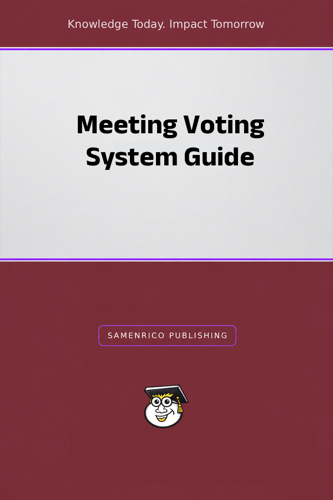 Meeting Voting System GuideDucharme Hye$11.99
 The Joy Finding WorkbookDucharme Hye$11.99
 Cleopatra Mark Antony RomanceDucharme Hye$11.99
 The Marvel Crisis: Superhero Fatigue RealizedDucharme Hye$11.99
 The Gold Weavers of Axum: The Economic Genius of the Aksumite EmpireDucharme Hye$11.99
 Freelance Bookkeeping Marketing PlanDucharme Hye$12.99
 Foreign Founder LLC GuideDucharme Hye$12.99
 Understanding Yeast InfectionDucharme Hye$17.99
 Ultimate Handbook Guide to Bucharest : (Romania) Travel GuideDucharme Hye$11.99
You may also like
 Hong Kong Handover 1997Dunn Johnnie$11.99
 Zumba For Postnatal Recovery CourseNeal Christian$11.99
 Zumba for BeginnersLadner Nikia$11.99
 YouTube Comment Mining GuideHumes Pandora$12.99
 Worry Box MeditationCarlin Rudy$11.99
 Workplace Stress MeditationNguyen Lynn$11.99
 Workplace Stress and Sleep RepairHawley Ivory$11.99
 Workplace Perfectionism CureDelaney Jeffry$11.99
 Workplace Injustice Anger GuideWallen Isabelle$11.99
 Work Addiction and Burnout LinkGreenwood Ester$11.99
 Women in Yoga and WellnessBeattie Galina$11.99
 Women in Stand Up ComedyChun Evangeline$11.99