
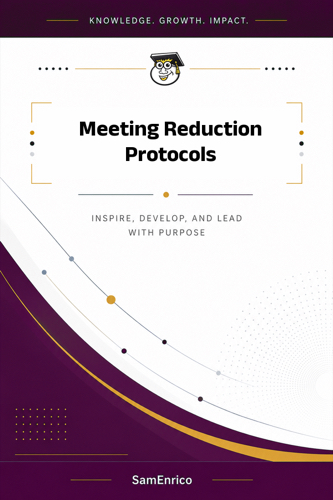
Non-FictionBusiness BriefMeetings
Meeting Reduction Protocols eBook
Eliminate unnecessary gatherings that drain energy
Eliminate unnecessary gatherings that drain energy and fragment focus.
Formats
Free sample
Chapter 1: The Gathering Tax--Imagine for a moment that every morning, before you pour your first cup of coffee, an invisible thief walks into your office, opens your calendar, and steals three hours of your day. Not your evening. Not your weekend. Three hours of your most alert, capable, focused work time. You would notice.
You would be furious. You would install locks, change passwords, maybe even hire security.Now consider this: that thief is already there. You invited it. You dress for it every day. You call it a "meeting."The average knowledge worker spends thirty-one hours per month in meetings that they themselves describe as "unproductive." That is nearly four full workdays.
When researchers at Harvard Business School analyzed millions of calendar invites across dozens of organizations, they found that meeting volume had increased by nearly 13 percent year over year for five consecutive years. Not because work required more collaboration. Because meetings had become the default. They had become a habit. And like any habit left unexamined, they had grown cancerous.This chapter is not about running better meetings.
There are already dozens of books that will teach you how to facilitate, how to keep time, how to arrange chairs in a circle. Those books have their place. But they miss the fundamental question. The question is not "How do we make this meeting less painful?" The question is "Why are we having this meeting at all?"The Billion-Dollar Blind Spot Let us begin with a number. One point four trillion dollars.
That is the annual cost of unproductive meetings in the United States alone, according to research by Steven Rogelberg, an organizational psychologist who has spent two decades studying meeting effectiveness. To put that number in perspective, it is roughly the GDP of Australia. It is more than the entire global market for smartphones. It is enough to send every single American to a four-year university. Twice.But large numbers can be numbing.
So let us make this personal. Take your fully loaded hourly compensation. Your salary, your benefits, your bonus, your overhead. Now multiply that by the number of hours you spend in meetings each week. Not the productive ones.
All of them. According to a 2022 study by the National Bureau of Economic Research, the average executive spends twenty-three hours per week in meetings. That has nearly doubled since 2008. You are likely spending more than half of your working hours in rooms, physical or virtual, with other people, listening, speaking, nodding, waiting.Now ask yourself an honest question. Of those twenty-three hours, how many actually required your presence?
Not your input. Not your approval. Your actual, indispensable presence. Research suggests the answer is somewhere between four and six hours. The rest is what one Fortune 500 executive called "the performance of attendance." You are there because you were invited.
You were invited because it was easier to send the invite than to explain why you did not need to be there.This is not a failure of individuals. It is a failure of design. Organizations have built elaborate systems for measuring revenue, tracking expenses, optimizing supply chains, and managing customer relationships. But they have built almost nothing for managing the single most expensive recurring activity they perform. Meetings are the only major business expense that is never budgeted, rarely audited, and almost never questioned.
You would not let a department spend a million dollars without approval. But you will let that same department schedule four thousand hours of meetings without a single person asking, "Is this the best use of our collective attention?"The Cognitive Wreckage The financial cost, however staggering, is not the worst part. The worst part is what meetings do to your mind.Consider the phenomenon that Rogelberg calls "Meeting Recovery Syndrome." After a meeting, especially a poorly run one, employees do not simply return to work. They experience a measurable cognitive hangover. In controlled studies, researchers gave participants a standard IQ test, then placed them in a sixty-minute meeting with no clear agenda, no decision structure, and no action items.
Afterward, they retook the test. Their scores dropped by an average of ten points. Ten points. That is the difference between the seventieth percentile and the forty-fifth. That is the difference between a sharp analyst and someone who struggles to follow a spreadsheet.The mechanism is well understood.
Your brain has a limited supply of what cognitive psychologists call "executive function." This is the resource that allows you to focus, to filter distractions, to hold multiple pieces of information in working memory, and to suppress irrelevant impulses. Every interruption, every context switch, every unplanned question burns a portion of this resource. And meetings are a fire hose of interruptions.Here is the brutal math. It takes an average of twenty-three minutes to return to a state of deep focus after an interruption. Not to resume working.
To return to the level of concentration you had before the interruption. If you have a sixty-minute meeting at 10 AM, you lose the hour of the meeting itself. But you also lose the twenty-three minutes before, because you cannot start anything substantial, and the twenty-three minutes after, because you cannot regain focus. That single hour of meeting time consumes nearly two hours of your cognitive capacity.Now stack those meetings back to back, as most knowledge workers do. A 9 AM meeting.
A 10 AM meeting. An 11 AM meeting. By noon, you have had zero hours of focused work, but your brain has been bombarded with three separate contexts, three sets of social dynamics, three streams of information. Your executive function is depleted. Your IQ has dropped.
And you still have four hours left in your workday.This is not weakness. This is neuroscience. And it explains why so many people finish their workdays exhausted but unable to point to a single meaningful output. They did not lack effort. They lacked the one thing meetings systematically destroy: uninterrupted time to think.The Industrial Era Hangover How did we arrive here?
Why do intelligent, well-meaning organizations continue to rely on a tool that is demonstrably destructive to productivity and cognition?The answer lies in history. Specifically, in the Industrial Era.In the late nineteenth and early twentieth centuries, work looked very different than it does today. Information was scarce. Communication was slow. A factory manager could not send a Slack message to a floor supervisor.
He could not share a Google Doc with a supplier. He could not record a Loom video explaining a process change. If he needed to coordinate action, he had to gather people in a room. There was no other option.That era has been dead for decades. We have email.
We have instant messaging. We have shared documents, project management software, asynchronous video, and collaborative whiteboards. The technological constraints that once made meetings necessary have evaporated. But the social and psychological patterns remain.Meetings, it turns out, are not primarily about information exchange. They are about power.Consider a simple experiment.
Watch who talks in your next meeting. Not what they say. Who they direct their comments to. In most organizations, the pattern is unmistakable. People talk to the highest-ranking person in the room.
They perform for that person. They signal competence, loyalty, and alignment. The meeting is not a tool for making decisions.…
This is the end of the free sample. Get the eBook to keep going. Buy now
About this book
Details
- Author
- Pinkerton Mirta
- Publisher
- SamEnrico
- Language
- English
- Genre
- Non-Fiction, Business Brief, Meetings
- Released
- 2026-06-10
- Pages (approx.)
- 127
- Available as
- eBook, Audiobook

Read better in the ZLOADR app
Your eBooks on your phone or tablet. Sign in with your SamEnrico account and start reading.
More by Pinkerton Mirta
 The Imposter To Expert TransitionPinkerton Mirta$11.99
 Fibromyalgia and Restless Leg SyndromePinkerton Mirta$11.99
 From Soldier to Buddhist MonkPinkerton Mirta$11.99
 The Pet Portrait GuidePinkerton Mirta$11.99
 Teen Sibling Comparison GuidePinkerton Mirta$11.99
 Interruption TriggersPinkerton Mirta$11.99
 Madeleine Albright PinPinkerton Mirta$11.99
 Image Rehearsal Therapy GuidePinkerton Mirta$11.99
 The Elven Forge of Valinor’s ShadowPinkerton Mirta$11.99
 The Mariner Kings: Portugal’s Golden FleetPinkerton Mirta$11.99
 The Complete Guide to the 400 Calorie Fix DietPinkerton Mirta$11.99
 Methodological Skills for PhD AppsPinkerton Mirta$12.99
You may also like
 Hong Kong Handover 1997Dunn Johnnie$11.99
 Zumba For Postnatal Recovery CourseNeal Christian$11.99
 Zumba for BeginnersLadner Nikia$11.99
 YouTube Comment Mining GuideHumes Pandora$12.99
 Worry Box MeditationCarlin Rudy$11.99
 Workplace Stress MeditationNguyen Lynn$11.99
 Workplace Stress and Sleep RepairHawley Ivory$11.99
 Workplace Perfectionism CureDelaney Jeffry$11.99
 Workplace Injustice Anger GuideWallen Isabelle$11.99
 Work Addiction and Burnout LinkGreenwood Ester$11.99
 Women in Yoga and WellnessBeattie Galina$11.99
 Women in Stand Up ComedyChun Evangeline$11.99