
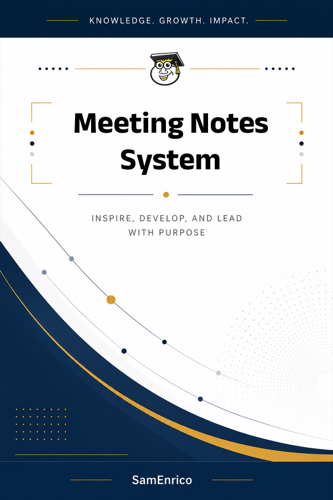
Meeting Notes System eBook
Capture decisions and action items without lengthy
Capture decisions and action items without lengthy minutes.
Formats
Free sample
Chapter 1: The Forgetting Tax--–- It is 3:47 PM on a Tuesday. You just walked out of a 90-minute meeting that had fourteen people on the call, a slide deck with thirty-seven slides, and exactly two moments of genuine clarity. Your coffee is cold. Your calendar is now a solid wall of color. And someone has already Slack’d you: “Hey, what did we decide about the Q3 timeline?
I had to drop off early.”You stare at your notes. You have three pages of sentence fragments, a photo of a whiteboard that is illegible, and a vague memory that someone named “David” said something about “circling back” on something that sounded important at the time. You cannot remember what was decided. You cannot remember who owns what. And you are absolutely certain that by tomorrow morning, neither will anyone else.This is not a failure of your intelligence, your work ethic, or your attention span.
This is the Forgetting Tax—the invisible cost that every organization pays when conversations outrun capture. And it is far more expensive than most leaders realize.The Forgetting Curve: Why Your Brain Betrays You In 1885, a German psychologist named Hermann Ebbinghaus published a monograph titled “Memory: A Contribution to Experimental Psychology.” He had spent years memorizing lists of nonsense syllables—meaningless combinations like “ZOF” and “WUK”—and then testing himself at intervals to see how much he retained. What he discovered became one of the most replicated findings in cognitive science: the Forgetting Curve.Ebbinghaus found that within one hour of learning new information, humans forget approximately 50 percent of it. Within 24 hours, that number climbs to 70 percent. Within one week, unless the information is actively reviewed or applied, nearly 90 percent is gone.Let that land for a moment.
You walk out of a one-hour meeting. By the time you have walked back to your desk and answered two emails, you have already forgotten half of what was discussed. By the time you sit down to write your meeting notes the next morning—the thing you promised yourself you would do before leaving work but did not because another meeting ran long—you have forgotten more than two-thirds of the conversation.Your brain is not broken. Your brain is doing exactly what evolution designed it to do: prioritizing survival-relevant information (where is the nearest exit, is that person a threat, have I eaten today) over meeting-relevant information (who is responsible for the Q3 forecast revision). The Forgetting Curve is not a bug; it is a feature.
But it is a feature that makes traditional meeting minutes a catastrophic failure.The Minutes Trap: Defensive Documentation Here is the uncomfortable truth that most productivity books dance around: traditional meeting minutes are not designed to help anyone remember anything. Traditional meeting minutes are designed to protect the minute-taker from blame.Consider the typical “comprehensive minutes” that circulate after a high-stakes meeting. They are written in passive voice. They are thick with qualifiers. They include verbatim quotes that preserve exactly what someone said, regardless of whether that statement constituted an agreement.
They are, in essence, a legal defense document.Example: “John Smith noted that the marketing team had been exploring several potential launch dates, with preliminary analysis suggesting that November might be feasible, though further research was required to confirm availability of key resources, and it was agreed that this would be discussed further at the next quarterly planning session.”What did this meeting actually decide? Nothing. What action items does this note produce? Zero. Who is accountable for what, by when?
No one, and never.This is what this book calls “defensive documentation”—writing that prioritizes coverage over clarity, volume over value, and historical accuracy over forward momentum. The defensive note-taker is terrified of two things: being wrong, and being blamed. So they write as much as possible, in as ambiguous a language as possible, so that no one can later point to a sentence and say, “You said we would do this, and we did not.”But here is the paradox that destroys productivity: defensive documentation does not prevent blame. It merely delays it. Because when a project misses its deadline because no one knew who was responsible for a critical action item, the first thing the team does is go back to the meeting notes to find out who dropped the ball.
And when those notes are a fog of passive-voice equivocation, the blame does not disappear—it spreads. Everyone gets a little bit blamed, which means no one is truly accountable, which means the same argument happens again in next week’s meeting.The note-taker who wrote those defensive minutes did not protect themselves. They planted a time bomb that will explode at the next project review.The Post-Meeting Hangover: A Familiar Epidemic This phenomenon is so common that it has acquired a name in corporate culture: the post-meeting hangover. The symptoms are unmistakable. Immediately after a meeting, there is a brief window of clarity—ten to fifteen minutes—during which participants can still recall the major decisions.
Then the forgetting begins. Emails arrive. Slacks ping. The next meeting starts. By the end of the day, the decisions have fragmented into a dozen individual recollections, none of which perfectly align.The following morning, the hangover is in full effect.
Team members begin asking each other: “What did we actually agree to?” “Was that a decision or just a suggestion?” “I thought Sarah was leading that?” “No, I thought it was Michael.” The team spends more time reconstructing the previous meeting than they spent attending it.This is not an exaggeration. Research from the Harvard Business Review found that the average knowledge worker spends 2.5 hours per week in “meeting recovery”—the act of clarifying, recapping, and re-deciding things that were already discussed. For a team of ten people, that is 25 hours per week, or more than one full-time employee’s worth of labor, spent purely on the work of remembering what was already said.The Forgetting Tax, then, is the sum total of all the hours lost to:Re-explaining decisions that were never clearly captured Re-opening discussions that were already closed Chasing down action items that were never formally assigned Re-litigating debates because the rationale was never recorded Waiting for notes that arrive too late to be actionable By conservative estimate, the Forgetting Tax costs the average Fortune 500 company more than $50 million per year in wasted labor. For a small team of twenty people, it costs the equivalent of one full-time salary every six months.But here is the good news: the Forgetting Tax is optional. You do not have to pay it.
There is a better way.The Pivot: From Minutes to Momentum The central argument of this book can be stated in seven words: Stop writing what people said. Start capturing what they agreed to.This requires a fundamental shift in how you think about the document that comes out of a meeting. The traditional “meeting minutes” document is backward-looking. It exists to answer the question, “What happened in that room?” But that question is almost always the wrong question. The right question—the only question that matters for getting work done—is, “What happens next?”When you shift from…
This is the end of the free sample. Get the eBook to keep going. Buy now
About this book
Details
- Author
- Faber Elenore
- Publisher
- SamEnrico
- Language
- English
- Genre
- Non-Fiction, Business Brief, Documentation
- Released
- 2026-06-10
- Pages (approx.)
- 133
- Available as
- eBook, Audiobook

Read better in the ZLOADR app
Your eBooks on your phone or tablet. Sign in with your SamEnrico account and start reading.
More by Faber Elenore
 The Remote Work Transition PeriodsFaber Elenore$11.99
 The Groin Strain PreventionFaber Elenore$11.99
 Vegan Food Allergy Cooking CourseFaber Elenore$11.99
 Franchising Your Local Brand Across Borders Tax GuideFaber Elenore$11.99
 The Quantum Crown Heist: How a Parallel Universe King Stole the British MonarchyFaber Elenore$11.99
 CRISPR: The Genetic ScalpelFaber Elenore$11.99
 Understanding Cutaneous AnthraxFaber Elenore$17.99
 Sales Scripts for StartupsFaber Elenore$12.99
 IP Fee Payment MethodsFaber Elenore$12.99
 After School Program LeaderFaber Elenore$11.99
 How to Become a Tree PlanterFaber Elenore$11.99
You may also like
 Remote Retreats Documentation GuideCoughlin Talia$11.99
 Meeting Minutes Template HandbookValerio Christena$11.99
 Remote First Documentation GuideLevin Marquis$11.99
 Meeting Minutes One PagerTurley Shirlene$11.99
 Legal Documentation for Cross BorderSchindler Estella$12.99
 Bank API Documentation ReadingBush Tammy$12.99
 Proof of Payment GuideLord Caroll$12.99
 Export Documentation for Shea CoffeeDeleon Suzann$12.99