
Non-FictionBusiness BriefMeetingsSettings
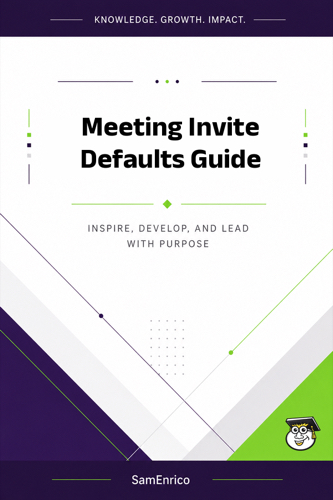
Meeting Invite Defaults Guide eBook
Set default meeting lengths to 25 or 50 minutes au
Set default meeting lengths to 25 or 50 minutes automatically.
Formats
Free sample
Chapter 1: The Latency Lie--–- The day my calendar broke me was a Tuesday like any other. I had seven meetings back to back, each one defaulting to 60 minutes because that was what Outlook suggested. The first started at 9:00 AM. The last ended at 4:00 PM. There was no lunch break because who has time for lunch when you have seven hours of back-to-back appointments?
At 4:07 PM, I sat in my car in the office parking garage and stared at the steering wheel. I had not shipped a single piece of work that day. I had not solved a problem. I had not created anything. I had simply attended.
And yet I was exhausted—the kind of bone-deep fatigue that comes not from physical labor but from the psychic weight of sitting through seven hours of people talking while your to-do list grew longer with every passing minute.That night, I did something I had never done before. I opened my calendar settings and looked at the default meeting length. It was set to 60 minutes. I had never changed it. No one had ever suggested that I could change it.
I clicked the dropdown menu. There were options for 15 minutes, 30 minutes, 45 minutes, 60 minutes, 90 minutes, and 120 minutes. I hovered over 30 minutes. Then 45. Then back to 60.
I closed the settings without changing anything because I was afraid. Afraid that a 30-minute meeting would be rude. Afraid that my colleagues would think I didn't care. Afraid that I would miss something important if I didn't give everyone a full hour to speak.That fear, as I would later learn, was the entire point. The default exists to keep you compliant.
And compliance is not productivity.The Invention of the Hour (And Why It Has Nothing to Do With You)Before we can understand why your calendar is broken, we need to understand where the hour came from. This is not a tangent. This is the foundation of everything that follows.The division of the day into 24 hours dates back to ancient Egypt, but the fixed-length hour—the idea that an hour is always 60 minutes regardless of season—is a medieval invention. Monastery bells in the 13th century standardized the liturgical day into equal segments so that monks could pray at predictable intervals. The mechanical clock, perfected in the 14th century, locked those segments into gears and escapements.
By the time the Industrial Revolution arrived, the hour had become the atomic unit of labor. Factory owners needed to measure output per hour. Wages were calculated by the hour. The 8-hour workday became a rallying cry for labor movements.None of this had anything to do with how the human brain processes information or makes decisions.Let me say that again: The 60-minute meeting is not based on science. It is based on monastery bells and factory punch clocks.The 30-minute meeting is equally arbitrary.
It emerged as a half-measure—literally half of the industrial hour—when office work replaced factory work. IBM, which dominated corporate culture for much of the 20th century, standardized the 30-minute and 60-minute blocks in its internal scheduling systems. When IBM released the first computerized calendar tools in the 1980s, those defaults became the defaults for everyone. Lotus Notes copied IBM. Microsoft Outlook copied Lotus Notes.
Google Calendar copied Outlook. And now, 40 years later, you are still scheduling 60-minute meetings because a dead computer company decided that was the right length before you were born.Consider the absurdity of this. If you were designing a meeting scheduling system from scratch today, with everything we know about cognitive science, attention spans, and workplace psychology, would you choose 60 minutes as the default? Of course not. You would ask questions like: How long does it take the average person to refocus after a distraction?
What is the optimal block for decision-making? How do we protect deep work? But no one asked those questions in 1984. They asked: What did Lotus Notes do?Parkinson's Law and the Meeting That Eats Itself There is a famous observation about bureaucracy known as Parkinson's Law: Work expands so as to fill the time available for its completion. This was written in 1955 by Cyril Northcote Parkinson, a British naval historian who noticed that the British Admiralty continued to grow in size and complexity even as the number of ships declined.
The work didn't need to be done. But the people needed to look busy.Parkinson's Law applies perfectly to meetings. Give a team 60 minutes to discuss a topic that requires 12 minutes of actual decision-making, and they will invent 48 minutes of content. Someone will re-explain something that was already explained. Someone will ask a question they could have answered by reading the document.
Someone will tell a long story about a related but irrelevant project. The meeting will expand to fill the container because the container exists. It is not malice. It is not incompetence. It is the natural human response to a vacuum.I have seen this happen hundreds of times.
A 60-minute meeting scheduled to approve a budget. The budget is clear. The numbers are correct. The decision should take 5 minutes. But the meeting has 60 minutes to fill, so the conversation drifts.
"Have we considered the marketing impact?" (Marketing wasn't in the scope.) "What about Q4?" (This is a Q2 budget.) "Let me just share a quick story about a similar situation at my last company..." By minute 45, the team has talked themselves into confusion. By minute 55, they've decided to "table it for further discussion." The decision that should have taken 5 minutes now requires a second 60-minute meeting. Parkinson's Law has claimed another victim.The solution, as you might have guessed, is to change the container. But before we get to solutions, we need to measure the damage.The True Cost of a 60-Minute Meeting Most people calculate meeting cost as: (number of attendees) × (hourly rate) × (meeting length in hours). This is wrong.
It is not merely imprecise. It is wrong by a significant margin because it ignores a phenomenon that cognitive scientists call attention residue.Attention residue was first identified by Professor Sophie Leroy at the University of Washington. In a series of experiments, Leroy found that when people switch from one task to another, their brains do not fully disengage from the first task. Some portion of their attention—sometimes as much as 30-40%—remains stuck on the previous activity for 5 to 10 minutes. They are physically present in the new meeting, but mentally they are still finishing that email, still solving that problem, still worrying about that deadline.
This is attention residue, and it is the hidden tax on every single meeting you attend.Here is what attention residue means for your 60-minute meeting:Minutes 0-5: Attendees are arriving, finding their seats, muting their microphones, and mentally disengaging from whatever they were doing before. Very little productive work happens in these first five minutes. If you ask "how was everyone's weekend?" you will get answers. If you ask "what's the decision we need to make?" you will get blank stares.Minutes 55-60: Attendees are checking their next calendar appointment, gathering their things, and mentally transitioning to what comes next. The last five minutes of any meeting are almost entirely wasted.…
This is the end of the free sample. Get the eBook to keep going. Buy now
About this book
Details
- Author
- Braxton Candy
- Publisher
- SamEnrico
- Language
- English
- Genre
- Non-Fiction, Business Brief, Meetings, Settings
- Released
- 2026-06-11
- Pages (approx.)
- 140
- Available as
- eBook, Audiobook

Read better in the ZLOADR app
Your eBooks on your phone or tablet. Sign in with your SamEnrico account and start reading.
More by Braxton Candy
 Recovery From Burnout WorkbookBraxton Candy$11.99
 Difficult Conversations For CouplesBraxton Candy$11.99
 Sleep Walking Safety GuideBraxton Candy$11.99
 The Outpatient Detox GuideBraxton Candy$11.99
 Blood and Roses: The Wars That Shaped England's ThroneBraxton Candy$11.99
 Daily User Testing RoutineBraxton Candy$12.99
 Community-Led CACBraxton Candy$12.99
 Hunter Biden: The Gun and Tax TrialsBraxton Candy$11.99
 Understanding X Fragile Site Folic ACID TypeBraxton Candy$17.99
 How to Start a Blinds (soft Furnishings) Business (Beginners Guide)Braxton Candy$11.99
You may also like
 Hong Kong Handover 1997Dunn Johnnie$11.99
 Zumba For Postnatal Recovery CourseNeal Christian$11.99
 Zumba for BeginnersLadner Nikia$11.99
 YouTube Comment Mining GuideHumes Pandora$12.99
 Worry Box MeditationCarlin Rudy$11.99
 Workplace Stress MeditationNguyen Lynn$11.99
 Workplace Stress and Sleep RepairHawley Ivory$11.99
 Workplace Perfectionism CureDelaney Jeffry$11.99
 Workplace Injustice Anger GuideWallen Isabelle$11.99
 Work Addiction and Burnout LinkGreenwood Ester$11.99
 Women in Yoga and WellnessBeattie Galina$11.99
 Women in Stand Up ComedyChun Evangeline$11.99