
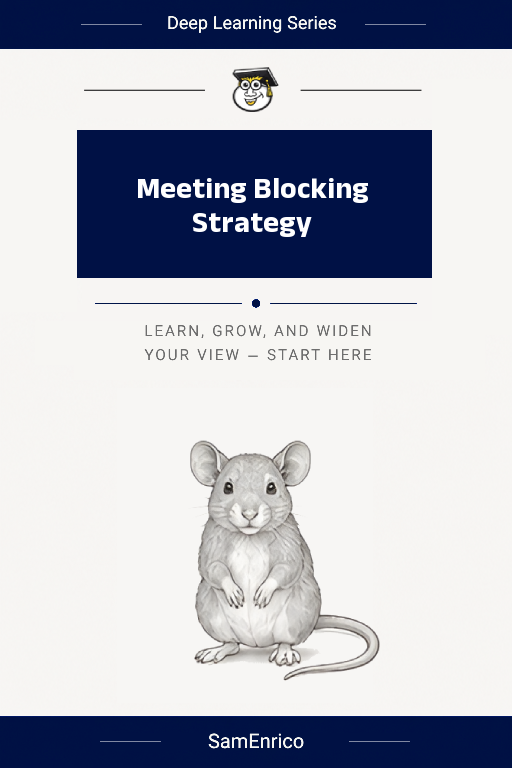
Non-FictionProfessional's Cheat SheetMeeting Management
Meeting Blocking Strategy eBook
Batch meetings into specific days or windows to pr
by Kurtz Linnea
Batch meetings into specific days or windows to protect deep work on remaining days.
Formats
Free sample
Chapter 1: The Calendar Predator--–- The morning light barely filtered through the blinds as Sarah, a 34-year-old marketing director, settled into her home office with a fresh cup of coffee. Her calendar showed only two meetings that day—one at 10 AM and another at 2 PM. Plenty of time, she thought, to finish the quarterly strategy document due Friday. By 5 PM, she had accomplished exactly nothing on that document. She had answered forty-seven emails, attended both meetings, extinguished three "urgent" fires, and spent twenty-three minutes searching for a file someone claimed she had sent.
She cried in her car—actually, in her desk chair, which somehow felt worse—because she had worked for nine hours and had nothing to show for it. Sarah is not lazy. Sarah is not incompetent. Sarah is being eaten alive by a predator she cannot see.The Beast That Devours Your Day This book is about that predator. I call it the Calendar Predator—a creature that stalks knowledge workers in every industry, from Silicon Valley startups to Midwestern insurance firms to London advertising agencies.
The Calendar Predator has no teeth, no claws, and no physical form. It lives in your Outlook, your Google Calendar, your Slack notifications, and your Zoom link history. It feeds on one thing: your uninterrupted attention. And it is winning.Let me show you what the Calendar Predator looks like in action. Open your calendar right now—go ahead, I will wait.
Look at the past seven days. Count the number of blocks labeled "Meeting," "Sync," "Check-in," "Stand-up," "Touch base," or "Quick call." Now count how many blocks are labeled with actual deliverables—"Write proposal," "Analyze Q3 data," "Code login feature," "Draft customer email." If you are like 87 percent of knowledge workers surveyed by Harvard Business Review, your calendar is dominated by the first category. You are spending your days in meetings about work instead of doing work.This is not an accident. This is not a personal failing. This is a systemic predation, and the first step to defeating the Calendar Predator is recognizing its primary weapon: the illusion of productivity.Movement Is Not Progress Here is a truth that will sting: Being busy is not the same as being effective.
I want you to tattoo this sentence on the inside of your eyelids. Most professionals confuse movement with progress. Movement is answering emails, attending status updates, shuffling files between folders, and sitting in meetings where everyone talks about what they will do next week. Progress is writing the proposal, building the prototype, closing the sale, solving the engineering problem, or producing the output that generates revenue.The Calendar Predator loves movement. Movement keeps you exhausted, distracted, and feeling virtuous about your exhaustion.
Progress requires uninterrupted focus—and the Calendar Predator cannot survive in an environment where people have long stretches of uninterrupted time. So it has evolved a brilliant strategy: fragment your day into tiny, unusable shards. A fifteen-minute sync here. A thirty-minute stand-up there. A forty-five-minute "collaboration workshop" somewhere else.
None of these meetings seems harmful on its own. Each one appears reasonable, even necessary. But together, they form a net that captures your entire day.The 53-Minute Rule Let me introduce you to a piece of research that will change how you see every meeting invitation. Psychologists at the University of California, Irvine, studied how long it takes knowledge workers to return to a deep focus state after an interruption. Their finding, replicated across multiple studies, is remarkably consistent: after a thirty-minute interruption, it takes an average of twenty-three minutes to fully re-engage with the original task.
This is not the time to "get back to work"—this is the time for your brain to rebuild the neural context it was using before the interruption.Do the math with me. A thirty-minute meeting costs you thirty minutes of meeting time. It also costs you twenty-three minutes of recovery time. That is fifty-three minutes. Your one-hour meeting is actually a fifty-three-minute meeting?
No, that is not the math. Let me be precise: A thirty-minute meeting plus its twenty-three-minute recovery tail equals fifty-three minutes of lost productive time. But wait, the meeting itself might have produced something. True. But if the meeting did not need to happen at all—and most meetings do not—then you have lost fifty-three minutes for zero return.Now scale this.
The average knowledge worker attends ten to fifteen meetings per week. Let us be conservative and say twelve meetings, averaging thirty minutes each. That is six hours of meeting time. Multiply each meeting by its twenty-three-minute recovery tail (twelve meetings × twenty-three minutes = 276 minutes, or 4.6 hours). Your six hours of meetings actually cost you 10.6 hours of your week.
That is more than a full workday. That is a full workday every week spent on meetings and their hidden recovery cost. Over a forty-eight-week working year, that is more than five full workweeks—five weeks—lost to the Calendar Predator.I want you to sit with that number. Five weeks per year. That is your vacation time, gone.
That is the time you could have spent on strategic projects, on learning new skills, on mentoring junior colleagues, or on leaving the office at 5 PM to have dinner with your family. The Calendar Predator has been stealing five weeks of your life every year, and you have probably been thanking it for the opportunity to collaborate.The Calendar Fragmentation Diagnostic Before we go any further, I need you to diagnose your own infestation. Take out a piece of paper or open a note-taking app. Answer these ten questions honestly:In the past week, how many days did you have at least one block of two consecutive hours with absolutely no meetings? (Zero to five)In the past week, how many times did you start a task, get interrupted by a meeting, and then struggle to remember where you left off?
(Estimate a number)On average, how long are the gaps between your meetings? (Less than 15 minutes / 15-30 minutes / 30-60 minutes / More than 60 minutes)Do you usually eat lunch at your desk while working? (Always / Often / Sometimes / Rarely)Have you ever described your day as "so busy" while feeling like you accomplished nothing? (Daily / Weekly / Monthly / Rarely)Do you have back-to-back meetings that leave you no time to prepare for the next one? (More than 3 per week / 1-3 per week / Rarely / Never)When you look at your calendar, can you immediately identify which blocks are dedicated to your most important project?
(Yes / Partially / No)Have you ever declined a meeting request because you needed to do actual work? (Never / Rarely / Sometimes / Often)Do you check email or Slack between meetings because the gap is too short for anything else? (Always / Often / Sometimes / Rarely)At the end of most days, do you feel a sense of completion and progress? (Never / Rarely / Sometimes / Often)Scoring: Give yourself 1 point for each answer that indicates calendar fragmentation (questions 1: 0-2 days; 2: more than 5 times; 3: less than 15 minutes; 4: Always or Often; 5: Daily or Weekly; 6: More than 3 per week; 7: No or Partially; 8: Never or Rarely…
This is the end of the free sample. Get the eBook to keep going. Buy now
About this book
Details
- Author
- Kurtz Linnea
- Publisher
- SamEnrico
- Language
- English
- Genre
- Non-Fiction, Professional's Cheat Sheet, Meeting Management
- Released
- 2026-06-01
- Pages (approx.)
- 144
- Available as
- eBook, Audiobook

Read better in the ZLOADR app
Your eBooks on your phone or tablet. Sign in with your SamEnrico account and start reading.
More by Kurtz Linnea
 Conversation Starters for Hotel LoungesKurtz Linnea$11.99
 Remote Communication TrainingKurtz Linnea$11.99
 Email Out of Office GuideKurtz Linnea$11.99
 Pinterest VA Rich Pins DecodedKurtz Linnea$11.99
 DCIS Diagnosis GuideKurtz Linnea$11.99
 Frozen Alchemy: The Arctic Quest for the Elements of LifeKurtz Linnea$11.99
 The Last Letter: A Family’s Hidden WWII Love StoryKurtz Linnea$11.99
 MarketForce YC GuideKurtz Linnea$12.99
 Ultimate Handbook Guide to Shishou : (China) Travel GuideKurtz Linnea$11.99
 Understanding Codesette SyndromeKurtz Linnea$17.99
 BlenderKurtz Linnea$11.99
You may also like
 Hong Kong Handover 1997Dunn Johnnie$11.99
 Zumba For Postnatal Recovery CourseNeal Christian$11.99
 Zumba for BeginnersLadner Nikia$11.99
 YouTube Comment Mining GuideHumes Pandora$12.99
 Worry Box MeditationCarlin Rudy$11.99
 Workplace Stress MeditationNguyen Lynn$11.99
 Workplace Stress and Sleep RepairHawley Ivory$11.99
 Workplace Perfectionism CureDelaney Jeffry$11.99
 Workplace Injustice Anger GuideWallen Isabelle$11.99
 Work Addiction and Burnout LinkGreenwood Ester$11.99
 Women in Yoga and WellnessBeattie Galina$11.99
 Women in Stand Up ComedyChun Evangeline$11.99