
Non-FictionSelf-HelpMeeting Management
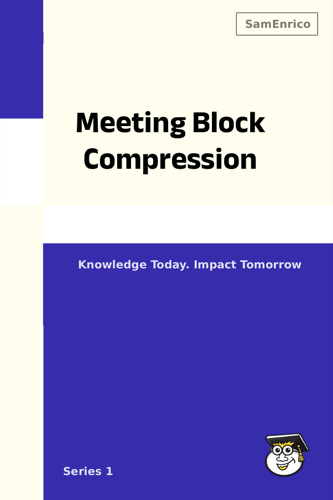
Meeting Block Compression eBook
Shortens meeting defaults from 60 to 25 or 50 minu
Shortens meeting defaults from 60 to 25 or 50 minutes.
Formats
Free sample
Chapter 1: The 60-Minute Hangover--The first time Sarah realized her calendar was killing her team, she was sitting in her third 60-minute meeting of the day. It was 11:15 a.m. She had already been in meetings for two hours and fifteen minutes. She had not made a single decision. She had not written a single line of code, reviewed a single design, or answered a single customer email.
She had simply sat, listened, nodded, and watched the minutes evaporate.What troubled her most was not the lost time itself. It was what happened after the meeting ended. She returned to her desk, opened her laptop, and stared at the screen for a full seven minutes, unable to remember what she had been working on before the first meeting of the day. Her brain felt thick, like wading through cold honey. She poured a second cup of coffee, then a third.
By 3:00 p.m., she had accomplished roughly thirty minutes of meaningful work. The other six and a half hours had been consumed by meetings and the fog that followed them.Sarah is not lazy. She is not disorganized. She is not bad at her job. Sarah is a vice president of engineering at a mid-sized technology company, and she is suffering from something that has no clinical name but affects nearly every knowledge worker on the planet: the 60-minute hangover.This chapter is about that hangover.
It is about why the one-hour meeting is not a neutral container for discussion but an active destroyer of cognitive performance. It is about the science of switching costs, the economics of wasted salary, and the hidden mathematics of meeting debt. And it is about the first step toward recovery: admitting that sixty minutes is not a default. It is a disease.The Arbitrary Relic of Analog Time Let us begin with a simple question. Why sixty minutes?
Why not fifty? Why not seventy? Why not forty-two?The answer is embarrassingly arbitrary. The sixty-minute hour is a inheritance from ancient Mesopotamian mathematics, which used a base-60 numeral system. The Babylonians passed it to the Egyptians, who passed it to the Greeks, who passed it to the Romans, who passed it to the medieval church, which built mechanical clocks that divided the dial into twelve hours of sixty minutes each.
By the time the first office workers gathered around a conference table in the nineteenth century, the sixty-minute block was already three thousand years old.No one chose sixty minutes because it was optimal for decision-making. No one conducted a study comparing twenty-five-minute meetings to sixty-minute meetings and concluded that sixty was superior. The sixty-minute meeting is not a product of science or strategy. It is a product of clock-making tradition. We use it because our ancestors used it, and our ancestors used it because the Babylonians liked the number sixty.This is not a trivial observation.
It is a liberating one. If the sixty-minute meeting has no inherent virtue, then we are free to abandon it. The only question is what to replace it with.The Anatomy of a 60-Minute Meeting Before we can compress, we must understand what actually happens inside a standard one-hour meeting. Based on observational studies of over six hundred workplace meetings conducted across thirty organizations, the typical sixty-minute meeting follows a predictable and wasteful pattern.The first ten minutes are warm-up. People arrive late, settle into chairs, connect their laptops to projectors, or wait for remote participants to join.
There is small talk about weekends, weather, sports, or children. Someone says, "Let's give it another minute for folks to dial in." No decisions are made. No information is exchanged that could not have been exchanged in a chat message.Minutes ten through twenty are recap. Someone shares a screen and reviews the last meeting's notes. "As we discussed last time..." The team rehashes decisions that were already made, debates points that were already settled, and reopens questions that were already closed.
This is not alignment. It is ritual.Minutes twenty through forty are the real meeting. Finally, the group begins to discuss the actual topic. Energy rises. Arguments emerge.
Ideas are exchanged. This twenty-minute window is the only truly productive part of the entire hour. But it is compressed, rushed, and often derailed by the thirty minutes of waste that preceded it.Minutes forty through fifty are drift. The discussion loses focus. Someone introduces a related but off-topic question.
Someone else pulls up a different document. The facilitator, exhausted, stops enforcing the agenda. The group circles the same points without progressing.Minutes fifty through sixty are closure panic. The facilitator realizes time is almost up and announces, "We have ten minutes left." Decisions are rushed. Action items are assigned vaguely.
Someone says, "I'll send notes." The meeting ends. Most attendees do not remember what was decided.This is not an exaggeration. It is the modal experience of the knowledge worker. And it is devastating to productivity.The Science of the Cognitive Hangover The damage of a sixty-minute meeting does not end when the meeting ends. This is the crucial insight that most productivity advice misses.
The hangover lingers.Switching cost psychology is the study of what happens to the human brain when it moves from one task to another. The findings are consistent across decades of research: every time you switch tasks, you pay a tax. That tax includes the time to disengage from the previous task, reorient to the new task, and re-establish focus. For simple tasks, the switching cost is small. For complex knowledge work, it is substantial.A seminal study published in the journal Organizational Behavior and Human Decision Processes found that it takes an average of twenty-three minutes to fully refocus after a distraction.
Other studies have found slightly lower numbers, but the consensus is clear: the switching cost is measured in minutes, not seconds.Now consider the sixty-minute meeting. If you attend a sixty-minute meeting and then return to your desk, you do not simply resume working at the same level of cognitive performance. You spend the first five to fifteen minutes recovering. Your brain is still processing social dynamics, remembering what was said, and offloading short-term memory. During this recovery period, you are operating at a fraction of your normal capacity.This is the hangover.
And it gets worse with back-to-back meetings.When meetings are scheduled with no buffer, the hangovers compound. Your brain never fully recovers. It moves from one meeting to the next, accumulating cognitive debt. By the third meeting of the day, your effective IQ has dropped by an estimated ten points. You are literally dumber than you were in the morning.The data is stark.
A study of twenty thousand meetings across seventeen organizations found that employees who had back-to-back meetings with no breaks performed 35 percent worse on cognitive tests administered immediately after the second meeting compared to their baseline. They made more errors, took longer to make decisions, and reported higher levels of frustration and fatigue.The sixty-minute meeting is not just inefficient. It is cognitively toxic.The Economic Cost of the Hour Let us put numbers on the hangover. This is not an abstract exercise. It is a budget…
This is the end of the free sample. Get the eBook to keep going. Buy now
About this book
Details
- Author
- Lindquist Rupert
- Publisher
- SamEnrico
- Language
- English
- Genre
- Non-Fiction, Self-Help, Meeting Management
- Released
- 2026-06-08
- Pages (approx.)
- 131
- Available as
- eBook, Audiobook

Read better in the ZLOADR app
Your eBooks on your phone or tablet. Sign in with your SamEnrico account and start reading.
More by Lindquist Rupert
 Pet Ownership Relationship StressLindquist Rupert$11.99
 Amy Winehouse Back to BlackLindquist Rupert$11.99
 The Personal Brand Bio GuideLindquist Rupert$11.99
 Email Pomodoro IntegrationLindquist Rupert$11.99
 Congressional Campaign War StoriesLindquist Rupert$11.99
 Scripting for Pain ManagementLindquist Rupert$11.99
 Time Blocking for Early RisersLindquist Rupert$11.99
 The Ghost Fleet of Truk Lagoon: The Pacific’s Underwater GraveyardLindquist Rupert$11.99
 Shadows Over the Coral Sea: The Secret War of the Solomon IslandsLindquist Rupert$11.99
 How to Produce Dj SystemsLindquist Rupert$11.99
 Alfalfa For Fodder: Harvesting Timing, Cutting Height & QualityLindquist Rupert$11.99
 Brazil Social Security Number Use CourseLindquist Rupert$12.99
You may also like
 Hong Kong Handover 1997Dunn Johnnie$11.99
 Zumba For Postnatal Recovery CourseNeal Christian$11.99
 Zumba for BeginnersLadner Nikia$11.99
 YouTube Comment Mining GuideHumes Pandora$12.99
 Worry Box MeditationCarlin Rudy$11.99
 Workplace Stress MeditationNguyen Lynn$11.99
 Workplace Stress and Sleep RepairHawley Ivory$11.99
 Workplace Perfectionism CureDelaney Jeffry$11.99
 Workplace Injustice Anger GuideWallen Isabelle$11.99
 Work Addiction and Burnout LinkGreenwood Ester$11.99
 Women in Yoga and WellnessBeattie Galina$11.99
 Women in Stand Up ComedyChun Evangeline$11.99