
Non-FictionSelf-HelpMeditation
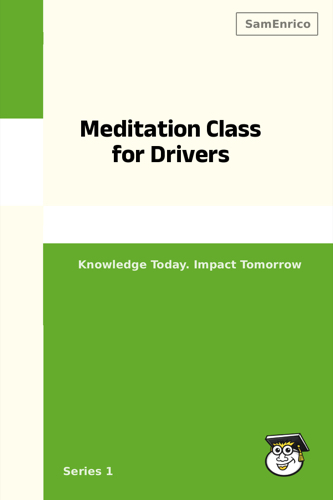
Meditation Class for Drivers eBook
Teaches attending meditation classes to improve em
Teaches attending meditation classes to improve emotional regulation behind wheel.
Formats
Free sample
Chapter 1: The Autopilot Lie--–- You have no idea where your hands are right now.Not metaphorically. Not philosophically. Literally. Pause for one second. Notice your hands.
Are they resting on a phone? Curled around a coffee mug? Tucked under a thigh? Dangling at your side? The answer doesn't matter.
What matters is this: you just became aware of something that was happening whether you were paying attention or not. Your hands have been there the whole time. You simply weren't looking.That moment—the shift from unconscious sensation to conscious awareness—is the entire thesis of this book. And it is the single most important skill you will ever learn for driving a car.Let me tell you about a driver named Carol. Carol commuted sixty miles round trip on the same highway for seventeen years.
She knew every pothole, every speed trap, every rest stop. She could tell you which lane moved faster at the 5:15 p.m. merge and exactly where the sun would blind her in November. Carol was, by any objective measure, an expert driver. She had never caused an accident.
She had never received a ticket. She changed her oil every 5,000 miles and rotated her tires like a saint.One Tuesday evening, Carol arrived home, pulled into her driveway, turned off the engine, and realized she had absolutely no memory of the last twenty-two miles. Not a blur. Not a haze. Nothing.
She remembered leaving work. She remembered merging onto the highway. And then—a void. The next thing she knew, she was turning into her neighborhood.Carol sat in her parked car for five minutes, hands still on the wheel, trying to retrieve something, anything, from the missing stretch of road. A song on the radio?
A construction zone? A red light? Nothing. Her brain had recorded approximately zero percent of the experience.She was not tired. She was not drunk.
She was not on medication. Carol was suffering from something so common that virtually every driver experiences it multiple times per week, yet so invisible that we almost never talk about it.She was on autopilot.And autopilot, as you are about to learn, is not a harmless quirk of the human mind. It is a form of dissociation that disconnects you from the very signals your body uses to warn you that something is about to go terribly wrong. This is the autopilot lie: that zoning out behind the wheel is normal, acceptable, and essentially harmless. It is none of those things.The Great Deception of Modern Driving Every driver's education class, every defensive driving course, every "stay safe out there" public service announcement has taught you the same lie: that driving is a visual and mechanical task.
Keep your eyes on the road. Keep your hands on the wheel. Check your mirrors. Signal your turns. These are all necessary, of course.
But they are not sufficient. Because before you can keep your eyes on the road, you have to know where your eyes are. Before you can keep your hands on the wheel, you have to feel your hands.Driving is not primarily a visual task. It is not primarily a mechanical task. Driving is a somatic task—a task of the body sensing itself in space.
And when you lose touch with your body, you lose the early warning system that could stop a road rage incident before it starts, prevent a crash before it happens, and bring you home present instead of possessed.The autopilot problem is not that you occasionally zone out. The autopilot problem is that zoning out has become the default state of the modern driver. We have normalized dissociation behind the wheel. We call it "highway hypnosis" as if it were a gentle meditation rather than a dangerous trance. We joke about "waking up at our exit" as if the absence of consciousness for miles of high-speed travel were a funny quirk rather than a terrifying indictment of how disconnected we have become.Consider this statistic: studies estimate that highway hypnosis contributes to approximately 20 percent of all fatal single-vehicle crashes.
Twenty percent. That means one in five drivers who die on the road did not crash because they were drunk, distracted by a phone, or driving recklessly. They crashed because their brain simply stopped paying attention. Their body kept driving while their mind went on vacation. And then reality intervened.Here is what actually happens during highway hypnosis, stripped of its cute name.Your brain, faced with repetitive visual input—white lines, asphalt, guardrails, taillights—begins to downregulate activity in the prefrontal cortex.
That is the part of your brain responsible for executive function, decision-making, and self-awareness. Simultaneously, your brain ramps up activity in the default mode network, the neural circuitry that runs automated scripts, daydreams, replays conversations, and plans dinner. You are, in a very real sense, no longer driving the car. A subroutine is driving the car. You are sitting in the passenger seat of your own mind, watching a movie about what you should have said to your boss three hours ago.And here is the kicker: that subroutine is actually pretty good at driving.
It will stay in the lane. It will slow down when the car in front slows down. It will even exit the highway at the right ramp. The subroutine can do all of that because driving, once learned, becomes largely procedural memory, the same system that lets you tie your shoes without thinking about each loop and knot.But the subroutine cannot do two critical things. First, it cannot anticipate novel threats.
If a deer jumps onto the highway, the subroutine will not see it coming because the subroutine is not seeing anything at all. It is running a script, not perceiving reality. Second, and more relevant to this book, the subroutine cannot feel your body. It cannot register the subtle increase in jaw tension that precedes a flash of rage. It cannot notice your shoulders creeping up toward your ears.
It cannot feel your breath growing shallow and fast. And without those signals, you will go from zero to explosion in seconds, with no warning and no memory of the transition.This is why road rage feels like it comes out of nowhere. It doesn't. It comes from your body, but you were not home to answer the door.The Body Keeps the Score (Even When You Do Not)There is a reason this book begins with the body rather than the breath, the mind, or the emotions. The reason is simple and non-negotiable: you cannot regulate what you cannot feel.Think of your body as the control panel of an airplane.
On that panel are hundreds of warning lights. Some are green, indicating everything is normal. Some are yellow, caution, pay attention. Some are red, emergency, act now. When you are on autopilot, you are not looking at the control panel.
You are not even in the cockpit. You are in the passenger cabin, watching an in-flight movie, trusting that someone else is flying the plane.The parking lot body scan, the central practice of this chapter, is the act of walking back into the cockpit…
This is the end of the free sample. Get the eBook to keep going. Buy now
About this book
Details
- Author
- Creamer Lamont
- Publisher
- SamEnrico
- Language
- English
- Genre
- Non-Fiction, Self-Help, Meditation
- Released
- 2026-06-08
- Pages (approx.)
- 136
- Available as
- eBook, Audiobook

Read better in the ZLOADR app
Your eBooks on your phone or tablet. Sign in with your SamEnrico account and start reading.
More by Creamer Lamont
 Sleep Microbiome InteractionCreamer Lamont$11.99
 Acupuncture For Smoking Cessation GuideCreamer Lamont$11.99
 Weekly Review for Pastors GuideCreamer Lamont$11.99
 Elizabeth I Execution of Mary Queen of ScotsCreamer Lamont$11.99
 The Frozen Dilemma: Science, Ethics, and the Race for the ArcticCreamer Lamont$11.99
 Echoes of the Red Planet: The Curious Case of Opportunity Rover's Last TransmissionCreamer Lamont$11.99
 Payment Tracking and TransparencyCreamer Lamont$12.99
 Inventory Valuation Automation GuideCreamer Lamont$12.99
 Understanding Behrens–baumann–dust SyndromeCreamer Lamont$17.99
 Loan Doc SpecialistCreamer Lamont$11.99
 How to Start a Containers Made of Glass or Crystal Business (Beginners Guide)Creamer Lamont$11.99
You may also like
 Hong Kong Handover 1997Dunn Johnnie$11.99
 Zumba For Postnatal Recovery CourseNeal Christian$11.99
 Zumba for BeginnersLadner Nikia$11.99
 YouTube Comment Mining GuideHumes Pandora$12.99
 Worry Box MeditationCarlin Rudy$11.99
 Workplace Stress MeditationNguyen Lynn$11.99
 Workplace Stress and Sleep RepairHawley Ivory$11.99
 Workplace Perfectionism CureDelaney Jeffry$11.99
 Workplace Injustice Anger GuideWallen Isabelle$11.99
 Work Addiction and Burnout LinkGreenwood Ester$11.99
 Women in Yoga and WellnessBeattie Galina$11.99
 Women in Stand Up ComedyChun Evangeline$11.99