
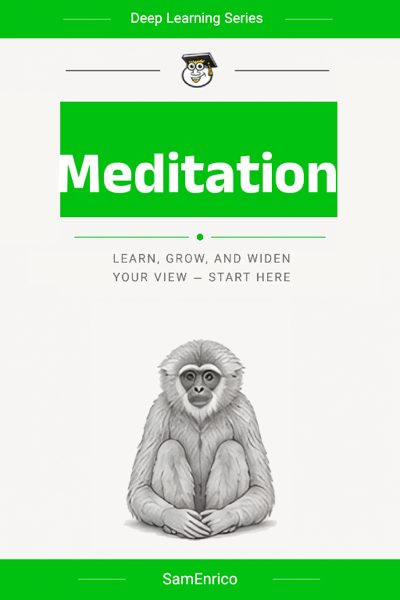
Non-FictionInformativeEducational
Meditation eBook
A Coursebook on Meditation
A Coursebook on Meditation
Formats
Free sample
Chapter 1: The Autopilot Epidemic--The phone buzzes. You glance at the screen. An email. A like. A headline about a disaster on the other side of the world.
You put the phone down, but your mind is no longer where it was a moment ago. You are somewhere else now—planning, remembering, worrying. This happens dozens, perhaps hundreds, of times each day. And you barely notice.This is the autopilot epidemic.You are not alone in this. Over the past two decades, the average human attention span has steadily declined.
One frequently cited study (though since debated) suggested it had fallen to eight seconds—less than that of a goldfish. Whether or not the number is precise, the lived experience is unmistakable. You sit down to read a single article. You make it three paragraphs before your hand reaches for your phone. You sit down to meditate—perhaps for the first time—and within seconds your mind has left the building entirely, chasing a memory from last week or a worry about tomorrow.The problem is not you.
The problem is the water you are swimming in.Modern life has been engineered, quite deliberately, to capture and fragment your attention. Social media platforms are designed by neuroscientists to deliver intermittent variable rewards—the same psychological mechanism that makes slot machines addictive. Email arrives in an endless, unpredictable stream. News cycles churn with outrage and urgency. Your boss expects instant responses.
Your children demand simultaneous attention. And your own biology, inherited from ancestors who needed to notice every rustle in the grass, conspires against you at every turn.You were not born distracted. You were trained to be.The Two Kinds of Attention Before we can repair something, we must understand how it works. Human attention is not a single, unified thing. Neuroscientists and cognitive psychologists have identified at least two distinct modes of attention, and understanding the difference between them is the first step toward reclaiming your mind.The first mode is directed attention.
This is what you use when you are solving a math problem, following a recipe, or listening carefully to a friend describe something important. Directed attention is effortful. It tires you out. It is governed by the prefrontal cortex, the most evolutionarily recent part of your brain. Directed attention is what you think of as "focusing"—and it is the mode that feels hardest to maintain in a world of constant interruptions.The second mode is stimulus-driven attention.
This is what happens when a loud noise makes you turn your head, or when a flashing notification pulls your eyes away from what you were reading. Stimulus-driven attention is automatic, effortless, and ancient. It is governed by older brain structures that evolved to keep you alive—to notice the predator in the tall grass, the sudden silence in the forest, the flicker of movement at the edge of your vision. Stimulus-driven attention is not something you choose. It is something that happens to you.Here is the problem: your phone, your email, your social media feeds, and your 24-hour news cycle have been optimized to trigger stimulus-driven attention as often as possible.
Each buzz, each notification, each red badge is a predator in the tall grass. Your brain cannot help but look. And every time you look, you are pulled out of directed attention and into reactive mode.Over time, your brain learns that stimulus-driven attention is more rewarding than directed attention. The neural pathways for sustained focus weaken from disuse. The neural pathways for distraction strengthen from constant exercise.
You are not becoming more distractible because you are lazy or weak-willed. You are becoming more distractible because your brain has been retrained—by your environment—to prefer the easy thrill of the notification over the difficult satisfaction of sustained thought.Mindfulness vs. Meditation: The Critical Distinction Now we must pause and define two terms that are often used interchangeably but mean very different things. Confusing them is like confusing the destination with the vehicle. You will not get where you are going if you do not know which is which.Mindfulness is the raw ability to be aware of what is happening, right now, without judgment.
It is not something you create. It is something you already possess, though it may be buried under layers of habit and distraction. Right now, as you read these words, you are aware of the page in front of you. You may also be dimly aware of the temperature of the room, the pressure of your body against the chair, the sound of a distant car or a nearby refrigerator hum. That awareness—that simple knowing of what is happening—is mindfulness.
It is innate. It is your birthright.Meditation is the structured training tool you use to build that muscle. If mindfulness is physical fitness, meditation is going to the gym. If mindfulness is speaking a foreign language fluently, meditation is the vocabulary drills and grammar exercises you practice until the language becomes natural. Meditation is not the goal.
Meditation is the method. The goal is a mind that rests naturally in awareness—not just on the cushion, not just during your daily sit, but while you are stuck in traffic, washing dishes, or enduring a difficult conversation.This distinction matters enormously because many people give up on meditation when they discover that it does not produce instant results. They sit down for ten minutes, their mind races, they feel no different afterward, and they conclude that meditation "does not work for them." This is like going to the gym once, lifting a few weights, feeling sore the next day, and concluding that exercise does not work. Of course it did not work. You have not trained yet.
The practice is the training.Throughout this book, we will be precise with these terms. When we say "mindfulness," we mean the quality of awareness itself. When we say "meditation," we mean the deliberate practice that cultivates that quality. And when we say "the autopilot epidemic," we mean the modern condition in which stimulus-driven attention has so thoroughly colonized your waking life that you rarely experience either directed attention or natural mindfulness at all.The Default Mode Network: Your Brain's Storyteller In the early 2000s, neuroscientists made a discovery that changed how we understand the distracted mind. Using functional magnetic resonance imaging (f MRI), they noticed that certain regions of the brain remained active even when subjects were doing nothing at all—lying in the scanner, resting, not given any task.
For years, researchers had treated this as "noise" in their data, something to be subtracted out. But eventually, they realized that this background activity was not noise at all. It was something fundamental.They called it the Default Mode Network, or DMN.The DMN is a collection of brain regions—including the medial prefrontal cortex, the posterior cingulate cortex, and the angular gyrus—that become active when your mind is not engaged in an external task. When you are doing something that requires focused attention (solving a puzzle, following a recipe, reading a book), the DMN quiets down. But the moment your mind is free to wander—the moment you finish your task, close your book…
This is the end of the free sample. Get the eBook to keep going. Buy now
About this book
Details
- Author
- Tripp Reynalda
- Publisher
- SamEnrico
- Language
- English
- Genre
- Non-Fiction, Informative, Educational
- Released
- 2026-06-02
- Pages (approx.)
- 134
- Available as
- eBook, Audiobook

Read better in the ZLOADR app
Your eBooks on your phone or tablet. Sign in with your SamEnrico account and start reading.
More by Tripp Reynalda
 IP Protection For BootstrapTripp Reynalda$11.99
 The Office Chair Stretch RoutineTripp Reynalda$11.99
 Presentation Persuasion SkillsTripp Reynalda$11.99
 Conflict Resolution Self WorthTripp Reynalda$11.99
 The Samurai of the Pitch: How a Japanese Tactician Revolutionized 18th-Century FootballTripp Reynalda$11.99
 How to Start a Bowling Alley Equipment Business (Beginners Guide)Tripp Reynalda$11.99
 Learn to Play the LangeleikTripp Reynalda$11.99
 LinkedIn Open to Work GuideTripp Reynalda$12.99
You may also like
 Hong Kong Handover 1997Dunn Johnnie$11.99
 Zumba For Postnatal Recovery CourseNeal Christian$11.99
 Zumba for BeginnersLadner Nikia$11.99
 YouTube Comment Mining GuideHumes Pandora$12.99
 Worry Box MeditationCarlin Rudy$11.99
 Workplace Stress MeditationNguyen Lynn$11.99
 Workplace Stress and Sleep RepairHawley Ivory$11.99
 Workplace Perfectionism CureDelaney Jeffry$11.99
 Workplace Injustice Anger GuideWallen Isabelle$11.99
 Work Addiction and Burnout LinkGreenwood Ester$11.99
 Women in Yoga and WellnessBeattie Galina$11.99
 Women in Stand Up ComedyChun Evangeline$11.99