
Non-FictionSelf-Help / Medication
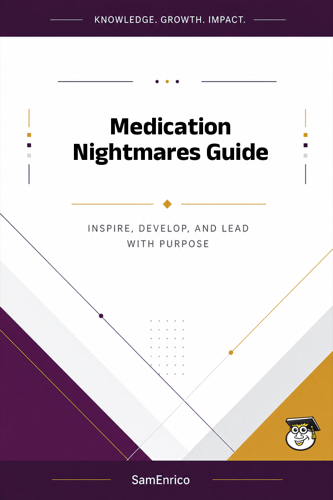
Medication Nightmares Guide eBook
undefined
by Loftin Bryce
undefined
Formats
Free sample
Chapter 1: The Swiss Cheese Killer...--The first time Linda watched her husband collapse in the driveway, she assumed he had tripped. He was fifty-four years old, reasonably fit, and had just finished mowing the lawn. The paramedics who arrived ten minutes later assumed the same thing. They checked his blood pressure, asked about dizziness, and helped him to the sofa. No one asked about his medications.
No one asked about the antibiotic he had started four days earlier for a routine sinus infection. No one mentioned the FDA's Black Box warning about tendon rupture, peripheral neuropathy, and permanent nerve damage. That night, David's Achilles tendon tore completely while he was walking to the bathroom. He has not walked without a cane since. The antibiotic was Levaquin.
The damage was permanent. And every single person who could have stopped it—the doctor who prescribed it without warning, the pharmacist who dispensed it without review, the paramedics who never asked—was acting within a system that makes these errors not just possible, but predictable.This chapter is not designed to scare you. It is designed to wake you up. Most people believe that medication errors happen to someone else—to the elderly, to the chronically ill, to those who are not paying attention. The truth is far more unsettling.
Medication nightmares happen because the healthcare system is built like Swiss cheese. No single slice has a hole large enough to cause harm on its own. But when the holes in the doctor's training, the pharmacist's workload, the nurse's exhaustion, and the patient's silence align perfectly, disaster reaches the bedside. The good news is that you can be the final slice. You can be the one who sees the alignment coming and stops it.The Illusion of Individual Villainy We are culturally conditioned to look for villains.
When a medication error makes headlines, we want to know which doctor was careless, which pharmacist was distracted, which drug company was greedy. This search for a single bad actor is comforting because it suggests that if we can just punish or avoid that person, we will be safe. The uncomfortable reality, supported by decades of patient safety research including the landmark Institute of Medicine report To Err Is Human (1999) and follow-up studies from Johns Hopkins, is that most medication errors are not the result of a single villainous doctor. They are the result of a fragmented, overloaded, and poorly designed system that sets even the most conscientious providers up for failure.Consider the typical chain of events that leads to a medication nightmare. A doctor works a twelve-hour shift, sees thirty patients back to back, and types a prescription into an electronic health record system with a drop-down menu that auto-suggests drugs with similar spellings.
The prescription is sent electronically to a pharmacy where a pharmacist fills three hundred prescriptions per shift, interrupted every four minutes by phone calls and insurance prior authorizations. The medication is dispensed in a bottle that looks identical to the patient's other three bottles. The patient takes the medication without reading the insert, assumes any unusual symptom is unrelated, and only calls for help when the damage is done. No one in this chain wakes up intending to cause harm. But every single person is operating within a system that makes error not an exception, but an expectation.The Swiss Cheese Model, developed by British psychologist James Reason in the 1990s, explains this phenomenon with elegant simplicity.
Imagine several slices of Swiss cheese stacked together. Each slice represents a layer of defense against error: the doctor's clinical judgment, the pharmacist's verification, the patient's own monitoring, the electronic alert system. Each slice has holes. Those holes represent weaknesses: fatigue, distraction, illegible handwriting, software glitches, communication failures. When the holes are scattered, the solid parts of each slice catch the errors from the previous slice.
But when the holes align—when the doctor is tired, the pharmacist is interrupted, the patient ignores the rash, and the electronic alert is dismissed as a false alarm—the error passes through every layer and reaches the patient.This is why blaming individual providers is both morally satisfying and practically useless. The same doctor who makes an error today may be perfectly safe tomorrow under different conditions. The same pharmacist who dispenses the wrong dose may be flawless for years before a single moment of interruption creates disaster. The system, not the individual, is the primary cause. But here is the critical nuance that this book will maintain from this chapter forward: while the system creates the conditions for error, the individuals within that system are still responsible when they ignore clear warnings or fail basic safety protocols.
A doctor who prescribes a drug despite a flagged allergy in the chart has committed individual negligence, not just a system error. A pharmacist who dispenses the wrong dose without verifying the pill imprint has made an individual mistake. Holding both truths simultaneously—that the system is broken and that individuals still bear responsibility—is the only path to real safety.The Alarming Scale of the Epidemic Before we dive into prevention strategies, it is essential to understand what you are up against. The numbers are not abstract statistics. They are mothers, fathers, siblings, and spouses.
According to a landmark analysis published in the Journal of the American Medical Association (JAMA) in 2016, adverse drug reactions are estimated to be the fourth leading cause of death in the United States, killing between 100,000 and 200,000 Americans annually. To put that in perspective, more people die each year from medication-related harm than from diabetes or Alzheimer's disease. Yet medication safety receives a fraction of the research funding and public attention given to those conditions.These deaths are not evenly distributed. The elderly are at highest risk. Adults over sixty-five account for approximately one-third of all outpatient prescriptions but two-thirds of all adverse drug reaction hospitalizations.
The reasons are multiple: age-related changes in liver and kidney function slow drug metabolism, polypharmacy (taking five or more medications) increases interaction risks, and cognitive decline can impair medication management. But the most disturbing statistic is also the most avoidable. According to a study published in BMJ Quality and Safety, approximately half of all adverse drug reactions are preventable. Half. That means fifty thousand to one hundred thousand deaths per year could be prevented with better systems, better communication, and better patient education.Beyond death, the toll of non-fatal medication nightmares is staggering.
Adverse drug reactions cause an estimated 1.3 million emergency department visits annually. They are responsible for nearly 10 percent of all hospital admissions in older adults. They prolong hospital stays, increase healthcare costs by billions of dollars, and leave countless patients with permanent injuries like tardive dyskinesia, peripheral neuropathy, and hearing loss. These are the nightmares that do not end with an emergency room discharge. They become new baselines, new realities, new limitations that patients carry for the rest of their lives.The financial cost is equally sobering.
The estimated annual cost of medication-related harm in the United States exceeds fifty billion dollars. This includes additional hospitalizations, longer stays, emergency department visits, outpatient follow-ups, rehabilitation, and long-term care. But the cost that cannot be calculated is…
This is the end of the free sample. Get the eBook to keep going. Buy now
About this book
Details
- Author
- Loftin Bryce
- Publisher
- SamEnrico
- Language
- English
- Genre
- Non-Fiction, Self-Help / Medication
- Released
- 2026-06-08
- Pages (approx.)
- 155
- Available as
- eBook, Audiobook

Read better in the ZLOADR app
Your eBooks on your phone or tablet. Sign in with your SamEnrico account and start reading.
More by Loftin Bryce
 Mobile App Data Leak ScriptsLoftin Bryce$11.99
 Mike Pompeo CIALoftin Bryce$11.99
 Legal Team ExhaustionLoftin Bryce$11.99
 The Monk Who Loved PlantsLoftin Bryce$11.99
 Reformation Zwingli Zurich Revolution GuideLoftin Bryce$11.99
 The TM Computer MantraLoftin Bryce$11.99
 IBS Relief Through MicrobiomeLoftin Bryce$11.99
 One Room for Seven PeopleLoftin Bryce$11.99
 The Silent Summit: María de la Cruz and the Forgotten Ascent of ChimborazoLoftin Bryce$11.99
 The Codebreakers of Bletchley: Cracking the EnigmaLoftin Bryce$11.99
 Echoes of the Last Broadcast: The Mysterious Signals of the S.O.S. from the Mary CelesteLoftin Bryce$11.99
 Supply Chain Optimization Using UAVsLoftin Bryce$11.99
You may also like
 Hong Kong Handover 1997Dunn Johnnie$11.99
 Zumba For Postnatal Recovery CourseNeal Christian$11.99
 Zumba for BeginnersLadner Nikia$11.99
 YouTube Comment Mining GuideHumes Pandora$12.99
 Worry Box MeditationCarlin Rudy$11.99
 Workplace Stress MeditationNguyen Lynn$11.99
 Workplace Stress and Sleep RepairHawley Ivory$11.99
 Workplace Perfectionism CureDelaney Jeffry$11.99
 Workplace Injustice Anger GuideWallen Isabelle$11.99
 Work Addiction and Burnout LinkGreenwood Ester$11.99
 Women in Yoga and WellnessBeattie Galina$11.99
 Women in Stand Up ComedyChun Evangeline$11.99