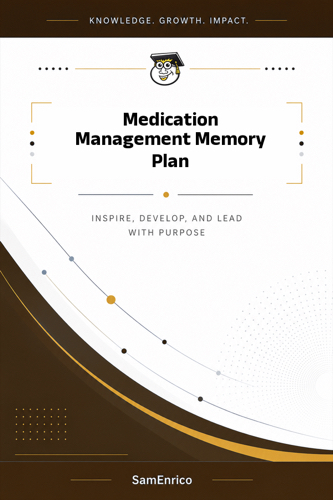
Medication Management Memory Plan eBook
Use blister packs, alarms, and checklists to avoid
by Rau Bryce
Use blister packs, alarms, and checklists to avoid missing doses due to forgetfulness.
Formats
Free sample
Chapter 1: The Forgetting Tax--–- Sarah was not confused. She was standing in her kitchen, coffee mug in hand, staring at a small amber vial on the counter. She had woken up early, taken her blood pressure medication—or so she thought. But now, two hours later, the vial was still full. Twenty-eight pills.
A full week's worth. She had done this before: walked to the bathroom, opened the bottle, tipped it toward her palm. The problem was that she could not remember whether any pill had actually landed in her mouth. The motion was automatic. The memory was blank.
Her cardiologist had warned her that uncontrolled hypertension would eventually damage her kidneys. Sarah was fifty-four years old, a retired school principal, and she was failing at the simple act of swallowing a tiny white tablet.She was not alone.Every morning, millions of people perform the same ritual. They open a bottle, they take a pill, they close the bottle. And then, anywhere from five minutes to five hours later, a cold whisper of doubt creeps in: Did I actually take it? For some, the doubt is resolved by finding an empty bottle or a missing pill from a weekly organizer.
For most, the doubt lingers. And for a shocking number, the doubt is resolved the wrong way—either by skipping a dose out of fear of doubling, or by taking a second dose out of fear of skipping. Both choices carry consequences. A missed blood pressure pill raises stroke risk for forty-eight hours. A doubled blood thinner can send a patient to the emergency room with internal bleeding.
The stakes could not be higher, yet the system that patients are given—a cheap plastic bottle with a childproof cap—has not changed in over fifty years.This book is built on a single, radical claim: You do not have a memory problem. You have a design problem.Human memory was never meant to track repetitive, time-based tasks. Our ancestors needed to remember where the river was (spatial memory), which berries caused vomiting (associative memory), and who in the tribe could be trusted (social memory). They did not need to remember to take a pill at 8:00 AM every day for forty years. That is not a failure of your brain; it is a mismatch between the task and the tool.
The solution is not to try harder, set more alarms, or feel guilty. The solution is to redesign your environment so that the right action happens without any conscious memory at all.This chapter introduces the concept that will guide the entire book: External Memory Cues. These are physical objects, sounds, locations, or actions placed in your environment that trigger behavior automatically. By the time you finish this book, you will have built a personalized system of External Memory Cues using blister packs, alarms, checklists, and environmental anchors. You will move from a state of constant doubt—did I take it?—to a state of quiet certainty.
You will know you took your pill because the foil is popped, the checklist is marked, and the blister pack is anchored to your toothbrush. You will not need to remember. You will have engineered remembering out of the equation.But first, we must understand the enemy. Not forgetfulness itself, but the hidden costs that forgetfulness extracts from your body, your mind, and your relationships.The Three Hidden Costs of Missed Doses Most people believe that missing a dose every now and then is no big deal. This belief is dangerous, and it is wrong.
Pharmaceutical adherence studies have shown that missing just 20% of doses—roughly one in five—can reduce a medication's effectiveness by over 50% for some chronic conditions. The relationship is not linear; it is exponential. A medication designed to be taken daily loses its therapeutic effect when the blood concentration dips below a certain threshold. Each missed dose creates a trough, and each trough requires two to three consecutive on-time doses to recover. In practical terms, missing one dose means your next three days of perfect adherence are merely catching up, not moving forward.The first hidden cost is clinical progression.
Blood pressure medications, statins, diabetes drugs, and antidepressants all rely on steady-state concentrations. Miss a dose of metformin, and your blood sugar spikes within hours. Miss a dose of levodopa for Parkinson's, and your motor symptoms return within minutes. For anticonvulsants, a single missed dose can trigger a breakthrough seizure. Patients are rarely told this.
They are handed a prescription and a bottle and told to "take as directed." No one explains that missing Tuesday's pill undoes Monday's gain.The second hidden cost is psychological. The constant low-grade anxiety of not knowing—did I take it?—creates what researchers call "adherence fatigue." You check the bottle once, then twice, then a third time. You count the remaining pills against the calendar. You ask your spouse, "Did you see me take my meds this morning?" You develop small superstitions: turning the bottle upside down after taking a dose, tapping it twice on the counter, saying the time out loud. These are not solutions; they are coping mechanisms that work inconsistently and fail entirely under stress.
The mental energy spent worrying about pills is energy not spent on your work, your family, or your life.The third hidden cost is social. Family members become de facto medication police. The well-intentioned question—"Did you take your pills?"—lands as an accusation. Patients feel infantilized; caregivers feel ignored. Relationships fray not because anyone is careless, but because the system forces one person to monitor another's memory.
This is not a sustainable dynamic, and it is entirely preventable. When the environment is designed correctly, no one has to ask. Everyone can see.Why Your Memory Is Not Broken To understand why traditional pill bottles fail, we must understand two different types of memory: event-based memory and time-based memory.Event-based memory is triggered by a change in your environment. You walk into a room and see a wet umbrella, which reminds you that it is raining, which reminds you to close the car windows. You hear the oven timer beep, which reminds you to take out the bread.
You see your child's backpack by the door, which reminds you to sign the permission slip. These cues are external, specific, and usually effective. Your brain evolved for this kind of memory because the environment was rich with triggers.Time-based memory is different. It requires you to initiate an action at a specific clock time without any external trigger. "Take your pill at 8:00 AM" is a time-based task.
Nothing in your environment at 7:59 AM signals that a pill is due. The coffee maker does not know. The sunrise does not care. The only cue is an internal sense of time, which is notoriously unreliable, especially when you are distracted, tired, or stressed. Time-based memory fails constantly, and that is not a personal flaw—it is a species-wide limitation.Here is the crucial insight: pill-taking is a time-based task that can be converted into an event-based task.
You cannot make your brain better at tracking clock time, but you can redesign your environment to supply the missing…
This is the end of the free sample. Get the eBook to keep going. Buy now
About this book
Details
- Author
- Rau Bryce
- Publisher
- SamEnrico
- Language
- English
- Genre
- Non-Fiction, Self-Help, Medication Adherence
- Released
- 2026-06-09
- Pages (approx.)
- 139
- Available as
- eBook, Audiobook

Read better in the ZLOADR app
Your eBooks on your phone or tablet. Sign in with your SamEnrico account and start reading.
More by Rau Bryce
 The Forgiveness VisualizationRau Bryce$11.99
 Autumn Leaf GuideRau Bryce$11.99
 Body Scan for Chronic Pain ReliefRau Bryce$11.99
 Journaling for Sobriety GuideRau Bryce$11.99
 Flying High: The Rivalry That Lifted Badminton to New HeightsRau Bryce$11.99
 College Essay Anxiety FixRau Bryce$12.99
 Ingersoll Rand SWOTRau Bryce$12.99
 Understanding Nonvenereal Endemic SyphilisRau Bryce$17.99
 Risk SpecialistRau Bryce$11.99
 How to Start a Cachous Business (Beginners Guide)Rau Bryce$11.99