
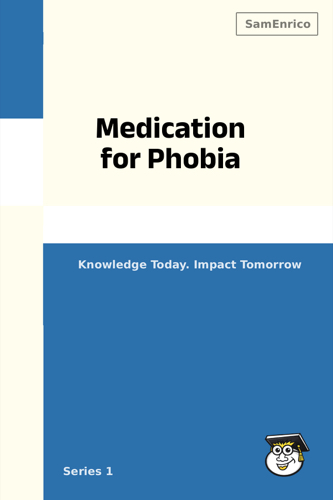
Medication for Phobia eBook
Use SSRIs or benzodiazepines temporarily alongside
Use SSRIs or benzodiazepines temporarily alongside exposure therapy when needed.
Formats
Free sample
Chapter 1: The Two Languages--–- Sarah had been standing in the airport parking lot for forty-seven minutes. Her suitcase rested against her left leg. Her boarding pass glowed on her phone screen. Gate B17. Departure in ninety-three minutes.
She had taken the week off work. She had packed carefully. She had driven two hours to get here. And now she could not move.Her heart was not racing. That was the strange part.
She had expected the pounding chest, the sweating palms, the shortness of breath that everyone described when they talked about panic. Instead, her heart felt slow and heavy, as if it were made of wet cement. Her legs felt disconnected from her body. Her vision had narrowed to a tunnel, and at the end of that tunnel was the sliding glass door that led to security, and beyond that door was the airplane, and beyond the airplane was the sky, and beyond the sky was everything she wanted—a promotion that required travel, a sister's wedding across the country, a life not constrained by a fear she could not explain to anyone who did not share it.Her husband had tried to help. "Just breathe," he had said.
She had wanted to throw her phone at him. Not because she was angry at him, but because she had already tried breathing. She had tried positive affirmations. She had tried visualization. She had tried imagining the plane as a bus, as a train, as a magic carpet.
None of it worked because none of it addressed what was actually happening inside her nervous system.Sarah did not know it yet, but she was standing at the intersection of two very different languages of fear. One language was biological, ancient, and fast. The other was learned, behavioral, and slow. They were speaking over each other, and until she learned to distinguish them, no amount of willpower or breathing or positive thinking would get her through that sliding glass door.This chapter is for Sarah. And for you.
And for everyone who has ever been told to "just calm down" by someone who did not understand that your amygdala does not take orders from your prefrontal cortex.The Great Misconception: It's Not "All in Your Head" (Or Just a Chemical Imbalance)There are two dominant myths about phobias in popular culture, and both are wrong. The first myth is that phobias are purely psychological—that if you just thought differently, or tried harder, or had more willpower, you could simply decide not to be afraid. This myth is perpetuated by well-meaning people who have never experienced a true phobia. They see a person afraid of spiders and think, "It's just a tiny creature. Why can't they see that?" What they do not understand is that the person with the phobia already knows the spider is tiny.
They already know it cannot hurt them. That knowledge lives in their prefrontal cortex, the rational part of the brain. But knowledge does not equal safety. The fear lives somewhere else entirely.The second myth is the opposite: that phobias are purely chemical—that your brain is simply "broken" and needs medication to fix it. This myth is perpetuated by pharmaceutical advertising and by doctors who have fifteen minutes to write a prescription.
The message is: take this pill, and your fear will go away. But anyone who has tried this knows that the pill does not make the fear disappear. It might dull the edge. It might make panic attacks less frequent. But the phobia remains, waiting beneath the surface like a dormant virus.
When the medication stops, the fear returns—often stronger than before, because while you were taking the pill, you were not learning anything new.Both myths share the same fatal flaw. They assume that fear speaks only one language. In reality, fear speaks two languages simultaneously, and they are not the same. One is biological. One is learned.
They interact constantly. And until you understand both, you will keep trying solutions that target the wrong language and wondering why they do not work.Language One: The Biological Fear Response (The Amygdala's Panic Button)Deep inside your brain, tucked beneath the cortex like a small almond-shaped secret, lives the amygdala. Its job is simple and ancient: detect threats and respond faster than conscious thought. The amygdala does not reason. It does not debate.
It does not wait for evidence. It reacts.Here is how fast the amygdala works. Imagine you are walking on a forest path and you see a long, curved shape on the ground in front of you. Within milliseconds—literally too fast for you to consciously register what you have seen—your amygdala has already released stress hormones. Your heart rate increases.
Your breathing quickens. Your pupils dilate. Blood rushes to your large muscle groups. Your digestive system shuts down. Your body is preparing to fight or flee before your brain has even identified the shape as a snake.Now imagine that the shape turns out to be a stick.
Your prefrontal cortex—the rational, thinking part of your brain—takes a few hundred milliseconds longer to process this information. It sends a signal to the amygdala: false alarm. Stand down. Your heart rate begins to return to normal. You laugh at yourself for being afraid of a stick.
The entire sequence, from the moment you saw the shape to the moment you laughed, took less than two seconds.This system is brilliant. It has kept humans alive for hundreds of thousands of years. The ancestors who stopped to ask "Is that a snake or a stick?" were eaten by snakes. The ancestors who jumped first and asked questions later survived to pass on their jumpy genes. You are descended from the jumpy ones.The problem arises when the amygdala learns to see threats where none exist.
This is not a failure of the amygdala. It is a failure of the learning system that is supposed to update the amygdala's threat database. In a healthy brain, when you encounter a stick enough times without being harmed, the amygdala gradually stops reacting. It learns. It updates.
But in a phobic brain, that updating process breaks down. The amygdala keeps sounding the alarm for spiders, for heights, for elevators, for flying, for public speaking—even when the rational part of the brain is shouting, "It's just a stick!"This is why you cannot "think" your way out of a phobia. By the time your prefrontal cortex has formed the sentence "This spider is not dangerous," your amygdala has already flooded your body with adrenaline. Your heart is already pounding. Your hands are already shaking.
Your rational knowledge arrives too late, like a firefighter showing up after the house has burned down.Language Two: The Learned Behavioral Pattern (The Avoidance Loop)If the biological fear response is the engine, the learned behavioral pattern is the steering wheel. And most people with phobias have been steering directly into the wall for years without realizing it.Here is how the avoidance loop works. You are afraid of something—let us say elevators. One day you have to take an elevator to a tenth-floor meeting. You step…
This is the end of the free sample. Get the eBook to keep going. Buy now
About this book
Details
- Author
- Tavares Noelia
- Publisher
- SamEnrico
- Language
- English
- Genre
- Non-Fiction, Health & Wellness
- Released
- 2026-06-09
- Pages (approx.)
- 143
- Available as
- eBook, Audiobook

Read better in the ZLOADR app
Your eBooks on your phone or tablet. Sign in with your SamEnrico account and start reading.
More by Tavares Noelia
 Channel Islands Boating LostTavares Noelia$11.99
 Private Investigator Stress GuideTavares Noelia$11.99
 Research Proposal for Knight Hennessy ScholarshipTavares Noelia$11.99
 Supply Shocks ManagementTavares Noelia$11.99
 Art School Critique Stress GuideTavares Noelia$11.99
 Cricket Batting HypnosisTavares Noelia$11.99
 Sales Talent Migration GuideTavares Noelia$11.99
 Van Morrison: Brown Eyed Girl, Blue Eyed SoulTavares Noelia$11.99
 The Golden Minds of the Nile: Black Nobel Laureates in ScienceTavares Noelia$11.99
 The Drowned Lullaby: The Lost Children of the SS City of AdelaideTavares Noelia$11.99
 Ultimate Handbook Guide to Louisville : (United States) Travel GuideTavares Noelia$11.99
 LinkedIn Advanced Search GuideTavares Noelia$12.99
You may also like
 Hong Kong Handover 1997Dunn Johnnie$11.99
 Zumba For Postnatal Recovery CourseNeal Christian$11.99
 Zumba for BeginnersLadner Nikia$11.99
 YouTube Comment Mining GuideHumes Pandora$12.99
 Worry Box MeditationCarlin Rudy$11.99
 Workplace Stress MeditationNguyen Lynn$11.99
 Workplace Stress and Sleep RepairHawley Ivory$11.99
 Workplace Perfectionism CureDelaney Jeffry$11.99
 Workplace Injustice Anger GuideWallen Isabelle$11.99
 Work Addiction and Burnout LinkGreenwood Ester$11.99
 Women in Yoga and WellnessBeattie Galina$11.99
 Women in Stand Up ComedyChun Evangeline$11.99