

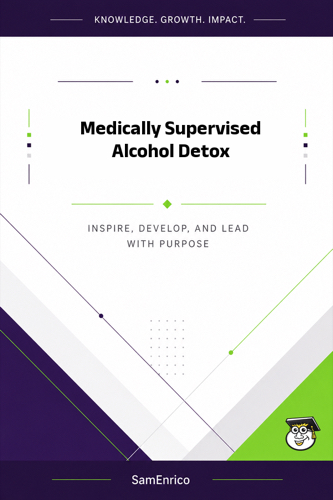
Non-FictionHealth & WellnessAddiction Medicine
Medically Supervised Alcohol Detox Audiobook
Explains clinical protocols for safe alcohol withd
Explains clinical protocols for safe alcohol withdrawal including symptom management and seizure prevention.
Formats
Free sample
Chapter 1: The Kindling Fire...--Alcohol withdrawal does not follow the logic of other dependencies. A heroin user who detoxes ten times faces the same physiological challenge on the tenth attempt as on the first. The same cannot be said for alcohol. Each withdrawal from alcohol fundamentally rewires the brain, making the next withdrawal more dangerous, more explosive, and more likely to kill. This phenomenon, known as the kindling effect, is the single most important concept in medically supervised detoxification, yet it remains virtually unknown outside of addiction medicine and neurology.
Understanding kindling is not academic—it is the difference between recognizing a patient in mild distress and predicting a seizure fifteen minutes before it happens.The term "kindling" comes from a simple observation in epilepsy research. In the 1960s, neuroscientist Graham Goddard discovered that if he delivered a weak electrical stimulus to a rat's brain—too weak to cause a seizure on its own—nothing happened the first time. But if he repeated that same weak stimulus day after day, something remarkable occurred. Around the tenth or fifteenth repetition, that previously harmless stimulus suddenly triggered a full-blown seizure. The brain had become sensitized.
The repeated, sub-threshold insults had "kindled" a seizure focus, lowering the threshold until the brain could no longer contain the electrical storm.Alcohol withdrawal operates on the exact same principle. Each detoxification episode—each time the brain is suddenly deprived of alcohol after a period of heavy use—acts like that weak electrical stimulus. Alone, any single withdrawal might be manageable. But the tenth withdrawal? The twentieth?
The brain has learned to seize. The seizure threshold has dropped permanently. And unlike the rat in Goddard's laboratory, the human patient arrives with a history that no one bothered to ask about.The Neurochemistry of Dependence To understand why kindling occurs, one must first understand what alcohol does to the brain during active use. Alcohol is a central nervous system depressant. It binds primarily to GABA-A receptors, the brain's primary inhibitory neurotransmitter system.
When alcohol binds to these receptors, it enhances their activity, allowing more chloride ions to flow into the neuron. This hyperpolarizes the cell, making it harder to fire. The result is sedation, reduced anxiety, muscle relaxation, and—at sufficient doses—respiratory depression and unconsciousness.The brain, however, is a homeostatic organ. It does not tolerate prolonged deviation from its set points. When alcohol floods the GABA system day after…
This is the end of the free sample. Get the Audiobook to keep going. Buy now
About this book
Details
- Author
- Guillory Odell
- Publisher
- SamEnrico
- Language
- English
- Genre
- Non-Fiction, Health & Wellness, Addiction Medicine
- Released
- 2026-06-07
- Pages (approx.)
- 156
- Available as
- eBook, Audiobook

Listen in the VoxFlicks app
Audiobooks and audio dramas wherever you go. Sign in with your SamEnrico account and press play.
More by Guillory Odell
 Toddler Transition TimerGuillory Odell$11.99
 SRS for Professional ExamsGuillory Odell$11.99
 Epigenetics of Depression GuideGuillory Odell$11.99
 Control Fallacy Anger WorkGuillory Odell$11.99
 Natural Movement For LongevityGuillory Odell$11.99
 Small Animal Loss GuideGuillory Odell$11.99
 Interpersonal TherapyGuillory Odell$11.99
 Whispers of the Underground: The Secret Network of Black Train PortersGuillory Odell$11.99
 Thomas Gainsborough's Brush with the World: The Birth of Portrait PhotographyGuillory Odell$11.99
 Service Providers Guide to Solar Panel InstallationGuillory Odell$11.99
 How to Produce Tilt SkilletsGuillory Odell$11.99
 How to Produce HumusGuillory Odell$11.99
You may also like
 Hong Kong Handover 1997Dunn Johnnie$11.99
 Zumba For Postnatal Recovery CourseNeal Christian$11.99
 Zumba for BeginnersLadner Nikia$11.99
 YouTube Comment Mining GuideHumes Pandora$12.99
 Worry Box MeditationCarlin Rudy$11.99
 Workplace Stress MeditationNguyen Lynn$11.99
 Workplace Stress and Sleep RepairHawley Ivory$11.99
 Workplace Perfectionism CureDelaney Jeffry$11.99
 Workplace Injustice Anger GuideWallen Isabelle$11.99
 Work Addiction and Burnout LinkGreenwood Ester$11.99
 Women in Yoga and WellnessBeattie Galina$11.99
 Women in Stand Up ComedyChun Evangeline$11.99