
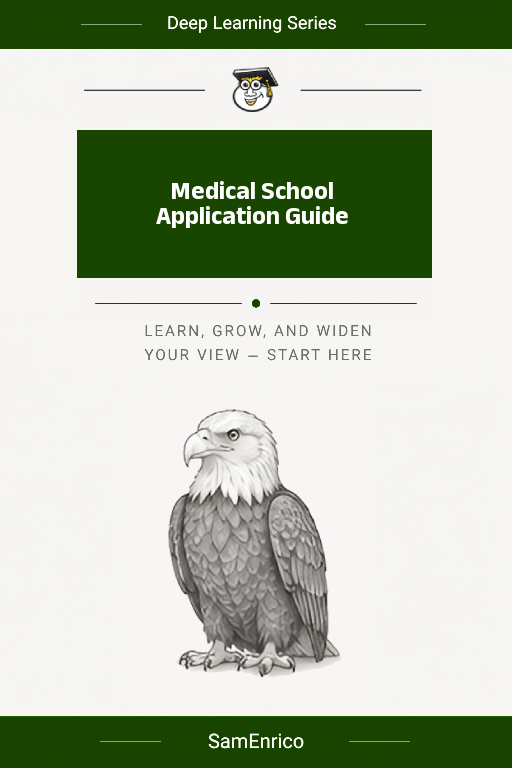
Medical School Application Guide eBook
Navigate UK UCAT, US MCAT, and Australian GAMSAT r
Navigate UK UCAT, US MCAT, and Australian GAMSAT requirements for international students applying to medical programs abroad.
Formats
Free sample
Chapter 1: The Wrong Playbook--–- The email arrived at 3:47 AM in Mumbai. Priya, a third-year biochemistry student at a prestigious Indian university, had been awake for hours, refreshing her inbox every few minutes. She had applied to medical schools in three countries: the United Kingdom, the United States, and Australia. She had taken three different entrance exams: the UCAT, the MCAT, and the GAMSAT. She had spent two years preparing, thousands of dollars on applications, and countless sleepless nights worrying.
Her parents had mortgaged their home to fund her dream. Her younger brother had deferred his own college plans. The weight of her family’s sacrifice pressed down on her shoulders with every passing minute of silence from her laptop.She had done everything right. At least, that was what every premed advisor had told her. She had volunteered at a hospital in Mumbai for 200 hours.
She had shadowed a cardiologist for three months. She had maintained a first-class GPA. She had scored well on all three entrance exams. She had written what she thought was a compelling personal statement about her grandmother’s death from a preventable disease. She had followed the premed playbook exactly as it was written.And now, finally, the first decision was here.
She opened the email with trembling hands. Her eyes scanned the screen. "We are pleased to offer you a conditional offer of admission..." Priya screamed. Her parents ran into the room. Her roommate started crying.
After all the uncertainty, all the sacrifice, all the navigating of three different systems in three different countries, she was going to be a doctor. But here is what Priya did not know: she had gotten lucky. For every Priya who succeeded by following the standard playbook, ten others failed. Not because they were not smart enough or dedicated enough, but because they were playing by the wrong rules.The Great International Premed Myth There is a myth that circulates among international students applying to medical schools abroad. It is whispered in online forums, repeated by well-meaning advisors, and reinforced by the success stories of a fortunate few.
The myth is this: if you follow the same playbook as domestic students, you will succeed. Get good grades. Take the entrance exams. Volunteer at a hospital. Shadow a doctor.
Write a personal statement about wanting to help people. Apply broadly. Wait for the acceptances to roll in.This is a lie.The domestic premed playbook was written for students who are competing in a different pool, with different rules, different timelines, and different expectations. Domestic students in the UK apply through UCAS with A-levels. Domestic students in the US apply through AMCAS with a bachelor’s degree.
They compete for seats that are reserved for them. They are judged against their peers, not against a global pool of thousands of international applicants.You are not competing against domestic students. You are competing against other international students. And the rules of that competition are different.Let me say that again, because it is the single most important sentence in this entire book: you are not competing against domestic students. You are competing against other international students.
The domestic student with a 3.5 GPA and a 505 MCAT might get into their state school. That same application from an international student will be rejected before anyone reads the personal statement. You are in a different pool, and the pool is smaller, deeper, and more competitive.The Myth of Meritocracy The hardest truth that international students must accept is that medical school admissions are not purely meritocratic. They are not even close. Medical schools have missions.
Those missions usually involve serving the local population. A medical school in Texas exists primarily to train doctors who will practice in Texas. A medical school in London exists primarily to train doctors who will practice in the NHS. A medical school in Sydney exists primarily to train doctors who will practice in Australia.International students are, by definition, not local. You do not count toward the school’s mission.
You do not fill a workforce need. You are, in many ways, an afterthought. This is not fair. But it is reality.The numbers are stark. In the United States, public medical schools admit so few international students that many publish statistics like "fewer than 1% of our incoming class are international." Some public schools admit zero international students.
Private schools are more friendly, but even there, the acceptance rate for international applicants is a fraction of the rate for domestic applicants. In the UK, international students face higher tuition, stricter visa requirements, and a separate application pool with fewer seats. In Australia, international students compete for a limited number of seats that are often capped by government regulations.Does this mean you should give up? Absolutely not. Thousands of international students matriculate every year.
They succeed because they understand the reality of the system and adapt to it. They do not waste time applying to schools that never accept international students. They do not follow a playbook written for domestic applicants. They have their own playbook. This book is that playbook.The Three Testing Pathways: A Primer Before we go further, you need to understand the testing landscape.
This book covers three major entrance exams, each used in different countries for different types of programs.The UCAT (University Clinical Aptitude Test) is used for undergraduate medical programs in the UK, Australia, and New Zealand. It is a two-hour computer-based test that assesses aptitude, not knowledge. It has five sections: Verbal Reasoning, Decision Making, Quantitative Reasoning, Abstract Reasoning, and Situational Judgment. You do not need to memorize facts. You need to practice speed and pattern recognition.
You typically take the UCAT in the summer before your application year.The MCAT (Medical College Admission Test) is used for all medical programs in the United States and Canada. It is a seven-and-a-half-hour exam that tests knowledge of natural sciences, critical analysis, and reasoning skills. It has four sections: Biological and Biochemical Foundations, Chemical and Physical Foundations, Psychological and Social Foundations, and Critical Analysis and Reasoning Skills (CARS). You need to study specific content from undergraduate courses in biology, chemistry, physics, psychology, and sociology. You typically take the MCAT in the year before you plan to matriculate.The GAMSAT (Graduate Medical School Admissions Test) is used for graduate-entry medical programs in Australia, the UK, and Ireland.
It is a five-and-a-half-hour exam that tests reasoning in the humanities, social sciences, and biological and physical sciences. It has three sections: Reasoning in Humanities and Social Sciences (reading comprehension and interpretation), Written Communication (two essays), and Reasoning in Biological and Physical Sciences (scientific reasoning). You need broad knowledge and strong reasoning skills, but less specific content knowledge than the MCAT.Most international students will take only one of these tests. If you are applying to the UK only, take the UCAT. If you are applying to Australia for undergraduate programs, take the UCAT.
If you are applying to the US, take the MCAT. Only take multiple tests if you have a specific, compelling reason to apply to multiple countries. Chapter 2 will help you decide.Why You Are Here You are reading this book for…
This is the end of the free sample. Get the eBook to keep going. Buy now
About this book
Details
- Author
- Tijerina Allene
- Publisher
- SamEnrico
- Language
- English
- Genre
- Non-Fiction, Student's Shortcut
- Released
- 2026-06-01
- Pages (approx.)
- 122
- Available as
- eBook, Audiobook

Read better in the ZLOADR app
Your eBooks on your phone or tablet. Sign in with your SamEnrico account and start reading.
More by Tijerina Allene
 IBS Bloating Relief GuideTijerina Allene$11.99
 Francis Crusade CritiqueTijerina Allene$11.99
 Purpose After AddictionTijerina Allene$11.99
 Fun Icebreaker ActivitiesTijerina Allene$11.99
 Parent Daily Shutdown RoutineTijerina Allene$11.99
 Space Station Shift SleepTijerina Allene$11.99
 GLP 1 Medications GuideTijerina Allene$11.99
 Catherine French Revolution ReactionTijerina Allene$11.99
 Leaping Into the Void: The Birth of Wingsuit Flying in the Southern SkiesTijerina Allene$11.99
 Nefertiti's Lost Voice: The Silent Pharaoh's CurseTijerina Allene$11.99
 Service Providers Guide to Assisted LivingTijerina Allene$11.99
 A Collector's Handbook to the Hudson Great EightTijerina Allene$11.99
You may also like
 Hong Kong Handover 1997Dunn Johnnie$11.99
 Zumba For Postnatal Recovery CourseNeal Christian$11.99
 Zumba for BeginnersLadner Nikia$11.99
 YouTube Comment Mining GuideHumes Pandora$12.99
 Worry Box MeditationCarlin Rudy$11.99
 Workplace Stress MeditationNguyen Lynn$11.99
 Workplace Stress and Sleep RepairHawley Ivory$11.99
 Workplace Perfectionism CureDelaney Jeffry$11.99
 Workplace Injustice Anger GuideWallen Isabelle$11.99
 Work Addiction and Burnout LinkGreenwood Ester$11.99
 Women in Yoga and WellnessBeattie Galina$11.99
 Women in Stand Up ComedyChun Evangeline$11.99