
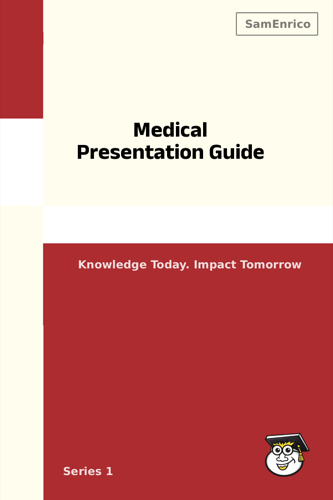
Free sample
Chapter 1: The Cognitive Crisis...–- Every year, thousands of brilliant medical discoveries die not in the laboratory, not in peer review, and not in clinical trials. They die in conference rooms, lecture halls, and Zoom calls. A groundbreaking immunotherapy regimen that could save hundreds of lives per year is presented to a sleepy tumor board at 7:45 AM on a Friday. A Nobel-worthy insight into disease progression is buried under seventeen bullet points on a single slide. A surgical innovation that reduces post-operative complications by forty percent is forgotten before the question period begins.This is not a failure of science.
It is a failure of communication. And it is a crisis unfolding quietly in every medical institution across the world.The problem is not that medical professionals lack intelligence, passion, or important data. The problem is that almost no one has ever taught them how to present that data effectively. Medical education excels at teaching what to say but remains catastrophically deficient at teaching how to say it. The result is a global misalignment between the quality of medical research and the quality of medical presentations.Consider this uncomfortable truth: a typical physician will spend over 10,000 hours learning to interpret a Kaplan-Meier curve but exactly zero hours learning how to present one.
A surgeon will complete 1,000 supervised procedures before operating independently but will give a hundred grand rounds presentations without a single minute of structured feedback on delivery. A researcher will spend six months perfecting a manuscript for a high-impact journal but sixty minutes throwing together slides for a major international conference.The consequences are not merely aesthetic. They are clinical, educational, and professional. A poorly presented trial result may lead colleagues to dismiss a therapy that could benefit their patients. A confusing lecture may leave medical students with fundamental misconceptions that persist through training.
An underwhelming job talk may cost a brilliant young investigator a faculty position that should have been theirs.This chapter diagnoses the underlying causes of this crisis. It introduces the core psychological framework—Cognitive Load Theory—that explains why most medical presentations fail. It presents the foundational tool that will transform every presentation you ever give: the discipline of distilling your entire talk into a single, memorable sentence. And it establishes the principles that will be applied throughout the remaining eleven chapters of this book.But first, we must understand why brilliant people give terrible presentations. The answer, it turns out, has less to do with nerves or lack of preparation than with a fundamental misunderstanding of how the human brain processes information.The Redundancy Effect: Why Reading Your Slides Destroys Learning Let us begin with an experiment.
Imagine you are attending a medical conference. You are seated in a dimly lit room, slightly jet-lagged, having consumed too much coffee. The presenter advances to a slide. On that slide are twelve bullet points. The presenter turns to the screen, points at the first bullet point, and reads it aloud.
Then the second. Then the third.You have witnessed this scene hundreds of times. You may have perpetrated it yourself. And here is what the cognitive science literature tells us with remarkable consistency: when a speaker reads text verbatim that is also displayed on a slide, audience retention drops by more than fifty percent compared to a presentation where the speaker talks around a visual image without reading it.This is called the Redundancy Effect. It was first described by cognitive psychologist John Sweller in the 1980s as part of his Cognitive Load Theory, and it has been replicated in dozens of studies across multiple domains, including medical education.
The mechanism is straightforward but counterintuitive: the human brain has separate processing channels for visual information (what you see) and auditory information (what you hear). When those two channels receive identical information simultaneously—the same words on the screen and through the speaker's voice—the brain does not double-learn. Instead, it experiences interference. It must cross-reference the two streams, checking for discrepancies, and in doing so, wastes precious cognitive resources that should be devoted to understanding and retention.Think of it this way: your working memory is not an infinite reservoir. It is a small desk.
On that desk, you can hold approximately three to five pieces of information at any given moment. When you read a bullet point while simultaneously listening to the speaker read that same bullet point, that piece of information takes up two spots on the desk—one for the visual representation, one for the auditory—without adding any new understanding. You have effectively halved your available mental workspace for no benefit.The medical context makes this problem particularly severe. Medical data is inherently complex. A single slide showing a forest plot from a meta-analysis may contain dozens of individual data points, confidence intervals, heterogeneity statistics, and subgroup analyses.
Even under ideal conditions, that slide imposes a high cognitive load. Add redundant text that the presenter reads aloud, and you have not just filled the desk—you have buried it under papers, spilled coffee, and a ringing phone.Yet the Redundancy Effect persists in medical presentations because of a well-intentioned but misguided belief: that slides should function as handouts. Clinicians reason, "If I put all the text on the slide, then even if someone zones out, they can read it later." This logic treats the presentation as a document rather than a live experience. But a presentation is not a document. A document is read privately, at the reader's own pace, with the ability to re-read and reflect.
A presentation is watched publicly, at the presenter's pace, with no rewind button. Trying to make a presentation function as both is like trying to make a bicycle function as both a vehicle and a piece of furniture. You end up with something that does neither well.The solution, which we will develop throughout this book, begins with a simple rule that you should memorize and repeat before every presentation you ever build: never put on a slide any sentence that you intend to speak aloud. If the words are coming out of your mouth, they should not also appear on the screen. The screen is for visuals—images, diagrams, graphs, single words, short phrases—that supplement and enhance your spoken narrative, not duplicate it.Intrinsic Versus Extraneous Cognitive Load: The Two Enemies of Understanding To understand why medical presentations fail, we must distinguish between two types of cognitive load: intrinsic and extraneous.
This distinction, also from Sweller's work, is essential for every decision you will make about slide design, narrative structure, and delivery pacing throughout this book.Intrinsic cognitive load is the unavoidable mental effort required to understand the content itself. A presentation on the management of status epilepticus has a high intrinsic load because the condition is complex, the treatment algorithm involves multiple drugs with specific dosing and timing, and the consequences of error are severe. A presentation on hand hygiene compliance has a lower intrinsic load because the core concept—wash your hands—is simple, even if the implementation details require attention. You cannot eliminate intrinsic load. It is the inherent difficulty of the topic.
Your job as a presenter is not to remove it but to manage it so that your audience has enough…
This is the end of the free sample. Get the eBook to keep going. Buy now
About this book
Details
- Author
- Laman Granville
- Publisher
- SamEnrico
- Language
- English
- Genre
- Non-Fiction, Self-Help / Medical
- Released
- 2026-06-06
- Pages (approx.)
- 136
- Available as
- eBook, Audiobook

Read better in the ZLOADR app
Your eBooks on your phone or tablet. Sign in with your SamEnrico account and start reading.
More by Laman Granville
 Nightmare Processing MedicationLaman Granville$11.99
 Cognitive Restructuring DiaryLaman Granville$11.99
 Fiverr Gig Video Production GuideLaman Granville$11.99
 The Elevator InductionLaman Granville$11.99
 Mnemonic Number Person SystemLaman Granville$11.99
 Hormone Therapy GuideLaman Granville$11.99
 Armenian Rug Restorer In LALaman Granville$11.99
 The Iron King: Andrew Carnegie and the Rise of American IndustryLaman Granville$11.99
 Peters the Great: Forge of an Empire - The Battle of PoltavaLaman Granville$11.99
 How to Produce Non-shrinkLaman Granville$11.99
 How to Produce Anti-infective DrugsLaman Granville$11.99
 Growing CarludovicaLaman Granville$11.99
You may also like
 Hong Kong Handover 1997Dunn Johnnie$11.99
 Zumba For Postnatal Recovery CourseNeal Christian$11.99
 Zumba for BeginnersLadner Nikia$11.99
 YouTube Comment Mining GuideHumes Pandora$12.99
 Worry Box MeditationCarlin Rudy$11.99
 Workplace Stress MeditationNguyen Lynn$11.99
 Workplace Stress and Sleep RepairHawley Ivory$11.99
 Workplace Perfectionism CureDelaney Jeffry$11.99
 Workplace Injustice Anger GuideWallen Isabelle$11.99
 Work Addiction and Burnout LinkGreenwood Ester$11.99
 Women in Yoga and WellnessBeattie Galina$11.99
 Women in Stand Up ComedyChun Evangeline$11.99