
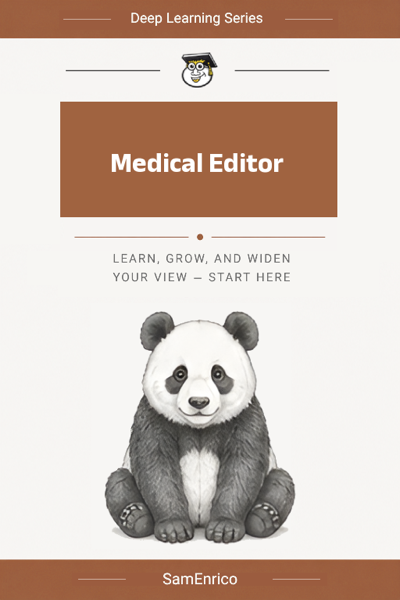
Non-FictionInformativeEducational
Medical Editor eBook
A Coursebook on Medical Editor
A Coursebook on Medical Editor
Formats
Free sample
Chapter 1: The Last Line...--In the summer of 2010, a 47-year-old woman named Carol walked into her oncologist’s office for routine follow-up after completing chemotherapy for stage III ovarian cancer. She had endured six cycles of carboplatin and paclitaxel. She had lost her hair, weathered the nausea, and missed her daughter’s school play. She was told she had a 65 percent chance of remaining cancer-free for five years. That number came from a landmark study published just eighteen months earlier in the Journal of Clinical Oncology — a study that claimed to have identified a genetic signature that predicted chemotherapy response with 94 percent accuracy.
Carol’s tumor carried that signature. Her oncologist prescribed the standard regimen based on that paper. Eight months later, Carol’s cancer returned. She died in 2012. She never knew that the study her treatment relied upon had been retracted for a single statistical error.
She never knew that a medical editor — anonymous, uncredited, working from a small office in Maryland — had been the one to find that error. She never knew his name. He never knew hers.This is the invisible world of medical editing. It is a profession defined by what it prevents rather than what it produces. When a medical editor does their job perfectly, nothing happens.
No retraction. No patient harm. No headline. The drug dose is correct. The consent form is clear.
The statistical analysis holds up. The paper is published, the findings are trusted, and the editor returns to their desk to start again. The best medical editor is the one you never hear about. The worst — the one who misses the error — may never be named either, but the consequences ripple outward for years.This chapter redefines the medical editor not as a grammar-checking technician but as the medical evidence chain's last human gatekeeper. Before you trust a drug, a treatment guideline, or a headline about the latest miracle cure, a medical editor has already read the underlying research, questioned its assumptions, verified its numbers, and decided whether it was fit for public consumption.
The editor is the patient's silent advocate, the author's sharpest critic, and the system's final safety net. Understanding what medical editors actually do — not what most people imagine they do — is the first step toward understanding how medical evidence becomes trustworthy or, when the system fails, how it becomes dangerous.The Four Domains: Where Medical Editors Work Medical editing is not a single job with a single workflow. It is four distinct professions that share a common skill set. Each domain has its own stakes, timelines, and pressures. Many editors specialize in one domain for their entire careers.
The most versatile editors move between them, but each requires a different mindset.Journal editing is the most visible domain. Journal editors work for peer-reviewed medical journals — The New England Journal of Medicine, The Lancet, JAMA, and thousands of specialty journals from Dermatology World to The Journal of Pediatric Infectious Diseases. Their primary responsibility is ensuring that research papers are clear, consistent, and free of errors before publication. But journal editing goes far beyond copyediting. Journal editors triage submissions (rejecting perhaps 70 percent without sending them for peer review), manage peer reviewers (finding experts who are not conflicted, not too slow, and not too harsh), edit decision letters (the delicate art of telling an author their paper is rejected without crushing their spirit), and coordinate with production editors who handle typesetting and proofing.
The journal editor answers to the editor-in-chief, who answers to the publisher, who ultimately answers to the journal's readers — physicians who will change their clinical practice based on what they read. A single error in a journal article can influence thousands of treatment decisions before a correction is issued. By then, the damage is done.Book editing operates on a longer timeline but carries similar weight. Medical textbooks — Harrison's Principles of Internal Medicine, Robbins & Cotran Pathologic Basis of Disease, Nelson Textbook of Pediatrics — are the foundational documents of medical education. A medical student who memorizes a fact from a textbook may carry that fact into their clinical practice for decades.
Book editors ensure consistency across hundreds of chapters written by dozens of authors. They enforce style guidelines, resolve contradictory statements (one author claims the drug dose is 5 mg; another claims it is 10 mg; which is correct?), and verify that references actually support the claims they are attached to. Unlike journal editing, which happens on a weekly or monthly cycle, book editing happens in intense bursts every two to four years between editions. The editor must hold the entire thousand-page manuscript in their head simultaneously, tracking a drug name from chapter 3 to chapter 31 to ensure it is spelled the same way both times.Med Comms editing — medical communications — is the domain most readers have never heard of. Med Comms agencies are hired by pharmaceutical companies to create educational content for physicians.
This includes slide decks for advisory board meetings, detail aids for sales representatives (the one-page summaries that reps leave on doctors' desks), journal supplements (collections of papers sponsored by pharma but published in medical journals), and standalone educational websites. Med Comms editors are the most commercially focused of the four domains. They work under tight deadlines (a slide deck may need to be turned around in 24 hours for a meeting that cannot be rescheduled). They must balance scientific accuracy with commercial objectives. And they must navigate FDA regulations on "fair balance" — for every benefit of a drug that is mentioned, the corresponding risks must be presented with equal prominence.
A Med Comms editor who fails to flag an unbalanced claim is not just doing bad editing; they are exposing their client to regulatory action, fines, and reputational damage.Regulatory editing is the highest-stakes, highest-paid niche. Regulatory editors work on documents submitted to health authorities: the FDA in the United States, the EMA in Europe, the PMDA in Japan, and dozens of other national agencies. These documents include Clinical Study Reports (CSRs — sometimes 5,000 pages long), Investigator Brochures (documenting everything known about a drug before human trials begin), and Briefing Documents (prepared for advisory committee meetings where the agency decides whether to approve a drug). A single error in a regulatory document can delay a drug approval by months or years. The cost of that delay is measured in billions of dollars and, occasionally, in human lives — a cancer drug that reaches patients six months later means that some patients who would have benefitted die waiting.
Regulatory editors must be obsessive about version control, hyper-vigilant about consistency, and unflappable under pressure. They are also the most anonymous editors in the profession. Their names appear on no bylines. Their work is sealed in FDA submission files, accessible only through Freedom of Information requests. They are the silent accountants of the pharmaceutical world, and they are paid accordingly.The Weight of a Decimal Point The consequences of medical editing errors are not theoretical.
They are measured in retractions, lawsuits, and deaths.Consider the case of the 2010 cancer study that Carol's oncologist relied upon. The paper claimed to have identified a six-gene signature that predicted chemotherapy response in ovarian cancer patients with 94 percent accuracy. It was published in the Journal of…
This is the end of the free sample. Get the eBook to keep going. Buy now
About this book
Details
- Author
- Cates Marguerita
- Publisher
- SamEnrico
- Language
- English
- Genre
- Non-Fiction, Informative, Educational
- Released
- 2026-05-04
- Pages (approx.)
- 160
- Available as
- eBook, Audiobook

Read better in the ZLOADR app
Your eBooks on your phone or tablet. Sign in with your SamEnrico account and start reading.
More by Cates Marguerita
 The Emotional Anticipation GuideCates Marguerita$11.99
 Breath Awareness For Grief WavesCates Marguerita$11.99
 Depreciation for Solar AssetsCates Marguerita$11.99
 The EQ for New Fathers GuideCates Marguerita$11.99
 Scoliosis Body Acceptance GuideCates Marguerita$11.99
 The Devil’s Dice: How the Russian Mafia Took Over Europe’s CasinosCates Marguerita$11.99
 Understanding Mandibulofacial Dysostosis Deafness Postaxial PolydactylyCates Marguerita$17.99
 Strategy Meeting Culture BuildingCates Marguerita$12.99
 Reverse Auction Strategy GuideCates Marguerita$12.99
 How to Start a Pedicure Business (Beginners Guide)Cates Marguerita$11.99
You may also like
 Hong Kong Handover 1997Dunn Johnnie$11.99
 Zumba For Postnatal Recovery CourseNeal Christian$11.99
 Zumba for BeginnersLadner Nikia$11.99
 YouTube Comment Mining GuideHumes Pandora$12.99
 Worry Box MeditationCarlin Rudy$11.99
 Workplace Stress MeditationNguyen Lynn$11.99
 Workplace Stress and Sleep RepairHawley Ivory$11.99
 Workplace Perfectionism CureDelaney Jeffry$11.99
 Workplace Injustice Anger GuideWallen Isabelle$11.99
 Work Addiction and Burnout LinkGreenwood Ester$11.99
 Women in Yoga and WellnessBeattie Galina$11.99
 Women in Stand Up ComedyChun Evangeline$11.99