
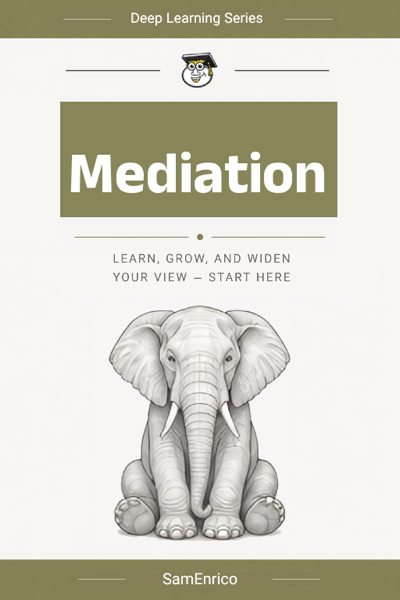
Non-FictionInformativeEducational
Mediation eBook
A Coursebook on Mediation
A Coursebook on Mediation
Formats
Free sample
Chapter 1: The Silence Before the Storm--The meeting was scheduled for nine o’clock on a Tuesday morning, but by eight forty-five, both parties had already taken their positions in opposite ends of the hallway. Neither would sit in the waiting area together. Neither would make eye contact. The receptionist later described the atmosphere as “the kind of quiet that happens just before something breaks.”This is how most conflicts arrive at a mediator’s doorstep—not with fireworks and shouting matches, though those happen too, but with a heavy, suffocating silence. The silence of people who have run out of words.
The silence of relationships that have been stretched past their breaking point. The silence of two human beings who once trusted each other and now cannot share the same square footage of carpet without feeling their chests tighten.The case that morning was, on paper, unremarkable. A small business partnership gone sour. Two friends who had started a coffee shop together four years earlier, now unable to agree on anything—not the lease, not the equipment, not the interpretation of their original handshake agreement. One believed they were fifty-fifty partners.
The other had done the books and insisted the split was sixty-forty based on capital contributed. Between them sat approximately forty-seven thousand dollars, a secondhand espresso machine, and the wreckage of a friendship neither knew how to salvage.They had tried lawyers. The lawyers had sent letters. The letters had been ignored or answered with other letters. Legal fees had already eaten through five thousand dollars with nothing to show for it except thicker files and thinner patience.
A judge had suggested mediation. Neither party had wanted to come. Neither party believed it would work. And yet here they were, sitting in separate chairs, staring at separate walls, waiting for a stranger to perform what they privately considered a kind of miracle or a kind of foolishness, depending on the hour.The mediator arrived at eight fifty-five. She did not sweep into the room like a television judge.
She walked quietly, carrying a leather portfolio and a thermos of tea. She introduced herself to the receptionist, reviewed the intake forms she had received the previous week, and asked to see each party separately before bringing them together. In the first private meeting, she listened to one partner describe betrayal. In the second, she listened to the other describe exhaustion. She did not take sides.
She did not offer opinions. She asked questions. She wrote down words. She looked each person in the eyes and said, “I hear you.”By eleven-fifteen that morning, the two partners had shaken hands. By noon, they had signed a memorandum of understanding dividing the business assets, establishing a payment schedule for the buyout, and agreeing to a joint statement for friends and family that neither would be blamed for the dissolution.
The mediator had not solved their problem. She had given them the space, the structure, and the safety to solve it themselves.This is what mediation does. This is what mediation is.Defining the Territory: What Mediation Actually Means Most people carry around a fuzzy understanding of mediation, shaped by television dramas where a therapist-type figure says things like, “Let’s all just calm down and talk this through.” That is not mediation. Or rather, that is a caricature of mediation—the equivalent of describing surgery as “cutting people open with a sharp knife.”Mediation is a facilitated, voluntary, confidential, and non-binding negotiation process in which a neutral third party assists disputing parties in reaching their own mutually acceptable agreement. Every word in that sentence matters.Facilitated means the mediator does not decide anything.
The mediator manages the process, not the outcome. Think of a mediator as a traffic controller at a busy intersection. The controller does not tell drivers where to go. The controller helps drivers navigate safely so they can reach their own chosen destinations.Voluntary means no one can be forced to mediate, and no one can be forced to stay. Either party may walk away at any time, for any reason, or for no reason at all.
This is both a practical feature and a psychological one. When people know they have an exit, they are paradoxically more willing to stay and engage.Confidential means what is said in mediation generally cannot be used later in court. There are important exceptions to this rule—and we will explore them in detail in Chapter 9—but the core principle is that parties can speak candidly without fear that their words will become weapons against them later. This confidentiality is the engine of honesty in mediation.Non-binding means the mediator has no power to impose a solution. Even if the parties reach an agreement, nothing forces them to sign it.
Even if they sign it, nothing forces them to comply except their own commitment and the enforceability of the resulting contract. The mediator cannot hand down a ruling. The mediator cannot issue a subpoena. The mediator cannot send anyone to jail.This final feature—non-binding—is often the hardest for newcomers to understand. Why would anyone participate in a process that cannot force a resolution?
The answer is both simple and profound: because people would rather design their own solution than have one imposed by a stranger. A judge’s order feels like a loss, even when you win. A mediated agreement feels like a victory, even when you compromise.The Shadow of the Law: Why Litigation Changes Everything To understand mediation, you must first understand what it replaces. For most people, the default image of dispute resolution is a courtroom. Two sides.
One winner. One loser. A robed authority figure who speaks in formal pronouncements and delivers a verdict that neither party fully controls.This is litigation. And it has its place. When someone has been physically harmed, when a contract has been blatantly violated, when the power imbalance between parties is so extreme that voluntary negotiation is impossible—litigation exists for good reasons.
But litigation also has costs that go far beyond money.Legal scholar Robert Mnookin coined the phrase “the shadow of the law” to describe how litigation risk shapes all negotiations, even those that never see a courtroom. When two parties know that a judge would likely award fifty thousand dollars to one side and nothing to the other, their private negotiations will reflect that reality. The party with the stronger legal case will demand more. The party with the weaker case will offer less. The law casts a shadow over every conversation.Mediation does not erase that shadow.
But mediation changes how parties relate to it. In litigation, the shadow is the main event—lawyers spend their time predicting what a judge will do, and negotiations happen in the shadow of that prediction. In mediation, the shadow is background information rather than the central focus. Parties can consider what a judge would do while also considering what they actually need, what they can actually afford, and what relationship they actually want to preserve going forward.The coffee shop partners from our opening story had a clear legal shadow. If they had gone to court, a judge would have reviewed…
This is the end of the free sample. Get the eBook to keep going. Buy now
About this book
Details
- Author
- Verdun Charlyn
- Publisher
- SamEnrico
- Language
- English
- Genre
- Non-Fiction, Informative, Educational
- Released
- 2026-05-18
- Pages (approx.)
- 160
- Available as
- eBook, Audiobook

Read better in the ZLOADR app
Your eBooks on your phone or tablet. Sign in with your SamEnrico account and start reading.
More by Verdun Charlyn
 Persuasion for Health BehaviorVerdun Charlyn$11.99
 Pricing Strategy BootstrapperVerdun Charlyn$11.99
 Blended Family Self WorthVerdun Charlyn$11.99
 The Dynamic Stretching Warm UpVerdun Charlyn$11.99
 The Ghost Writer of Havana: How a Journalist Exposed Batista’s RegimeVerdun Charlyn$11.99
 LinkedIn Profile for Recruiters GuideVerdun Charlyn$12.99
 Learn to Play the KokleVerdun Charlyn$11.99
 Ultimate Handbook Guide to Daye : (China) Travel GuideVerdun Charlyn$11.99
You may also like
 Hong Kong Handover 1997Dunn Johnnie$11.99
 Zumba For Postnatal Recovery CourseNeal Christian$11.99
 Zumba for BeginnersLadner Nikia$11.99
 YouTube Comment Mining GuideHumes Pandora$12.99
 Worry Box MeditationCarlin Rudy$11.99
 Workplace Stress MeditationNguyen Lynn$11.99
 Workplace Stress and Sleep RepairHawley Ivory$11.99
 Workplace Perfectionism CureDelaney Jeffry$11.99
 Workplace Injustice Anger GuideWallen Isabelle$11.99
 Work Addiction and Burnout LinkGreenwood Ester$11.99
 Women in Yoga and WellnessBeattie Galina$11.99
 Women in Stand Up ComedyChun Evangeline$11.99