
Non-FictionConsumer Mind ReportMedia
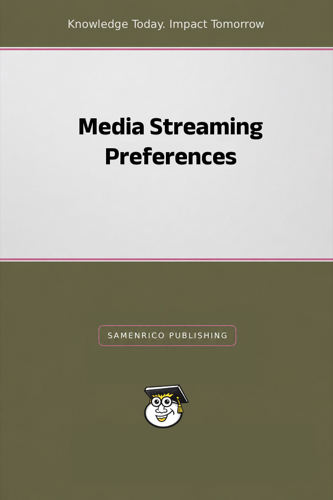
Media Streaming Preferences eBook
Analyze Boomer cable loyalty against Gen Z fragmen
Analyze Boomer cable loyalty against Gen Z fragmented streaming subscriptions.
Formats
Free sample
Chapter 1: The Two Screens--The Thursday night ritual began at precisely 7:58 PM. That gave everyone two minutes to settle in—to claim the good spot on the couch, to microwave the popcorn, to argue about who had touched the remote last and why the batteries were always dead. By 8:00 PM, the living room was full. Grandpa in the recliner. Grandma on the end of the couch closest to the kitchen.
Mom and Dad somewhere in between. The kids on the floor, cross-legged, faces tilted up toward the glow.The show was Seinfeld. It was always Seinfeld in 1995, or sometimes Friends, or on the really big nights, ER. But the specifics didn't matter. What mattered was the structure.
Thursday at 8:00 belonged to NBC. Everyone knew this. The schedule was a public good, as known and as reliable as the sunrise. If you missed it, you missed it. There was no catching up.
There was no "skip intro" button. There was no watching at 1.5x speed while scrolling through something else. There was only the couch, the screen, and the shared experience of 23 million other Americans doing exactly the same thing at exactly the same time.Now consider a different room. A 2025 bedroom, eighteen feet away from that 1995 living room, separated by thirty years and an unbridgeable cognitive gulf. A nineteen-year-old lies in bed.
The ceiling is dark. The only light comes from three screens. A laptop streams Stranger Things on Netflix, but not at normal speed—at 1.5x, because who has time for normal speed? A phone scrolls Tik Tok in portrait mode, the algorithm feeding an endless river of fifteen-second dopamine hits. A tablet is open to Discord, where seven strangers are live-reacting to the same episode, posting memes, speculating about the plot, and ignoring each other's spoiler warnings.
Earbuds deliver three different audio streams simultaneously: the dialogue from the laptop, a song from the phone, and a notification ping from the tablet.The nineteen-year-old is watching Stranger Things. She is also not watching Stranger Things. She is watching it at accelerated speed while reading plot summaries on Reddit to ensure she doesn't miss anything. She will finish the episode in thirty-seven minutes instead of fifty-two. She will then spend twenty minutes watching fan edits on Tik Tok, fifteen minutes arguing about the ending on Discord, and ten minutes creating her own meme response.
By the time she goes to sleep, she will have spent ninety minutes engaging with Stranger Things but only thirty-seven of those minutes actually watching the show itself.This is not distraction. This is a different model of attention entirely.These two scenes—the 1995 living room and the 2025 bedroom—are not separated by technology alone. They are separated by psychology, by economics, by the very structure of time itself. The people in the first scene grew up in an era of scarcity. Three networks.
One schedule. The VCR was the most revolutionary technology they had ever seen, and even that required learning to program a clock that blinked 12:00 for years. The people in the second scene grew up in an era of abundance. Five hundred streaming services. Infinite choice.
Algorithms that learn your taste better than your own mother. The difference is not that one generation is smarter or lazier or more tech-savvy. The difference is that they lived through different media ecologies, and those ecologies shaped their brains in ways they do not even recognize.The Scarcity Era: How Limited Choice Created Shared Rituals To understand Boomers—the generation born between 1948 and 1964—one must understand what it meant to grow up with three television networks. ABC, CBS, and NBC. That was it.
In some markets, a fourth independent station if you were lucky. In rural areas, maybe just two. The public broadcast spectrum was finite, and the Federal Communications Commission had divvied it up like a pie. There was no cable in the 1950s and 1960s. There was no satellite.
There was no streaming. There was an antenna on the roof, a pair of pliers to adjust it when the wind blew it off course, and a deep, abiding appreciation for whatever came through.This scarcity produced something that feels almost alien to the modern viewer: shared rituals. When The Ed Sullivan Show aired on Sunday nights, 40 million people watched. That was not a typo. Forty million people, in a country of 180 million, watching the same variety show at the same time.
When the Beatles appeared on that show in February 1964, 73 million people watched—more than 40 percent of the entire US population. The next day at school, everyone talked about it. Not because they had coordinated their viewing, but because there was no alternative. You either watched The Ed Sullivan Show, or you watched nothing. There was no DVR.
No streaming. No "watch later." The schedule was the only game in town.This scarcity created something deeper than habit. It created psychological security. The schedule was a public good—a shared framework that organized time itself. The evening news at 6:30 meant dinner was approaching.
60 Minutes at 7:00 on Sunday meant the weekend was ending. Thursday at 8:00 on NBC meant Seinfeld, which meant laughter, which meant relief from the workweek. The schedule was not just a list of programs. It was a calendar. It was a clock.
It was a source of meaning.A Boomer interviewed for this book put it simply: "I like knowing what's on. I don't want to have to decide what to watch. I want to turn it on and there it is."This preference—for curation over choice, for predictability over novelty—is not laziness. It is a rational response to a childhood spent in scarcity. When you grew up with three channels, you learned to appreciate whatever was offered.
You developed what psychologists call "satisficing"—the ability to accept a good enough option rather than searching endlessly for the perfect one. You learned to find joy in the schedule, to trust that the programmers knew what they were doing, to surrender your attention to someone else's curation.This is the Boomer blueprint. And it is dying.The Abundance Era: How Infinite Choice Created Individualized Bubbles Now consider Gen Z—the generation born between 1997 and 2007. They have never known a world without the "skip intro" button. They have never waited a week for the next episode of a serialized drama.
They have never rushed home to catch a show at its scheduled time. The very concept of "appointment viewing" is, to them, a historical curiosity—like rotary phones or encyclopedias.Gen Z grew up with Netflix streaming, which launched in 2007 when the oldest members of the generation were ten years old. They grew up with You Tube, which launched in 2005. They grew up with the i Phone, which launched in 2007. Their entire media experience has been on-demand, algorithmically curated, and infinitely abundant.
The scarcity that defined Boomer childhood—three channels, one schedule, no second chances—is not a memory for Gen Z. It is not even a concept. It is a historical artifact.This abundance has produced a very different psychology. When you have infinite choice, you cannot satisfice. You must optimize.
You must find the perfect show, the perfect movie, the perfect Tik Tok video. The algorithm helps—it learns your taste…
This is the end of the free sample. Get the eBook to keep going. Buy now
About this book
Details
- Author
- Schwarz Enriqueta
- Publisher
- SamEnrico
- Language
- English
- Genre
- Non-Fiction, Consumer Mind Report, Media
- Released
- 2026-06-09
- Pages (approx.)
- 129
- Available as
- eBook, Audiobook

Read better in the ZLOADR app
Your eBooks on your phone or tablet. Sign in with your SamEnrico account and start reading.
More by Schwarz Enriqueta
 Self Doubt In Ministry GuideSchwarz Enriqueta$11.99
 Anger and Property DamageSchwarz Enriqueta$11.99
 The Visual Distraction EliminatorSchwarz Enriqueta$11.99
 Low Carb For IBS ReliefSchwarz Enriqueta$11.99
 Sociopathy Versus Psychopathy DefinedSchwarz Enriqueta$11.99
 Digital Nomad RetirementSchwarz Enriqueta$11.99
 70 Percent Rule DelegationSchwarz Enriqueta$11.99
 The Last Kingpin: How a Quiet Neighborhood Became a Cartel HubSchwarz Enriqueta$11.99
 Ravana's Lament: The Fall of the Ten-Headed KingSchwarz Enriqueta$11.99
 Understanding HypercortisolismSchwarz Enriqueta$11.99
 A Collector's Handbook to the Cadillac 370aSchwarz Enriqueta$11.99
 How to Produce a Skid-steer LoaderSchwarz Enriqueta$11.99
You may also like
 Hong Kong Handover 1997Dunn Johnnie$11.99
 Zumba For Postnatal Recovery CourseNeal Christian$11.99
 Zumba for BeginnersLadner Nikia$11.99
 YouTube Comment Mining GuideHumes Pandora$12.99
 Worry Box MeditationCarlin Rudy$11.99
 Workplace Stress MeditationNguyen Lynn$11.99
 Workplace Stress and Sleep RepairHawley Ivory$11.99
 Workplace Perfectionism CureDelaney Jeffry$11.99
 Workplace Injustice Anger GuideWallen Isabelle$11.99
 Work Addiction and Burnout LinkGreenwood Ester$11.99
 Women in Yoga and WellnessBeattie Galina$11.99
 Women in Stand Up ComedyChun Evangeline$11.99