
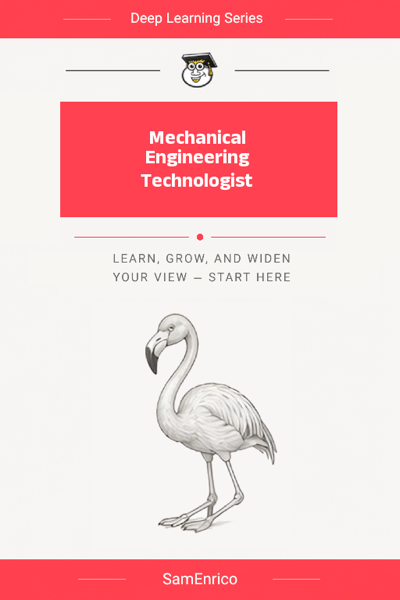
Mechanical Engineering Technologist
A Coursebook on Mechanical Engineering Technologis
A Coursebook on Mechanical Engineering Technologist
Formats
About this book
Free sample
Chapter 1: The Bridge Builders--The mechanical engineering technologist sits at a strange crossroads—too technical to be called a technician, too applied to be called an engineer, and too valuable to be ignored. If you have opened this book, someone has likely told you that you are "good with your hands" but also "good with math." You take things apart to understand them. You draw diagrams in the margins of notebooks. When something breaks, you do not just want to replace it—you want to know why it broke. You are the person friends call when their car makes a noise, not because you are a mechanic, but because you think mechanically.
Welcome to the tribe.This chapter dismantles a persistent confusion that has plagued industry for decades: the difference between the mechanical engineer (ME), the mechanical engineering technologist (MET), and the mechanical technician (MEC). These three roles form a vertical stack of responsibility, education, and application—but unlike a hierarchy, none is "higher" than the others. They are different, complementary, and equally essential. Understanding where you fit in this stack is the first step toward a career that pays well, satisfies deeply, and never becomes obsolete.The Three-Legged Stool of Mechanical Industry Imagine a three-legged stool. The seat represents a functioning product—a car engine, an assembly line robot, an HVAC system in a hospital.
The left leg is the engineer, who derives the equations that predict performance. The right leg is the technician, who turns wrenches, reads gauges, and keeps the machine running. The center leg—the one that bears the most subtle load—is the technologist. Without this leg, the engineer's calculations never become real, and the technician's repairs never address root causes.The mechanical engineer typically holds a four-year bachelor's degree (BSME) steeped in calculus, differential equations, thermodynamics theory, and advanced stress analysis. Engineers ask: "What is the theoretical maximum efficiency of this cycle?" or "Can we derive a new material model for this composite?" They work in research and development, computational simulation, and novel design.
They are comfortable with ambiguity and abstraction. They think in partial derivatives.The mechanical technician typically holds a two-year associate degree…
This is the end of the free sample. Get the eBook to keep going. Buy now
Contents
- Chapter 1
- Chapter 2
- Chapter 3
- Chapter 4
- Chapter 5
- Chapter 6
- Chapter 7
- Chapter 8
- Chapter 9
- Chapter 10
- Chapter 11
- Chapter 12
Details
- Author
- Seibert Rosalva
- Publisher
- SamEnrico
- Language
- English
- Genre
- Non-Fiction, Informative, Educational
- Released
- 2026-05-18
- Pages (approx.)
- 124
- Available as
- eBook, Audiobook

Read better in the ZLOADR app
Your eBooks on your phone or tablet. Sign in with your SamEnrico account and start reading.
More by Seibert Rosalva
 The Emotional Memory Bank GuideSeibert Rosalva$11.99
 Breath Awareness For Suicidal ThoughtsSeibert Rosalva$11.99
 French Resistance Urban SnipersSeibert Rosalva$11.99
 Penis Size Self Esteem GuideSeibert Rosalva$11.99
 The EQ for Customer Support GuideSeibert Rosalva$11.99
 The Vanishing of the Princess: A Victorian Mystery and the Birth of Victim AdvocacySeibert Rosalva$11.99
 Understanding Mallory–Weiss SyndromeSeibert Rosalva$17.99
 Goods Receipt and Inspection GuideSeibert Rosalva$12.99
 Strategy Meeting Recurring ScheduleSeibert Rosalva$12.99
 How to Start a Hobby in SwingSeibert Rosalva$11.99