
Non-FictionMental WealthNutritionTiming
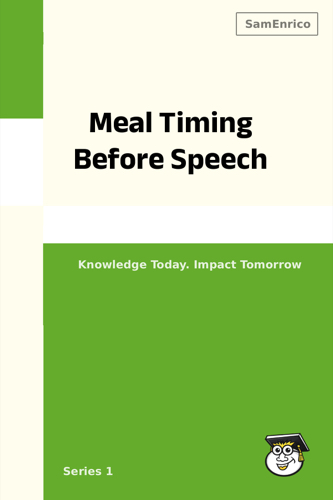
Meal Timing Before Speech eBook
Eat strategically to avoid blood sugar crashes or
Eat strategically to avoid blood sugar crashes or digestive distraction.
Formats
Free sample
Chapter 1: The 4-Hour Trap--Most speakers believe that nervousness is a mental problem. They practice deep breathing, visualize success, and repeat affirmations. But eight minutes into their speech, their hands begin to tremble. Their voice loses its lower register. Words they have rehearsed fifty times suddenly vanish from memory.
They blame anxiety. They blame lack of preparation. They blame the audience's cold stares.They almost never blame what they ate – or failed to eat – four hours ago.This chapter will dismantle the single most common and destructive myth in public speaking: that speaking on an empty stomach makes you sharper, leaner, or less nauseous. In reality, going longer than four hours without food triggers a physiological stress response that nearly perfectly mimics stage fright. The body does not distinguish between the hunger-induced release of stress hormones and the anxiety-induced release of the same chemicals.
Your audience cannot tell the difference either. They will interpret your shaking hands, quivering voice, and mental fog as nervousness, unpreparedness, or worse – dishonesty.By the end of this chapter, you will understand exactly why the fourth hour without food is the most dangerous time for any speaker. You will learn to recognize your personal crash symptoms before they derail a presentation. And you will complete a simple self-experiment – the Fuel Window Finder – that will forever change how you schedule food before speaking.The Blood Sugar Lie You Have Been Told Every tissue in the human body can run on alternative fuels. Muscles can burn fat.
The heart can use ketones. But the brain is different. The brain runs almost exclusively on glucose. Under normal conditions, it consumes approximately 120 grams of glucose daily – roughly the amount in two cups of cooked white rice or three bananas. Unlike muscles, which store glycogen for later use, the brain has minimal onboard fuel reserves.
It requires a constant, steady supply of glucose from the bloodstream.When blood glucose drops below optimal levels – a condition called hypoglycemia – the brain does not simply feel "a little tired." It perceives a survival threat. The body's emergency response systems activate exactly as they would for physical danger. The adrenal glands release cortisol and adrenaline to signal the liver to convert stored glycogen into glucose and release it into the bloodstream. These are the exact same hormones released during anxiety, fear, and stage fright.Here is the cruel irony that destroys speeches every day: the symptoms of hypoglycemia are nearly identical to the symptoms of performance anxiety. Both cause:Hand tremors and fine motor instability A quivering or thinning voice Rapid heartbeat and shallow breathing Irritability and shortened temper Mental fog and word-finding difficulty Sweating, particularly on the palms and forehead When these symptoms appear eight minutes into your speech, you will naturally assume you are nervous.
The audience will assume the same. But you may not be nervous at all. You may simply be hungry. And because the physiological response is identical, your standard anxiety-reduction techniques – deep breathing, positive visualization, slowing down – will have minimal effect. You cannot breathe your way out of low blood sugar.
You cannot visualize your way out of cortisol release. You can only eat your way out.The 4-Hour Rule is the foundation of this book precisely because this misunderstanding is so common and so destructive. Going longer than four hours without food triggers the crash response in most people. Some individuals begin to crash at 3.5 hours. Others can stretch to 5 hours before symptoms appear.
But the 4-hour mark is the average danger zone – the point at which enough people experience significant symptoms that it serves as a reliable rule of thumb.This is not a suggestion to eat a large meal four hours before speaking. That would violate the digestion principles covered in Chapter 2. The 4-Hour Rule is a warning: if you have not eaten anything in four hours, your brain is running on emergency reserves. You are speaking with the biological equivalent of a check-engine light illuminated on your dashboard. You might finish the speech.
You might even finish it well. But you are gambling against your own physiology.The Hangry Speaker Phenomenon The term "hangry" – a portmanteau of hungry and angry – entered popular culture as a joke. It is not a joke. It is a precise description of a neurological event that destroys speaker-audience rapport.When blood sugar crashes, the prefrontal cortex – the region of the brain responsible for impulse control, executive function, and articulate speech – begins to downregulate. The brain, sensing an energy crisis, diverts resources away from "non-essential" higher cognitive functions toward basic survival systems.
Simultaneously, the amygdala – the brain's fear and threat detection center – becomes hyperactive. The result is a speaker who is simultaneously less able to control their impulses and more sensitive to perceived threats.In practical terms, this means:You are more likely to snap at an audience member during Q&AYou are more likely to interpret a neutral question as hostile You are less able to access memorized content and transitions You experience word-finding failures mid-sentence Your vocal tone becomes flat or defensive without your awareness The hangry speaker does not know they are hangry. They believe they are stressed, anxious, or underprepared. They might even believe the audience has turned against them. But the audience has not changed.
The speaker's brain has changed. And the audience will respond accordingly. A speaker who snaps at a question will be remembered as difficult. A speaker who stumbles through transitions will be remembered as unprepared. A speaker who cannot find their words will be remembered as nervous.
None of these judgments are fair if the root cause is a missed meal, but fair is irrelevant. The audience's perception is the only reality that matters.This chapter includes a self-assessment tool called the Symptom Tracker. For your next two weeks of speaking engagements – whether formal keynotes, team meetings, classroom presentations, or even conference calls where you are the primary speaker – log the following information:The time of your last meal before speaking What you ate (approximately)The time you began speaking Any symptoms you experienced in the first 15 minutes Any symptoms you experienced after 15 minutes Your subjective rating of the speech (1-10)After fourteen days, review your log. Look for patterns. Many speakers discover that symptoms consistently appear at the 4.5-hour mark, worsen at 5 hours, and become debilitating at 6 or more hours.
Others discover they are highly sensitive to specific foods – particularly high-glycemic carbohydrates – regardless of timing. The Symptom Tracker is not a scientific instrument. It is a personal discovery tool. Use it to learn your own body's signals before they learn you.The Physiology of the Crash: A Step-by-Step Walkthrough To fully understand why the 4-Hour Rule exists, it helps to walk through the crash sequence in detail. This section describes what happens inside your body between the last bite of food and the first word of your speech.Hour 0-1: Digestion and Absorption You finish eating.
Your stomach begins breaking down food into chyme – a semi-fluid mass of partially digested food. Carbohydrates are broken into simple sugars. Proteins are broken into amino acids. Fats are emulsified by bile. Within 30-60 minutes, glucose from the meal enters your bloodstream.
Insulin is released to shuttle this glucose into cells for energy or storage. If you ate a balanced meal with…
This is the end of the free sample. Get the eBook to keep going. Buy now
About this book
Details
- Author
- Christianson Roxann
- Publisher
- SamEnrico
- Language
- English
- Genre
- Non-Fiction, Mental Wealth, Nutrition, Timing
- Released
- 2026-06-08
- Pages (approx.)
- 160
- Available as
- eBook, Audiobook

Read better in the ZLOADR app
Your eBooks on your phone or tablet. Sign in with your SamEnrico account and start reading.
More by Christianson Roxann
 Divorce and ChildrenChristianson Roxann$11.99
 Telehealth MAT Prescribing GuideChristianson Roxann$11.99
 Anger at Unethical Workplace PracticesChristianson Roxann$11.99
 The Magnesium Relaxation MineralChristianson Roxann$11.99
 The Maestro of Movement: How a Luthier Revolutionized Dance with Instruments of the BodyChristianson Roxann$11.99
 Buy Me a Coffee MonetizationChristianson Roxann$11.99
 Travel Spending by Income LevelChristianson Roxann$12.99
 YouTube Educational Content GuideChristianson Roxann$12.99
 Understanding Polyglucosan Body Disease, AdultChristianson Roxann$17.99
 How to Become a Comb-machine OperatorChristianson Roxann$11.99
You may also like
 Hong Kong Handover 1997Dunn Johnnie$11.99
 Zumba For Postnatal Recovery CourseNeal Christian$11.99
 Zumba for BeginnersLadner Nikia$11.99
 YouTube Comment Mining GuideHumes Pandora$12.99
 Worry Box MeditationCarlin Rudy$11.99
 Workplace Stress MeditationNguyen Lynn$11.99
 Workplace Stress and Sleep RepairHawley Ivory$11.99
 Workplace Perfectionism CureDelaney Jeffry$11.99
 Workplace Injustice Anger GuideWallen Isabelle$11.99
 Work Addiction and Burnout LinkGreenwood Ester$11.99
 Women in Yoga and WellnessBeattie Galina$11.99
 Women in Stand Up ComedyChun Evangeline$11.99