
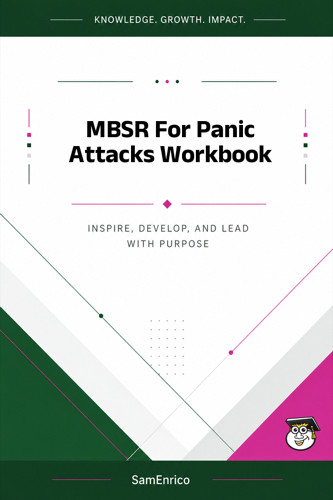
Non-FictionSelf-HelpPanic Disorder
MBSR For Panic Attacks Workbook eBook
Teaches grounding during acute panic episodes.
Teaches grounding during acute panic episodes.
Formats
Free sample
Chapter 1: The False Alarm...–- You are not dying. You are not going crazy. You are not losing control. What you are experiencing right now—the racing heart, the suffocating sensation, the tunnel vision, the absolute certainty that something catastrophic is about to happen—is a biological event. It is uncomfortable beyond words.
It is terrifying in ways that people who have never experienced a panic attack cannot understand. But it is not dangerous.Let that land for a moment. The worst feeling you have ever endured is not a threat to your life. It is a false alarm.This chapter is called The False Alarm because that is precisely what a panic attack is: your brain’s smoke detector going off at full volume when there is no fire. The smoke detector is doing exactly what it was designed to do—detect threat, mobilize resources, prepare the body for survival—but it is responding to a faulty signal.
Your nervous system has mistaken a harmless internal sensation (a skipped heartbeat, a slight dizziness, a change in breathing) for a life-threatening event. And once that alarm sounds, your body responds exactly as it would to a real predator, a falling building, or a drowning event.The purpose of this chapter is to give you a complete, jargon-free map of that false alarm. By the time you finish reading, you will understand exactly what is happening inside your body during a panic attack, why it feels so real, and—most importantly—how to recognize the earliest warning signs before the alarm reaches full volume. You will complete your first worksheets, establish your baseline on the SUDS scale (Subjective Units of Distress, 0-10), and identify your unique “panic signature”—the specific physical cues that signal an attack is coming. This signature will become your most important tool throughout this workbook.Let us begin with a question that may surprise you: Have you ever been truly, genuinely scared for your life?The Biology You Were Never Taught Think back to the most frightened you have ever been.
Perhaps you have swerved to avoid a car accident. Perhaps you have lost sight of a child in a crowded store for fifteen seconds. Perhaps you have heard a noise in your house at 2 AM. In that moment, your body did something remarkable. Your heart began pounding to pump oxygen-rich blood to your large muscles.
Your breathing quickened to take in more oxygen. Your pupils dilated to take in more visual information. Your digestive system shut down (which is why you might feel nauseous or have a “knot” in your stomach) to redirect energy to your arms and legs. Your blood vessels in your skin constricted (causing chills or cold hands) to minimize bleeding if you were injured. You may have felt an urgent need to move, to run, to fight, to do something.That response has a name.
It is called the sympathetic nervous system. Think of it as your body’s accelerator pedal. It evolved over hundreds of millions of years to do one thing: keep you alive in the presence of actual danger. It does not require your conscious permission. It does not wait for you to think, “Hmm, perhaps I should be frightened now.” It activates in milliseconds, faster than thought.
This is why you can jerk your hand away from a hot stove before you consciously register the pain.Now here is the critical point: during a panic attack, that exact same system activates. Your heart pounds. Your breath quickens. Your pupils dilate. Your hands get cold.
You feel an urgent need to escape. The difference is that there is no car swerving toward you. There is no lost child. There is no intruder. There is only a sensation—a skipped heartbeat, a moment of lightheadedness, a feeling of unreality—that your brain has mislabeled as a predator.This is the false alarm.Your brain’s threat-detection system (a small, almond-shaped structure called the amygdala) does not distinguish between a real tiger and a thought about a tiger.
It does not distinguish between actual suffocation and the feeling of breathlessness caused by hyperventilation. It only recognizes one thing: a signal that matches the pattern of “danger.” And once that pattern is matched, the alarm sounds.But your body also has a brake pedal. This is the parasympathetic nervous system, sometimes called the “rest and digest” system. It slows your heart rate, deepens your breathing, restores blood flow to your skin and digestive system, and returns your body to a state of calm. The good news is that the brake pedal works just as quickly as the accelerator—once the false alarm is recognized as false.
The purpose of this workbook is to teach you how to engage that brake pedal deliberately, reliably, and without struggle.Before we go further, let us introduce a tool you will use throughout every chapter of this book: the SUDS scale.The SUDS Scale: Your Personal Distress Thermometer SUDS stands for Subjective Units of Distress. It is a simple 0-to-10 rating system that will allow you to track your panic attacks, measure your progress, and decide which tool to use in any given moment. You will use it so often that it will become second nature.Here is what each number means:0 – Complete calm. No anxiety, no physical tension, no distressing thoughts. You might feel this while deeply asleep or completely absorbed in a peaceful activity.1-2 – Very mild distress.
You notice something slightly off—perhaps a flicker of worry, a shallow breath, a subtle muscle tension—but it is easy to ignore. You could have a conversation without anyone noticing anything different about you.3-4 – Mild to moderate distress. You are definitely aware of discomfort now. Your heart might be beating a little faster than usual. You might feel slightly nauseous or jittery.
You can still function normally, but you would prefer not to be feeling this way. This is the level of anxiety most people feel before a job interview or a medical appointment.5-6 – Moderate to strong distress. Your physical symptoms are now hard to ignore. Your heart is pounding noticeably. You might feel short of breath.
You have the urge to do something to make it stop—leave the room, call someone, check your pulse. You can still think clearly, but your attention keeps getting pulled back to the discomfort.7-8 – Strong to severe distress. You are now in the territory of a mild to moderate panic attack. Your thoughts may be racing. You might feel dizzy, sweaty, or disconnected from your surroundings.
You are having trouble concentrating on anything except the sensation. The part of your brain that makes rational decisions (the prefrontal cortex) is starting to shut down, which is why you might feel “frozen” or “stupid” during a panic attack.9 – Severe distress. This is a full-blown panic attack. You are certain something terrible is about to happen. You may believe you are having a heart attack, a stroke, or a mental breakdown.
You may feel an overwhelming urge to escape or to call for help. You are not thinking clearly. Your entire focus is on survival.10 – Extreme distress.…
This is the end of the free sample. Get the eBook to keep going. Buy now
About this book
Details
- Author
- Veal Christin
- Publisher
- SamEnrico
- Language
- English
- Genre
- Non-Fiction, Self-Help, Panic Disorder
- Released
- 2026-06-07
- Pages (approx.)
- 150
- Available as
- eBook, Audiobook

Read better in the ZLOADR app
Your eBooks on your phone or tablet. Sign in with your SamEnrico account and start reading.
More by Veal Christin
 Silver Economy Regional OutlookVeal Christin$11.99
 Hypoarousal Trauma ResponseVeal Christin$11.99
 Compass Visualization Direction CalmVeal Christin$11.99
 Sales Persuasion Closing TechniquesVeal Christin$11.99
 The Servant Girl Murders: Austin's 1885 Nightmare and the Birth of Forensic ScienceVeal Christin$11.99
 Understanding Ota–kawamura–Ito SyndromeVeal Christin$17.99
 Portuguese: Lisbon to RioVeal Christin$11.99
 Job Board Terms of Service GuideVeal Christin$12.99
 Tutoring While Traveling GuideVeal Christin$12.99
 How to Become a Twister TenderVeal Christin$11.99
You may also like
 Hong Kong Handover 1997Dunn Johnnie$11.99
 Zumba For Postnatal Recovery CourseNeal Christian$11.99
 Zumba for BeginnersLadner Nikia$11.99
 YouTube Comment Mining GuideHumes Pandora$12.99
 Worry Box MeditationCarlin Rudy$11.99
 Workplace Stress MeditationNguyen Lynn$11.99
 Workplace Stress and Sleep RepairHawley Ivory$11.99
 Workplace Perfectionism CureDelaney Jeffry$11.99
 Workplace Injustice Anger GuideWallen Isabelle$11.99
 Work Addiction and Burnout LinkGreenwood Ester$11.99
 Women in Yoga and WellnessBeattie Galina$11.99
 Women in Stand Up ComedyChun Evangeline$11.99