
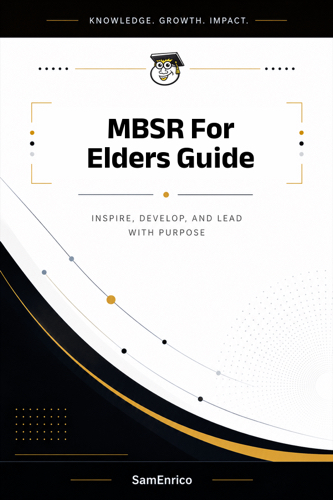
MBSR For Elders Guide eBook
Adapt mindfulness for older adults, addressing pai
by Fogle Adella
Adapt mindfulness for older adults, addressing pain, loneliness, and end-of-life anxiety with compassion.
Formats
Free sample
Chapter 1: The Breath That Waits--–- The first thing you need to know is that you have not failed at mindfulness. You have only been given instructions written for someone else’s body, someone else’s life, someone else’s fears. The thin woman on the meditation cushion who can sit for forty-five minutes without shifting? She is not you. The man who describes his chronic pain as “just another sensation passing through”?
He may be sincere, but he is also younger, or luckier, or perhaps simply not living inside the particular architecture of your joints, your history, your tired heart. This book is not for them. This book is for the person who wakes up at 3:00 AM with a back that has forgotten how to be comfortable, who spends holidays alone even when the phone is silent, who has started to wonder what the last breath will feel like. And the first thing this book wants to tell you is that you can put down the struggle. You can rest.
The breath has been waiting for you all along.The Myth of the Perfect Meditator If you have ever tried to meditate before, you almost certainly ran into the same wall. Someone gave you a recording or a book or a class, and the instructions sounded simple enough. Sit up straight. Close your eyes. Bring your attention to your breath.
When your mind wanders, gently return. But within ninety seconds, something happened. Your knee began to ache. Your hip started to complain. Your lower back sent a message that was impossible to ignore.
You shifted. You tried to find a better position. You opened your eyes to check the clock. And then you heard the voice in your head—the one that sounds suspiciously like a disappointed teacher—saying, “You’re doing it wrong.”That voice is wrong. You were not doing it wrong.
You were doing it with an elder’s body, and the instructions you received were written for someone thirty or forty or fifty years younger. The assumption behind most mindfulness teaching is that the body is a neutral container, that sitting still is a matter of willpower, that discomfort is a distraction to be observed and released. But when you are seventy-five or eighty-five or ninety-five, discomfort is not a visitor. It is a roommate. It has its own key.
It eats your food. It does not leave.The myth of the perfect meditator has done enormous harm. It has convinced countless elders that mindfulness is not for them, that their bodies are too broken, their minds too scattered, their remaining time too short to learn something new. None of that is true. What is true is that classic mindfulness-based stress reduction, or MBSR, was designed in a university medical center in the late 1970s for working-age adults with stress-related conditions.
It was not designed for arthritis. It was not designed for progressive hearing loss. It was not designed for the kind of exhaustion that comes from a body that has been working for eight or nine decades. And it was certainly not designed for the kind of existential weight that settles onto the shoulders when you realize that the number of years ahead is smaller than the number behind.So we are going to throw out most of those old instructions. Not the wisdom underneath them—the wisdom remains.
But the forms, the postures, the time requirements, the expectations? Gone. In their place, we are going to build something that fits the body you have right now, not the body you used to have or the body you wish you had.What This Chapter Will Give You Before we go any further, let me tell you exactly what you will walk away with after reading this chapter and trying its practices for a few days. You will have one single anchor that you can return to anytime, anywhere, in any condition—even if you are lying in a hospital bed, even if you are in the middle of a pain flare, even if you cannot remember what you ate for breakfast. That anchor is your breath.
Not the breath as a concept. Not the breath as something you need to control, lengthen, deepen, or measure. Just the ordinary, unglamorous, always-available sensation of air moving in and out of your body.You will also receive permission. Explicit, written, repeatable permission to stop when you need to stop, to rest when you need to rest, to skip practices that do not serve you on any given day. That permission is not a failure of discipline.
It is the core of elder-friendly mindfulness. And finally, you will learn a simple tool called the OK-to-Rest bell, which you can set up in sixty seconds and which will remind you, throughout the day, that you are allowed to close your eyes and do nothing.None of this requires flexibility, physical comfort, or the ability to sit still. None of it requires a cushion, a special room, or a quiet mind. Your mind will wander. Your body will hurt.
You will sometimes forget why you closed your eyes in the first place. That is not a problem. That is the material.Redefining Success: From Fixing to Befriending The single biggest shift this book asks you to make is also the simplest to understand and the hardest to believe. Here it is: you are not trying to fix anything. Not your pain.
Not your loneliness. Not your fear of dying. Not the racing thoughts that keep you awake at 3:00 AM. The goal is not symptom reduction. The goal is not better coping.
The goal is not even peace, if by peace you mean the absence of difficulty.The goal is befriending.Befriending means turning toward your present-moment experience—whatever it is, pleasant or unpleasant, quiet or noisy, calm or terrified—and saying, without judgment, “Ah. Here you are. I see you.” That is all. You do not have to like what you see. You do not have to want it to stay.
You simply stop running from it. And here is the strange, counterintuitive truth that every long-term mindfulness practitioner eventually discovers: when you stop fighting your experience, something in the experience often softens. The pain may not go away, but the suffering around the pain—the resistance, the fear, the story of catastrophe—can loosen its grip. The loneliness may not disappear, but the desperate need for it to disappear can relax. The fear of dying may still be there, but it no longer has to run the whole show.Notice the wording: the suffering can loosen.
Not will. Not must. This is not a guarantee. This is not another performance standard. Some days, you will turn toward your pain or your loneliness or your fear, and nothing will soften.
Those days are not failures. They are just days when the befriending is the entire practice. You showed up. You turned toward. That is success.This is the point where many mindfulness books pivot into inspirational language about transformation and breakthrough.
I am not going to do that. Transformation is rare. Breakthroughs are unpredictable. What is reliable is the small, daily…
This is the end of the free sample. Get the eBook to keep going. Buy now
About this book
Details
- Author
- Fogle Adella
- Publisher
- SamEnrico
- Language
- English
- Genre
- Non-Fiction, Self-Help, Aging
- Released
- 2026-06-10
- Pages (approx.)
- 121
- Available as
- eBook, Audiobook

Read better in the ZLOADR app
Your eBooks on your phone or tablet. Sign in with your SamEnrico account and start reading.
More by Fogle Adella
 Amos Shepherd ProphetFogle Adella$11.99
 Nutrition for Burnout Recovery WorkbookFogle Adella$11.99
 Workplace Stress for TradespeopleFogle Adella$11.99
 The Disability Body Acceptance GuideFogle Adella$11.99
 The Midnight Riders: The Untold Story of Black Loyalists in the Revolutionary WarFogle Adella$11.99
 Alterations ManagerFogle Adella$11.99
 SaaS in Energy GuideFogle Adella$12.99
 AI Calendar Optimizer WorkbookFogle Adella$12.99
 Understanding KoilonychiaFogle Adella$17.99
 How to Start a Hobby in Shark DivingFogle Adella$11.99
You may also like
 Hong Kong Handover 1997Dunn Johnnie$11.99
 Zumba For Postnatal Recovery CourseNeal Christian$11.99
 Zumba for BeginnersLadner Nikia$11.99
 YouTube Comment Mining GuideHumes Pandora$12.99
 Worry Box MeditationCarlin Rudy$11.99
 Workplace Stress MeditationNguyen Lynn$11.99
 Workplace Stress and Sleep RepairHawley Ivory$11.99
 Workplace Perfectionism CureDelaney Jeffry$11.99
 Workplace Injustice Anger GuideWallen Isabelle$11.99
 Work Addiction and Burnout LinkGreenwood Ester$11.99
 Women in Yoga and WellnessBeattie Galina$11.99
 Women in Stand Up ComedyChun Evangeline$11.99