
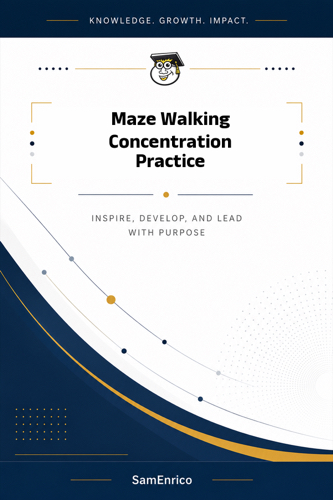
Non-FictionSelf-HelpFocus Training
Maze Walking Concentration Practice eBook
Navigate hedgerow mazes with focused attention on
Navigate hedgerow mazes with focused attention on each turn.
Formats
Free sample
Chapter 1: The 47-Second Prison--–- You are about to do something that has become nearly impossible in the modern world. You are going to focus on one thing, for an extended period, without distraction, without interruption, and without the creeping urge to check a screen. This single act—walking a hedgerow maze with concentrated attention on each turn—will feel unnatural at first. It will feel slow, uncomfortable, and perhaps even pointless. That discomfort is not a sign that you are doing something wrong.
It is the precise sensation of a neglected cognitive muscle being used for the first time in years.This book is not about solving mazes faster than anyone else. It is not about beating a timer, impressing your friends, or posting a photograph of your triumphant exit on social media. This book is about the radical, countercultural act of doing one thing at a time. The hedgerow maze is simply the tool—a beautifully designed obstacle course for your attention. The walls block out the visual chaos of the outside world.
The rustling leaves provide a natural white noise that masks the digital pings and buzzes you have been conditioned to obey. And the path itself, with its endless forks and dead ends, forces you to make choice after choice after choice, each one demanding your full presence.If you have picked up this book, you have likely noticed something troubling about your own mind. You sit down to read a single article, and before finishing the second paragraph, you have reached for your phone three times. You have a conversation with your partner or your child, and halfway through their sentence, you realize you have not heard a word they said because you were rehearsing a work email in your head. You lie down to sleep, and your brain responds by serving up a greatest-hits reel of every mistake you made in the past decade.
This is not a personal failing. This is the natural result of living in an environment that has been systematically engineered to fracture your attention.The average adult now switches between screen-based tasks every forty-seven seconds. Forty-seven seconds. That is not focus. That is a nervous system in perpetual emergency mode, jumping from notification to notification, from tab to tab, from anxiety to anxiety.
And here is the cruel irony: you feel busy. You feel productive. You feel like you are holding everything together. But attention science tells a different story. Every time you switch tasks, you leave behind a residue of the previous task—a cognitive drag that slows you down and increases your error rate.
This is called attention residue, and it is the hidden tax of modern life. By attempting to do everything at once, you are actually doing nothing well.The hedgerow maze offers a way out. Not an escape from reality, but a return to it. When you walk a maze with focused attention on each turn, you are doing something that your ancestors did naturally: moving through physical space, making decisions based on sensory information, and receiving immediate feedback from the environment. There is no loading screen.
There is no buffering. There is no algorithm curating your next move. There is just you, the hedge, the path, and the next turn.This chapter will establish the existential need for this practice. It will diagnose the crisis of fragmented attention in precise, unsentimental terms. It will introduce the hedgerow maze as a "cognitive gym"—a dedicated space for rebuilding the attention span that digital culture has eroded.
And it will redefine success in a way that may surprise you. Getting lost is not failure. Getting lost is data. Every wrong turn is a clue about where your attention broke down. The goal is not to exit quickly.
The goal is to return, again and again, to the present moment, until that return becomes automatic.Let us begin by understanding exactly what you are up against.The Forty-Seven Second Problem In 2016, a team of researchers at the University of California, Irvine, decided to measure how long office workers could stay focused on a single screen-based task before switching to something else. The results were grim. The average time was three minutes. By 2019, that number had dropped to seventy-five seconds. And by 2022, in the wake of a global shift to remote work and round-the-clock screen exposure, the average had collapsed to forty-seven seconds.Let that number sit with you for a moment.
Forty-seven seconds. That is less time than it takes to boil an egg, tie a pair of shoelaces, or sing the chorus of most popular songs. It is shorter than the average commercial break on television. And it is the length of time your brain can currently sustain attention on a single task before something—a notification, a thought, a habit—pulls you away.You might protest that you are simply good at multitasking. You might believe that you can check email while listening to a podcast while scanning a spreadsheet while answering a text message.
The science is unequivocal on this point: you cannot. The human brain is not wired for parallel processing of complex tasks. What you are actually doing is something called rapid serial task-switching—jumping from one thing to another so quickly that it feels simultaneous. But each jump costs you time, accuracy, and mental energy.The hidden cost of switching is attention residue. When you stop working on Task A and move to Task B, a portion of your cognitive resources remains stuck on Task A.
You are thinking about the email you just sent while you are supposed to be listening to your colleague. You are mentally drafting a reply to your boss while you are supposed to be reading bedtime stories to your child. You are rehashing an argument from three hours ago while you are supposed to be falling asleep. The residue lingers, sometimes for up to fifteen minutes, quietly degrading your performance on whatever you are doing in the present.Now multiply that residue by the number of times you switch tasks in a single hour. If you switch every forty-seven seconds, you are switching roughly seventy-six times per hour.
Seventy-six times. That is seventy-six little cognitive taxes, each one stealing a portion of your focus, each one leaving you feeling frazzled and unproductive without any clear understanding of why.The hedgerow maze is the antidote not because it is easy, but because it is hard in exactly the right way. A well-designed maze forces you to make decisions, but it limits the scope of those decisions to the immediate environment. You cannot see the entire route. You cannot scroll ahead.
You cannot outsource the navigation to an algorithm. You must stand at each junction, assess the options, choose a direction, and then live with the consequences of that choice until the next junction appears. This is monotasking in its purest form.The Maze as Cognitive Gym Consider what happens in your brain when you enter a hedgerow maze. The first thing you notice is the absence of digital noise. No notifications.
No email chimes. No vibrating pocket. The hedgerow itself is a physical filter, blocking your view of the outside world…
This is the end of the free sample. Get the eBook to keep going. Buy now
About this book
Details
- Author
- Lancaster Valentine
- Publisher
- SamEnrico
- Language
- English
- Genre
- Non-Fiction, Self-Help, Focus Training
- Released
- 2026-06-07
- Pages (approx.)
- 136
- Available as
- eBook, Audiobook

Read better in the ZLOADR app
Your eBooks on your phone or tablet. Sign in with your SamEnrico account and start reading.
More by Lancaster Valentine
 Habit Journaling WorkbookLancaster Valentine$11.99
 Laundromat Conversation GuideLancaster Valentine$11.99
 Nobel Laureates In Light MicroscopyLancaster Valentine$11.99
 Ecological Momentary AssessmentLancaster Valentine$11.99
 Echoes of the Ice Age: The First Explorers of the Frozen ReefsLancaster Valentine$11.99
 The Last Stand of the Black Prince: A Century of Unclaimed GloryLancaster Valentine$11.99
 Return on Investment AnalystLancaster Valentine$11.99
 Currency Conversion Optimization GuideLancaster Valentine$12.99
 Freemium Device FragmentationLancaster Valentine$12.99
 Understanding GoutLancaster Valentine$17.99
 How to Become a Kick-press OperatorLancaster Valentine$11.99
You may also like
 Hong Kong Handover 1997Dunn Johnnie$11.99
 Zumba For Postnatal Recovery CourseNeal Christian$11.99
 Zumba for BeginnersLadner Nikia$11.99
 YouTube Comment Mining GuideHumes Pandora$12.99
 Worry Box MeditationCarlin Rudy$11.99
 Workplace Stress MeditationNguyen Lynn$11.99
 Workplace Stress and Sleep RepairHawley Ivory$11.99
 Workplace Perfectionism CureDelaney Jeffry$11.99
 Workplace Injustice Anger GuideWallen Isabelle$11.99
 Work Addiction and Burnout LinkGreenwood Ester$11.99
 Women in Yoga and WellnessBeattie Galina$11.99
 Women in Stand Up ComedyChun Evangeline$11.99