
Non-FictionBiographyVerstappen
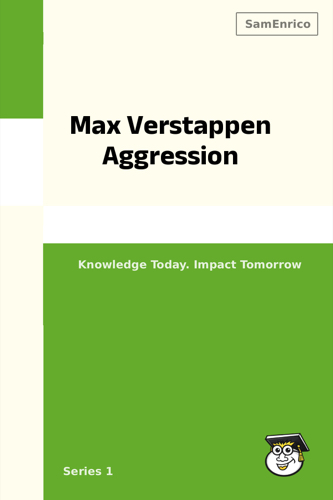
Max Verstappen Aggression eBook
Push rules to limit for championship dominance.
Push rules to limit for championship dominance.
Formats
Free sample
Chapter 1: The Weight of a Bullet...--The first time I watched Max Verstappen drive a Formula 1 car in anger—truly in anger, not just in speed—I was standing in the Turn 3 grandstands at the Circuit de Barcelona-Catalunya. It was 2016, his first season with Red Bull Racing, and I had spent the previous decade writing about drivers who played chess with steering wheels. Fernando Alonso’s surgical precision. Lewis Hamilton’s balletic smoothness. Sebastian Vettel’s metronomic consistency.
These were men who treated racing as a discipline to be mastered.Verstappen treated it as a war to be won.What I witnessed that afternoon was not a pass for position. It was an eviction notice. The driver ahead—I believe it was Kimi Räikkönen, though the victim hardly matters—defended the inside line as every textbook teaches. He left exactly one car’s width on the outside, the universal signal of fair but firm defense. Verstappen ignored the signal.
He placed his front wheel alongside Räikkönen’s rear wheel at the 150-meter board, a mathematical impossibility for a clean pass, and then simply… refused to brake. The two cars entered the corner side-by-side. They exited with Räikkönen’s front wing missing an endplate and Verstappen’s position gained.After the race, Räikkönen said exactly seven words to the press: “That’s not racing. That’s survival.”He was right. And that was the point.The Mistake Everyone Makes About Aggression For twenty years, Formula 1 journalism has made the same elementary error.
We have treated aggression as an emotion—a hot-blooded surge of adrenaline that overrides reason. We write about “feisty” drivers and “fiery” temperaments. We describe wheel-to-wheel combat as though the drivers are gladiators possessed by fury rather than engineers calculating vectors.This book exists to correct that error.Max Verstappen’s aggression is not an emotion. It is a physical dialectic—a conversation conducted through car mass, velocity, and trajectory. When Verstappen squeezes a rival toward the pit wall at 200 miles per hour, he is not angry.
He is communicating. The message is precise, repeatable, and devastatingly effective: Yield, or we both crash.The receiver of that message faces a brutal calculation. Professional race car drivers are not reckless thrill-seekers; they are risk-managers with millions of dollars of machinery, years of physical conditioning, and championship points on the line. When Verstappen presents them with the yield-or-crash ultimatum, their survival instinct triggers before their competitive instinct. They yield.
They always yield. Not because they are cowards, but because they are rational.Verstappen has weaponized rationality against the rational.The 1,800-Pound Argument Let us begin with a number: 1,800 pounds. That is the approximate weight of a Formula 1 car with driver and fuel, rounded for dramatic effect (the technical minimum is 798 kilograms, or 1,759 pounds, but “The 1,759-Pound Argument” lacks the necessary punch). Every driver on the grid commands the same mass. What distinguishes Verstappen is how he uses that mass as an argumentative tool.In classical rhetoric, persuasion relies on three pillars: ethos (credibility), pathos (emotion), and logos (logic).
Verstappen has introduced a fourth pillar: bios—the biological imperative of self-preservation. When two cars approach a corner at 180 miles per hour, and one driver makes it clear that he will not turn the steering wheel any further than absolutely necessary, the other driver’s brain does not consult the rulebook. It consults the amygdala. The amygdala says: Avoid impact. Survive.
Fight another lap.This is not a metaphor. Sports psychologists have documented the phenomenon through biometric data. Rivals who have been “Verstappen’d” show elevated cortisol levels and decreased heart rate variability in subsequent corners—physiological markers of threat response. They are not racing Max Verstappen. They are surviving him.Consider the forensic breakdown of two pivotal moments: the 2021 Abu Dhabi Grand Prix (the title-deciding final lap against Lewis Hamilton) and the 2024 Austrian Grand Prix (the contentious contact with Lando Norris).
In both cases, Verstappen placed his car in positions that the laws of physics and the regulations of the FIA declared illegitimate—but only retrospectively. In the moment, the rival had to decide.At Abu Dhabi, Hamilton entered Turn 5 with the racing line. Verstappen, on fresh soft tires against Hamilton’s worn hards, launched a dive bomb from 0.7 seconds behind. The move was mathematically doomed unless Hamilton yielded. Hamilton yielded.
Not because he lacked courage—the man has seventy championships between his ears—but because the cost of not yielding was a double retirement and a championship decided by a crash instead of a pass. Verstappen knew that. He calculated Hamilton’s risk tolerance and found its upper boundary.At Austria, Norris refused to yield. He held his line, expecting Verstappen to back out. Verstappen did not back out.
The resulting contact punctured both rear tires, cost Norris a certain podium, and handed Verstappen a ten-second penalty that barely affected his final position. The outcome was not a failure of Verstappen’s strategy; it was a demonstration. Norris learned that day that yielding is cheaper than crashing. In every subsequent wheel-to-wheel battle between the two, Norris has left more space. The lesson was expensive but effective.Three Ages of Wheel-to-Wheel Combat To understand Verstappen’s revolution, we must first understand what came before.
The history of Formula 1 aggression is not a straight line from gentlemanly courtesy to modern brutality. It is a three-act drama with a clear turning point.Act I: The Pre-Senna Era (1950–1989)In the early decades of Formula 1, drivers treated each other with a professional courtesy that seems almost alien today. This was not moral superiority; it was practical necessity. Cars were fragile, circuits were deadly, and the championship was often decided by reliability rather than overtakes. Juan Manuel Fangio, five-time world champion, famously said, “You win by finishing, not by fighting.” Drivers gave each other space because the alternative was a flaming wreck and a hospital bed.Even in the turbocharged eighties, when Alain Prost and Nelson Piquet duelled for titles, the gentleman’s agreement held.
Prost was known as “The Professor” for his calculated, low-risk style. Ayrton Senna, who would shatter every norm, was still an outlier rather than an archetype. The default assumption was that a rival who had claimed the inside line would be given the apex. The default assumption was that a pass would be completed before the exit kerb. The default assumption was that racing was a shared project.Act II: The Senna Revolution (1990–1994)Ayrton Senna changed everything.
He did not invent aggression, but he was the first to systematize it—to treat the car as a weapon and the rival’s survival instinct as a vulnerability. His famous quotation—“If you no longer go for a gap that exists, you are no longer a racing driver”—has been repeated so often that it has lost its radical edge. But read it again. Senna did not say “if you no longer go for a gap that is safe.” He said “exists.” A gap exists if the rival has left any space at all, regardless of whether that space is large enough for a car.The 1990 Japanese Grand Prix is the ur-text of modern aggression. Senna entered the first corner…
This is the end of the free sample. Get the eBook to keep going. Buy now
About this book
Details
- Author
- Dunham Gaylene
- Publisher
- SamEnrico
- Language
- English
- Genre
- Non-Fiction, Biography, Verstappen
- Released
- 2026-06-09
- Pages (approx.)
- 134
- Available as
- eBook, Audiobook

Read better in the ZLOADR app
Your eBooks on your phone or tablet. Sign in with your SamEnrico account and start reading.
More by Dunham Gaylene
 Name Recall for Brain InjuryDunham Gaylene$11.99
 Assertiveness Academic GuideDunham Gaylene$11.99
 Florence Harding First LadyDunham Gaylene$11.99
 Tobacco Free Breathing ExercisesDunham Gaylene$11.99
 Relationship Anger Management GuideDunham Gaylene$11.99
 The Spy in the Shadows: The Anna Chapman Espionage TrialDunham Gaylene$11.99
 Adrenal Master GuideDunham Gaylene$11.99
 Fentanyl Crisis Survival GuideDunham Gaylene$11.99
 Whispers in the Lamplight: The Djinn’s Bargain with the PoetDunham Gaylene$11.99
 A Collector's Handbook to the Borgward 1800dDunham Gaylene$11.99
 UK Trade Credit BuildingDunham Gaylene$12.99
 Sci Fi and Space Stock Channel GuideDunham Gaylene$12.99
You may also like
 Hong Kong Handover 1997Dunn Johnnie$11.99
 Zumba For Postnatal Recovery CourseNeal Christian$11.99
 Zumba for BeginnersLadner Nikia$11.99
 YouTube Comment Mining GuideHumes Pandora$12.99
 Worry Box MeditationCarlin Rudy$11.99
 Workplace Stress MeditationNguyen Lynn$11.99
 Workplace Stress and Sleep RepairHawley Ivory$11.99
 Workplace Perfectionism CureDelaney Jeffry$11.99
 Workplace Injustice Anger GuideWallen Isabelle$11.99
 Work Addiction and Burnout LinkGreenwood Ester$11.99
 Women in Yoga and WellnessBeattie Galina$11.99
 Women in Stand Up ComedyChun Evangeline$11.99