
Non-FictionStartup GuideTeam CommunicationCollaboration
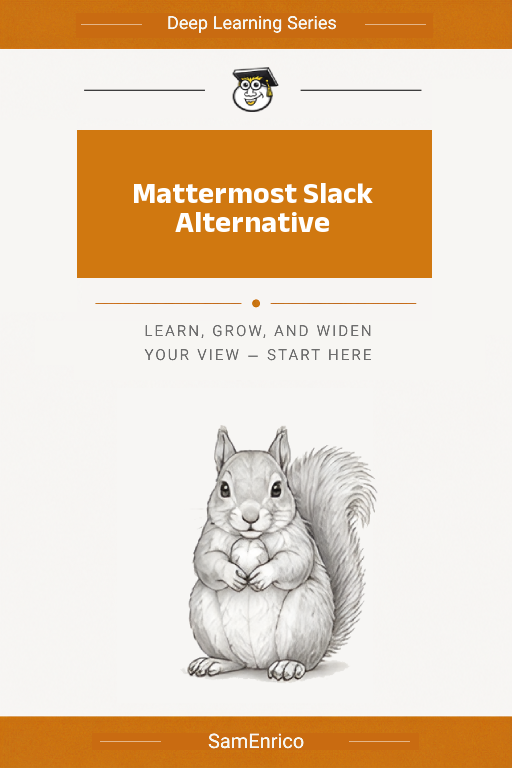
Mattermost Slack Alternative eBook
Collaborate with team chat using free Mattermost i
by Lowell Drew
Collaborate with team chat using free Mattermost instead of paying for Slack premium features.
Formats
Free sample
Chapter 1: The $8.75 Lie--–- The price tag looked innocent enough. 8.75peruserpermonth.That’slessthanalargeartisansandwich,lessthanamovieticket,lessthantwofancycoffees.Whenthe Slack Proupgradedialogappearedonscreen,mostteamleadsclicked“Approve”withoutasecondthought.Afterall,what’s8.75 per user per month. That’s less than a large artisan sandwich, less than a movie ticket, less than two fancy coffees. When the Slack Pro upgrade dialog appeared on screen, most team leads clicked “Approve” without a second thought. After all, what’s 8.75peruserpermonth.That’slessthanalargeartisansandwich,lessthanamovieticket,lessthantwofancycoffees.Whenthe Slack Proupgradedialogappearedonscreen,mostteamleadsclicked“Approve”withoutasecondthought.Afterall,what’s8.75?
The company spends more on office snacks. But here’s what the pricing page doesn’t tell you: $8.75 is the starting price, not the final price. It’s the bait. The hook comes later, buried in a quarterly invoice that makes your finance person choke on their coffee.This chapter is not about hating Slack. Slack is a fine product.
It revolutionized team communication. But its pricing model is designed to punish growth, and the true cost of “just paying for Slack” only reveals itself after you’ve already built your entire workflow around it. By the time you realize you’re overpaying, migration feels impossible. That’s the trap. And this chapter exists to show you the jaws of that trap before you close them around your own budget.The Psychology of Per-Seat Pricing Software companies love per-seat pricing for one simple reason: it scales automatically with your success.
When you hire more people, your software bill increases. That feels fair on the surface. More users, more value, more cost. But hidden beneath this logic is a perverse incentive: the software vendor profits from every single body in your company, regardless of whether that person actively uses the tool.Consider the average sales development representative (SDR). They spend 90% of their day in a CRM and an email client.
They might check Slack twice daily. Yet you pay the same $8.75 for that SDR as you do for your head of engineering who lives inside Slack. Multiply this across marketing, finance, operations, and legal, and you’re paying thousands of dollars annually for users who barely touch the product.Slack knows this. Their entire enterprise sales motion is built around “seat utilization reports” that show you how many of your paid users are inactive. They will happily sell you a tool to identify the waste you’re paying them for.
It’s a beautiful business model: charge customers for something, then charge them again to measure how much they’re wasting on the first thing.But the real deception begins when you outgrow the free tier.The Free Tier: A Museum of Your Own Conversations Slack’s free tier is not free. It’s a time-limited trial disguised as a permanent option. The most famous limitation is the 10,000 message history cap, but that’s only the beginning. Let me walk you through what actually happens when a team uses Slack Free for six months.In month one, everything is wonderful. Your team discovers channels, direct messages, and the delightful chaos of animated emoji reactions.
You create a #random channel where people share pet photos. You build a #announcements channel that reaches everyone. The search function works perfectly, retrieving any message from yesterday or last week.By month three, you notice something strange. A conversation you had with a client two months ago doesn’t appear in search. You scroll up in a busy channel and hit a wall: “This message is from outside your 10k message history window.
Upgrade to view.” The conversation still exists, technically, but it’s locked behind a paywall. Your own words, your own decisions, your own context – held hostage.By month six, the free workspace becomes a museum of amnesia. You can see the last 10,000 messages, which might represent only two weeks of conversation in a busy channel. Everything older is there but invisible. You can’t search it, you can’t reference it, and you certainly can’t export it without upgrading first.
The free tier doesn’t give you team communication. It gives you a preview of team communication, with a “pay to remember” button.Here’s the kicker: Slack does not delete those old messages. They remain on Slack’s servers, occupying storage space, accruing no cost to Slack whatsoever. The limitation is purely artificial – a software switch that hides data you already created. This is not a technical constraint.
It is a deliberate product decision designed to frustrate you into paying.The Hidden Fees They Don’t Show You Slack’s pricing page lists exactly two numbers: Free and Pro ($8.75/user/month). That simplicity is a lie. The real pricing structure contains at least seven hidden costs that only appear after you’ve signed up.Hidden Fee #1: Guest Overages Slack Pro includes five guest accounts. These are external collaborators – contractors, clients, agency partners – who need access to specific channels but not your entire workspace. Five guests sounds reasonable until you realize that a single project might involve three clients, two agencies, and four freelancers.
Each one beyond the fifth costs an additional 2/user/month.Thatdoesn’tsoundlikemuchuntilyouhave20guests,adding2/user/month. That doesn’t sound like much until you have 20 guests, adding 2/user/month.Thatdoesn’tsoundlikemuchuntilyouhave20guests,adding40/month to your bill – a 30% increase on a 10-person team’s base cost.Hidden Fee #2: Idle User Penalties You pay for every seat every month, regardless of whether the person has logged in. That employee on parental leave? You’re paying for them. That intern who worked for three months and left?
You paid for the remaining nine months unless you remembered to deprovision them. That contractor who finished their engagement but still has an active account because nobody told IT? You’re paying for them too. Slack has no “pause” option. There is no reduced rate for infrequent users.
Every human with an email address costs the same $8.75, even if they open Slack once per week.Hidden Fee #3: Message Retention Taxes Slack Pro retains your full message history. That’s the feature, actually. But what about compliance requirements? If you work in finance, healthcare, or legal services, you may need to retain messages for seven years. Slack Business+ (15/user/month)addsretentionpolicies.Slack Enterprise Grid(15/user/month) adds retention policies.
Slack Enterprise Grid (15/user/month)addsretentionpolicies.Slack Enterprise Grid(custom pricing, typically $25-40/user/month) adds legal hold and e-discovery. You are paying a tax to keep your own conversation history accessible for legal reasons – something self-hosted Mattermost does for free.Hidden Fee #4: Workflow Run Limits Slack’s Workflow Builder lets you automate simple tasks: send a welcome message when someone joins a channel, post a form response to a channel, etc. Pro plans include 5,000 workflow runs per month. That sounds generous until you automate daily standups for a 20-person team (600 runs/month), customer feedback collection (200 runs/month), and onboarding checklists (50 runs/month per new hire). Exceed 5,000 runs, and your workflows start failing until the next billing cycle.
To get unlimited runs, you need Business+ at $15/user/month.Hidden Fee #5: API Rate Limit Throttling Slack’s API allows 50 requests per second per app. That’s plenty for most integrations until you have multiple bots, custom slash commands, and third-party connectors all competing for the same…
This is the end of the free sample. Get the eBook to keep going. Buy now
About this book
Details
- Author
- Lowell Drew
- Publisher
- SamEnrico
- Language
- English
- Genre
- Non-Fiction, Startup Guide, Team Communication, Collaboration
- Released
- 2026-05-29
- Pages (approx.)
- 154
- Available as
- eBook, Audiobook

Read better in the ZLOADR app
Your eBooks on your phone or tablet. Sign in with your SamEnrico account and start reading.
More by Lowell Drew
 Group Creative Playbook For Managers ManualLowell Drew$11.99
 The Instagram Lead Generation GuideLowell Drew$11.99
 Remote Worker Burnout GuideLowell Drew$11.99
 IBS Food Diary WorkbookLowell Drew$11.99
 Feeling Ignored Trigger RecognitionLowell Drew$11.99
 Silent Weavers: The 1934 Passaic Textile Strike and the Birth of Labor SolidarityLowell Drew$11.99
 How to Start a Hobby in R/C BoatsLowell Drew$11.99
 Associate Client ExecutiveLowell Drew$11.99
 Tuck In Acquisition TargetsLowell Drew$12.99
 Understanding Chromosome Chromosome 1Lowell Drew$17.99
You may also like
 Hong Kong Handover 1997Dunn Johnnie$11.99
 Zumba For Postnatal Recovery CourseNeal Christian$11.99
 Zumba for BeginnersLadner Nikia$11.99
 YouTube Comment Mining GuideHumes Pandora$12.99
 Worry Box MeditationCarlin Rudy$11.99
 Workplace Stress MeditationNguyen Lynn$11.99
 Workplace Stress and Sleep RepairHawley Ivory$11.99
 Workplace Perfectionism CureDelaney Jeffry$11.99
 Workplace Injustice Anger GuideWallen Isabelle$11.99
 Work Addiction and Burnout LinkGreenwood Ester$11.99
 Women in Yoga and WellnessBeattie Galina$11.99
 Women in Stand Up ComedyChun Evangeline$11.99