
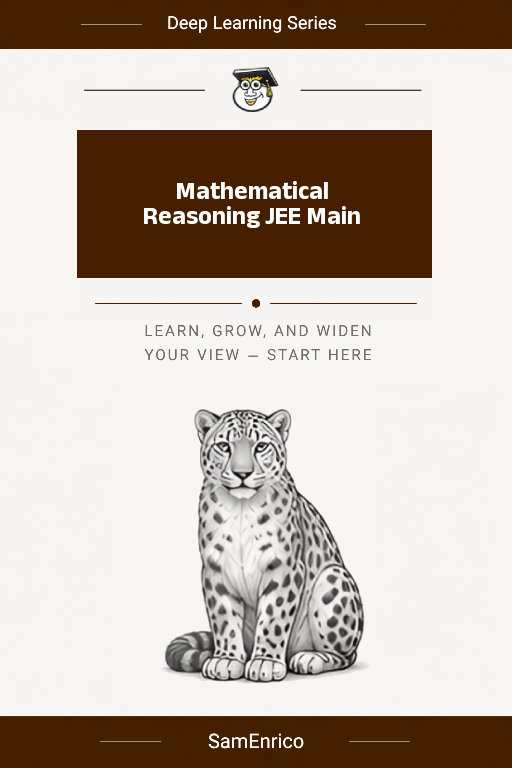
Mathematical Reasoning JEE Main eBook
Solve logical statements truth tables and tautolog
Solve logical statements truth tables and tautology problems for simple scoring marks.
Formats
Free sample
Chapter 1: The Free Candy...–- JEE Main is a battlefield. Every year, over a million students charge into its gates, armed with calculus textbooks, algebra shortcuts, and geometry theorems. They spend months mastering derivatives, perfecting quadratic equations, and memorizing trigonometric identities. And yet, when the results arrive, a brutal truth emerges: thousands of students who solved complex integration problems still fall short of their target percentile. Why?
Because they ignored the one topic that offers guaranteed marks with minimal effort. They overlooked the free candy.This chapter is not about logic. Not yet. This chapter is about strategy. It is about understanding the JEE Main examination as a game—a game where knowing where to invest your limited time matters more than knowing everything.
Mathematical Reasoning is the most efficient scoring zone in the entire JEE Main syllabus. Efficiency, not difficulty, is what separates toppers from the rest. A problem from Calculus might take you three to four minutes of derivations, substitutions, and checks. A problem from Mathematical Reasoning should take you forty-five seconds or less. And the marks are exactly the same: four marks per correct answer.Think about that for a moment.
Four marks for four minutes of calculus work. Four marks for forty-five seconds of logical reasoning. Which one gives you a better return on your time? The answer is obvious. Yet every year, students walk into the exam hall unprepared for Reasoning questions.
They guess. They panic. They draw messy truth tables that take five minutes and still get the answer wrong. And then they leave four marks on the table—marks that could have pushed their percentile from 95 to 97, from 97 to 99.This book exists because that should never happen to you.The JEE Main Blueprint: What the Data Tells Us Let us look at the facts. Over the past ten years of JEE Main examinations, Mathematical Reasoning has appeared with remarkable consistency.
You will see exactly one to two questions from this unit in every paper. That is approximately four to eight marks. On the surface, that seems small. But here is what the data does not tell you at first glance: the accuracy rate for Reasoning questions among top scorers is nearly ninety-five percent. The accuracy rate for calculus questions among the same group is barely seventy percent.Why such a dramatic difference?
Because Reasoning questions do not test computational stamina. They test clarity of thought. They test whether you understand the difference between "OR" in everyday English and "OR" in logic. They test whether you know that a false statement implying another false statement is actually considered true. These are not mathematical skills in the traditional sense.
They are thinking skills. And thinking skills, once learned, are remarkably stable under exam pressure.Consider the typical distribution of questions in JEE Main Mathematics:Topic Area Approximate Questions Time per Question (Average)Accuracy Rate (Toppers)Calculus8-103-4 minutes65-70%Algebra6-82-3 minutes70-75%Coordinate Geometry4-62-3 minutes70-75%Trigonometry2-41.5-2 minutes75-80%Vector & 3D2-42-3 minutes70-75%Mathematical Reasoning1-245 seconds90-95%The pattern is unmistakable. Mathematical Reasoning is the highest-accuracy, lowest-time-investment topic on the entire syllabus. In the time it takes you to solve one moderately difficult calculus problem, you could solve four Reasoning problems and guarantee all of them correct. This is not a guess.
This is the mathematics of test-taking.The High-Scoring Zone: Why Toppers Call It "Free Candy"There is a phrase that circulates among JEE toppers in coaching institutes across the country. When they talk about Mathematical Reasoning, they do not call it a topic. They do not call it a chapter. They call it "free candy." The metaphor is perfect. Candy requires no cooking, no preparation, no complex recipe.
You simply pick it up and enjoy it. Similarly, Reasoning questions require no heavy calculations, no lengthy derivations, no memorized formulas. You simply apply a few clear rules and collect your marks.But if it is so easy, why do so many students lose marks on Reasoning questions? The answer is not lack of intelligence. It is lack of preparation.
Most students spend ninety-five percent of their study time on calculus and algebra, assuming that Reasoning is "common sense" that does not need practice. This is a catastrophic error. Common sense is not common. Logical reasoning is a formal discipline with specific rules, and those rules must be learned, practiced, and internalized just like any other subject.Let me give you an example. Consider this simple statement: "If it is raining, then the ground is wet." In everyday language, most people would say this statement is true.
Now consider a variation: "If it is raining, then the ground is dry." Everyone agrees that is false. But here is the question that confuses thousands of JEE aspirants every year: What is the truth value of "If it is NOT raining, then the ground is NOT wet"?Instinctively, many students say this statement is true. After all, if there is no rain, the ground should be dry, right? Wrong. The ground could be wet from a sprinkler, a hose, or a spilled bucket.
The statement "If not raining, then not wet" is actually false in many real-world scenarios. But here is the kicker: in formal logic, we are not evaluating real-world possibilities. We are evaluating strict conditional relationships. And the correct answer depends entirely on the truth values assigned to the component statements.This is why Reasoning requires dedicated study. Your intuition will betray you.
The rules of formal logic sometimes contradict everyday thinking. And JEE examiners know this. They design questions specifically to trap students who rely on intuition rather than formal rules. The toppers who call Reasoning "free candy" are not being flippant. They are being strategic.
They have invested the small amount of time needed to master the rules, and now they collect their marks effortlessly.The Four Question Types: Your Complete Roadmap Throughout this book, we will focus on four and only four question types. Master these four types, and you will answer every single Mathematical Reasoning question on the JEE Main paper correctly. No exceptions.Type 1: Truth Tables. These questions ask you to determine the truth value of a compound statement given specific truth values for its components. For example: "If p is true and q is false, what is the truth value of (p ∧ q) → p?" You will learn to answer such questions in seconds, not minutes.Type 2: Tautology Checks.
These questions ask whether a given compound statement is always true regardless of the truth values of its components. For example: "Is (p ∨ ∼p) a tautology?" You will learn multiple methods to check tautologies, from systematic truth tables to the lightning-fast "Look for F" trick.Type 3: Logical Equivalence. These questions ask which of several statements is logically equivalent to a given statement. For example: "Which of the following is logically equivalent to 'If it rains, then the ground is wet'?" You will learn that the contrapositive is your best friend and that the converse and inverse are traps.Type 4: Quantifiers. These questions involve statements about "all," "some," or "there exists." For example: "What is the negation of 'All prime numbers…
This is the end of the free sample. Get the eBook to keep going. Buy now
About this book
Details
- Author
- Buchanan Nick
- Publisher
- SamEnrico
- Language
- English
- Genre
- Non-Fiction, Student's Shortcut
- Released
- 2026-06-01
- Pages (approx.)
- 126
- Available as
- eBook, Audiobook

Read better in the ZLOADR app
Your eBooks on your phone or tablet. Sign in with your SamEnrico account and start reading.
More by Buchanan Nick
 Emergency Dispatch Stress GuideBuchanan Nick$11.99
 LGBTQ Aging PlanningBuchanan Nick$11.99
 Body Image And Self Esteem In Midlife GuideBuchanan Nick$11.99
 Arches National Park VanishedBuchanan Nick$11.99
 Gobi Desert Survival GuideBuchanan Nick$11.99
 Eye Rolling as ContemptBuchanan Nick$11.99
 Creditors Committee ParticipationBuchanan Nick$11.99
 Mindful Grocery ShoppingBuchanan Nick$11.99
 The Velvet Revolution: How a 20-Year-Old Designer Toppled a Fashion DynastyBuchanan Nick$11.99
 Anansi the Weaver and the Round Table’s Greatest TestBuchanan Nick$11.99
 Ultimate Handbook Guide to Leiyang : (China) Travel GuideBuchanan Nick$11.99
 Agile Scrum FundamentalsBuchanan Nick$11.99
You may also like
 Hong Kong Handover 1997Dunn Johnnie$11.99
 Zumba For Postnatal Recovery CourseNeal Christian$11.99
 Zumba for BeginnersLadner Nikia$11.99
 YouTube Comment Mining GuideHumes Pandora$12.99
 Worry Box MeditationCarlin Rudy$11.99
 Workplace Stress MeditationNguyen Lynn$11.99
 Workplace Stress and Sleep RepairHawley Ivory$11.99
 Workplace Perfectionism CureDelaney Jeffry$11.99
 Workplace Injustice Anger GuideWallen Isabelle$11.99
 Work Addiction and Burnout LinkGreenwood Ester$11.99
 Women in Yoga and WellnessBeattie Galina$11.99
 Women in Stand Up ComedyChun Evangeline$11.99