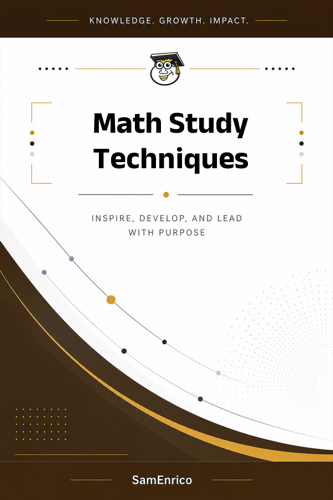
Math Study Techniques Audiobook
Solves problems and understands proofs.
by Larsen Ludie
Solves problems and understands proofs.
Formats
Free sample
Chapter 1: The Unspoken Barrier–- Maria stared at the blank page. The exam prompt read: “Prove that the square root of 2 is irrational.” She had seen this proof before. She had nodded along in lecture. She had even highlighted the steps in her textbook. But now, with forty-five minutes on the clock, her mind was a wall of fog.
She could recite definitions: “An irrational number cannot be expressed as a ratio of integers.” She could remember fragments: “Assume √2 = a/b in lowest terms… then square both sides…” But the logical chain would not hold together. She wrote three false starts, crossed them out, and finally scribbled something incomplete. She left the exam hall feeling like a fraud.Six months earlier, Maria had aced calculus. She memorized derivative rules, practiced integration techniques, and solved every odd-numbered problem at the back of the chapter. She believed she knew math.
But proof-based mathematics revealed the difference between performing calculations and understanding structure. Her old study methods—re-reading, highlighting, memorizing solution steps—had crumbled like cheap plaster under real pressure.Maria is not alone. Every year, thousands of students transition from computational courses (algebra, calculus, differential equations) to proof-based courses (real analysis, abstract algebra, number theory, linear algebra with proofs). And every year, a significant fraction crash. Not because they are less intelligent.
Not because they lack effort. But because no one taught them how to study mathematics differently.This chapter is about that hidden barrier. It is about the psychological and behavioral shifts that must happen before any technique—any heuristic, any logical rule, any proof template—can take root. You cannot build a house on a cracked foundation. And you cannot learn proof-based mathematics with a high-school-study mindset.The Illusion of Comprehension Let us begin with an uncomfortable truth: Understanding a proof when someone else explains it is not the same as being able to construct it yourself.Psychologists call this the illusion of comprehension.
When you listen to a lecture or read a textbook solution, your brain creates a satisfying narrative. The steps flow logically. The conclusion follows inevitably. You think, “I get it.” But here is the trap: the lecturer or author has already done the hard work—choosing the strategy, unpacking the definitions, spotting the hidden connection. You are merely following a trail that someone else blazed.Research in cognitive science (Roediger & Karpicke, 2006) shows that students who re-read…
This is the end of the free sample. Get the Audiobook to keep going. Buy now
About this book
Details
- Author
- Larsen Ludie
- Publisher
- SamEnrico
- Language
- English
- Genre
- Non-Fiction, Student's Shortcut, Mathematics
- Released
- 2026-06-08
- Pages (approx.)
- 147
- Available as
- eBook, Audiobook

Listen in the VoxFlicks app
Audiobooks and audio dramas wherever you go. Sign in with your SamEnrico account and press play.
More by Larsen Ludie
 Missionary Kid Identity RecoveryLarsen Ludie$11.99
 Anger De escalation for VeteransLarsen Ludie$11.99
 Medical Record RequestsLarsen Ludie$11.99
 Small Talk for Introverts WorkbookLarsen Ludie$11.99
 Nightmare Processing Movement TherapyLarsen Ludie$11.99
 Facial Composite SoftwareLarsen Ludie$11.99
 Control Loss TriggersLarsen Ludie$11.99
 The Rajah's Ransom: The 1892 Bombay Hostage Crisis and the Bollywood UnderworldLarsen Ludie$11.99
 Tipu's Last Stand: The Siege of Seringapatam (1799)Larsen Ludie$11.99
 How to Produce GPS MountsLarsen Ludie$11.99
 A Collector's Handbook to the Daimler LimousineLarsen Ludie$11.99
 Business Loan Prepayment Penalty GuideLarsen Ludie$12.99