
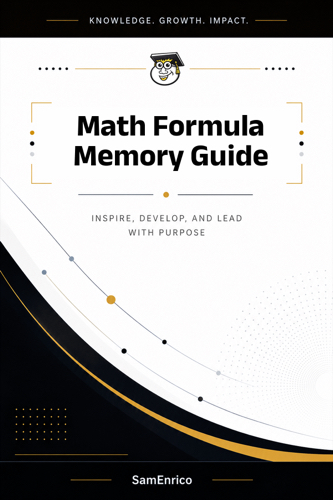
Math Formula Memory Guide eBook
Remembers equations through pattern recognition.
Remembers equations through pattern recognition.
Formats
Free sample
Chapter 1: The Architecture Hunt--–- You have memorized the quadratic formula before. Probably more than once. Perhaps you wrote it on a flashcard. Perhaps you chanted it in a study group at 11 PM, fueled by cold pizza and desperation. And yet, here you are, staring at a problem set or an exam review, and the formula has vanished from your mind like a dream moments after waking.This is not because you have a bad memory.This is because you were taught to memorize symbols instead of hunting for architecture.Every formula is a building.
The symbols are the bricks. But bricks alone, scattered on the ground, are not a building. They are rubble. What turns bricks into a cathedral is structure: arches, columns, symmetry, repetition, proportion. Yet when most students study math, they pick up each brick individually and hope the building assembles itself inside their skull.
It never does. Then they conclude, falsely, that they are "not a math person."The truth is far more liberating. Your brain is not a hard drive designed to store isolated facts. It is a pattern-matching machine, honed by millions of years of evolution to detect structure in chaos. You can spot a face in a cloud.
You can hear a melody from a handful of notes. You can recognize a friend's gait from a hundred meters away. This same machinery, applied to formulas, turns memorization into recognition.This chapter hunts for the hidden architecture inside every equation. By the end, you will never again see formulas as random strings of symbols. You will see patterns.
And once you see the pattern, the formula becomes unforgettable.The Cathedral Not the Bricks Let us begin with a simple experiment. Look at the following string of letters for five seconds:MDPh DVMDBJFKFBINow look away. Try to recall the sequence.Difficult, isn't it? The letters feel random. They slide off memory like water off glass.Now look at this sequence for five seconds:FBIJFKMDPh DVMThis looks equally random at first.
But if you know that FBI, JFK, MD, Ph D, and VM are all common abbreviations, the sequence becomes five chunks instead of twelve letters. Suddenly it is easy. Your brain did not get smarter. It got more structure.Formulas work the same way. The quadratic formula appears as a terrifying string of symbols:x=−b±b2−4ac2ax = \frac{-b \pm \sqrt{b^2 - 4ac}}{2a}x=2a−b±b2−4acBut when you learn to see it as three chunks—"neg b," "plus or minus square root of b squared minus 4ac," "all over 2a"—the cognitive load collapses.
What looked like ten separate elements becomes three meaningful groups.This is called chunking. It is the single most powerful tool in the memory toolkit. Psychologists have known for decades that working memory can hold approximately seven items at once. But those items can be individual digits or entire chunks of meaning. A chess master does not remember the position of thirty-two pieces individually.
They remember five or six meaningful configurations—"king-side castle formation," "isolated queen pawn"—and from those configurations, the individual pieces reconstruct themselves automatically.Mathematical chunking works exactly the same way. When you look at the formula for the area of a circle, A=πr2A = \pi r^2A=πr2, you do not see four symbols. You see one chunk: "area equals pi r squared." When you look at the formula for kinetic energy, Ek=12mv2E_k = \frac{1}{2}mv^2Ek=21mv2, you see another chunk: "one half m v squared." And when you realize that both formulas share the same underlying shape—a constant times a quantity squared—you have discovered architecture.That is what this chapter hunts for.The Seven Pillars of Formula Architecture Every formula in algebra, calculus, physics, and statistics rests on one or more of seven fundamental patterns. Think of these patterns as the pillars of a cathedral. They are not the formulas themselves.
They are the structural principles that generate formulas. Once you know the pillars, you can reconstruct any formula built upon them.The seven patterns are:1. Symmetry A formula exhibits symmetry when one side mirrors the other in a meaningful way. In even functions, f(−x)=f(x)f(-x) = f(x)f(−x)=f(x), the left side mirrors the right side exactly. In odd functions, f(−x)=−f(x)f(-x) = -f(x)f(−x)=−f(x), the mirror includes a sign flip.
In conservation laws, the quantity before an event equals the quantity after—a temporal symmetry. Symmetry is memory's best friend because you only need to remember one side. The other side follows automatically.2. Recursion A recursive formula refers to itself. The most famous example is the Fibonacci sequence: Fn=Fn−1+Fn−2F_n = F_{n-1} + F_{n-2}Fn=Fn−1+Fn−2.
Each term is defined by previous terms. Compound interest is recursive: At+1=At×(1+r)A_{t+1} = A_t \times (1 + r)At+1=At×(1+r). Recursion creates loops in memory. Instead of remembering a long list of values, you remember a rule and a starting point.3. Scaling Scaling describes how a quantity changes when its inputs grow or shrink.
If you double the radius of a circle, the area quadruples. That is quadratic scaling: A∝r2A \propto r^2A∝r2. If you double the velocity of a moving object, the kinetic energy quadruples. Same scaling. If you double the side length of a square, the area quadruples.
Same scaling. Scaling is the pattern that connects geometry, physics, and algebra across apparent boundaries.4. Distribution Distribution describes how operations spread across terms. The distributive law, a(b+c)=ab+aca(b + c) = ab + aca(b+c)=ab+ac, is the simplest example. But distribution appears everywhere: the integral of a sum is the sum of integrals.
The derivative of a sum is the sum of derivatives. The logarithm of a product is the sum of logarithms. Distribution turns complex expressions into simpler pieces.5. Conservation Conservation says something stays constant even as other things change. Energy conservation: Einitial=Efinal E_{\text{initial}} = E_{\text{final}}Einitial=Efinal.
Momentum conservation. Mass conservation. Charge conservation. Conservation is a memory spine because it gives you a fixed point. If you forget the details of a transformation, you can ask: "What must remain the same?" That question often reconstructs the missing pieces.6.
Unit-Derivable A unit-derivable formula can be reconstructed from its units alone. If you know that force is measured in kg⋅m/s2\text{kg} \cdot \text{m/s}^2kg⋅m/s2, you know that force must be mass times acceleration. There is no alternative. Power is kg⋅m2/s3\text{kg} \cdot \text{m}^2/\text{s}^3kg⋅m2/s3. That could be force times velocity, current times voltage, or energy per time.
Units narrow the possibilities dramatically. When you forget a physics formula, you can derive it from scratch using nothing but unit fingerprints.7. Narrative Narrative formulas tell a story with a beginning, middle, and end. Bayes' theorem is the story of updating beliefs when evidence arrives. Integration by parts is the story of swapping roles between two functions.
The quadratic formula is the story of finding roots through completing the square. Narrative turns abstract symbols into sequences of…
This is the end of the free sample. Get the eBook to keep going. Buy now
About this book
Details
- Author
- Acevedo Francesca
- Publisher
- SamEnrico
- Language
- English
- Genre
- Non-Fiction, Self-Help, Mathematics
- Released
- 2026-06-06
- Pages (approx.)
- 151
- Available as
- eBook, Audiobook

Read better in the ZLOADR app
Your eBooks on your phone or tablet. Sign in with your SamEnrico account and start reading.
More by Acevedo Francesca
 Breaking Free From Alcohol DependenceAcevedo Francesca$11.99
 Male Fertility Age GuideAcevedo Francesca$11.99
 Franchising Your Local Brand Across Borders Visual IdentityAcevedo Francesca$11.99
 NVC Grief Processing GuideAcevedo Francesca$11.99
 Drug Influenced DisappearancesAcevedo Francesca$11.99
 Cocaine and DUIAcevedo Francesca$11.99
 Section 202 Housing GuideAcevedo Francesca$11.99
 The Siege of Manila: Blood in the Philippines (1899)Acevedo Francesca$11.99
 Jörmungandr and the Jade Serpent: A Norse-Dragon ClashAcevedo Francesca$11.99
 Mastering The Art of Cheena DiAcevedo Francesca$11.99
 How to Produce Stacking Racks and ShelvesAcevedo Francesca$11.99
 How to Produce Grease GunsAcevedo Francesca$11.99
You may also like
 Math Pattern RecognitionMull Lulu$11.99
 Dreaming for Math ProblemsOhara Louie$11.99
 Math Formula PalaceKarr Krysta$11.99
 Benzo Taper Calculator WorkbookNickel Kirstie$11.99
 Pattern Recognition in MathLea Gwenn$11.99
 Memory Palace For MathematicsSinger Cristine$11.99
 Math SRS Card DesignMarch Digna$11.99
 Anki For Math FormulasCorreia Eugena$11.99