
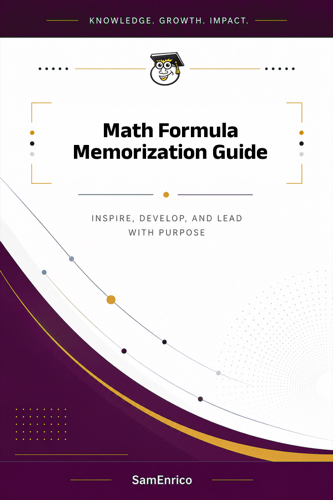
Math Formula Memorization Guide eBook
Understand derivations and use pattern recognition
by Mead Chloe
Understand derivations and use pattern recognition to recall equations.
Formats
Free sample
Chapter 1: The Memorization Lie--You have been lied to about how memory works.Not by malicious actors, necessarily. Not by teachers who wanted you to fail. But by a system that confuses recognition with knowing, that rewards the temporary cram and punishes the deep understanding. The lie sounds reasonable. It sounds like common sense.
It sounds like this: If you repeat something enough times, you will remember it.This is false.Or rather, it is partially true in the most useless way possible. Yes, repetition can lodge a fact into your short-term memory. You can stare at a flashcard that says "Area of a circle = πr²" fifty times, and five minutes later you might recite it. But ask yourself what happens a week later, when you are sitting in an exam room, the clock is ticking, and your mind goes blank. The formula you "knew" has vanished.
Worse, you have no way to get it back because you never understood why it was πr² in the first place. You only knew that it was πr².This chapter is about unlearning that lie. It is about understanding how your brain actually encodes, stores, and retrieves mathematical information. And it is about replacing the fragile, temporary strategy of rote repetition with three durable pillars that will serve you for the rest of your mathematical life: Derivation, Pattern Recognition, and Visualization.By the end of this chapter, you will not have memorized a single new formula. Instead, you will have learned how to learn formulas.
You will understand why your past efforts have felt so difficult and why a different approach will feel almost effortless in comparison. And you will be introduced to the two fundamental patterns that underlie nearly every formula you will ever encounter.The Cognitive Science of Forgetting Let us start with a simple experiment. Read the following sequence of numbers once, then close your eyes and try to repeat them:3 1 4 1 5 9 2 6 5 3 5 8 9 7 9 3Difficult, right? Most people can hold between five and nine random digits in working memory before the information degrades. This is not a personal failing.
It is a biological constraint. The psychologist George Miller famously described it as "The Magical Number Seven, Plus or Minus Two" – the capacity of our short-term memory for unrelated, unpatterned information.Now try this sequence:1 4 9 1 6 2 5 3 6 4 9 6 4 8 1 1 0 0Still difficult. But if you recognize these as the squares of the numbers from one to ten (1²=1, 2²=4, 3²=9, 4²=16, 5²=25, 6²=36, 7²=49, 8²=64, 9²=81, 10²=100), the sequence becomes trivially easy to remember. You are not holding seventeen random digits anymore. You are holding a rule: "List the squares from 1 to 10." The cognitive load drops from seventeen units of information to one.This is the difference between rote recall and pattern recognition.Rote recall treats each piece of information as an isolated island.
Your brain must store every island separately, build a bridge to every other island, and maintain all those bridges indefinitely. This is metabolically expensive and evolutionarily unsound. Your brain did not evolve to store quadratic formulas. It evolved to recognize predators, find food, and navigate social relationships.Pattern recognition, by contrast, treats information as a connected web. Your brain stores the relationships between pieces of information, not the pieces themselves.
When you need a specific fact, you do not retrieve it from a dusty file cabinet. You reconstruct it from the relationships you have stored.Here is the truth that will transform your approach to mathematics: Your brain is a pattern-matching machine, not a hard drive.Every time you have struggled to remember a formula, it was not because your memory was bad. It was because you were trying to use your brain as a hard drive when it is fundamentally designed to be something else. You were fighting your own neurobiology.The implications are radical. If you stop trying to store formulas and start trying to understand the patterns from which formulas emerge, you will find that the formulas remember themselves.
They become inevitable. They become the only logical conclusion given the starting assumptions.The Three Pillars: Derivation, Pattern Recognition, and Visualization Throughout this book, you will encounter three core strategies. Think of them as three lenses. Any formula you encounter can be understood through one or more of these lenses. And any formula you understand through these lenses will never need to be memorized.Pillar One: Derivation Derivation is the process of building a formula from first principles.
It answers the question: Where does this formula come from?Most math education presents formulas as finished products, like cakes pulled from an oven. You never see the ingredients. You never see the mixing process. You never see why the cake rises. You are just told: "This is the cake.
Eat it. Remember its taste for the exam."Derivation is the recipe. It is the logical chain of reasoning that starts with something simple and obvious (an axiom, a definition, a geometric relationship) and ends with the formula you need.Consider the quadratic formula. Most students memorize: x = [-b ± √(b² - 4ac)] / 2a. They recite it like a magic spell.
But if you forget the magic spell, you have no backup. If you know the derivation, however, you can rebuild the quadratic formula from scratch in under two minutes by completing the square on ax² + bx + c = 0. You do not need to remember the formula. You need to remember the method. The formula is just the method written in shorthand.Derivation transforms you from a passive consumer of formulas into an active participant in their creation.
It gives you the power to reconstruct what you have forgotten. And it gives you the confidence that comes from knowing why something works, not just that it works.Pillar Two: Pattern Recognition Pattern recognition is the process of seeing the underlying structure beneath the surface variation. It answers the question: What kind of relationship is this?In this book, we will use a precise, unified definition of pattern recognition: Pattern recognition means asking, "What is the relationship between the quantities as one of them changes?"This single question reveals whether you are looking at linear growth (constant addition), exponential growth (constant multiplication), periodic behavior (repeating cycles), or something else entirely. Once you know the pattern, you know which derivation rules apply.For example, consider the formulas for the perimeter of a square (4s) and the distance traveled at constant speed (d = rt). These appear to be completely different formulas from different domains of mathematics.
But pattern recognition reveals they are identical in structure: both are linear relationships of the form y = kx. The perimeter changes by adding 4 every time the side length increases by 1. The distance changes by adding r every time time increases by 1. Same pattern. Same derivation rules.Pattern recognition allows you to transfer knowledge from one domain to another.
You do not need to memorize a hundred different linear formulas. You need to recognize the linear pattern once. Everything else is just renaming the variables.Pillar Three: Visualization Visualization is the process of turning abstract symbols into spatial pictures. It answers the question: What would this look like if I drew it?Your brain has dedicated, massively parallel hardware for processing visual and spatial information. You can recognize a face in a fraction of a second.
You can navigate a crowded room without bumping into furniture. You can catch a thrown ball by intuitively solving differential…
This is the end of the free sample. Get the eBook to keep going. Buy now
About this book
Details
- Author
- Mead Chloe
- Publisher
- SamEnrico
- Language
- English
- Genre
- Non-Fiction, Self-Help, Math Learning
- Released
- 2026-06-10
- Pages (approx.)
- 135
- Available as
- eBook, Audiobook

Read better in the ZLOADR app
Your eBooks on your phone or tablet. Sign in with your SamEnrico account and start reading.
More by Mead Chloe
 Relapse Prevention Coping Skills WorkbookMead Chloe$11.99
 Patrouille de France PilotMead Chloe$11.99
 Career Transition for Manufacturing WorkersMead Chloe$11.99
 Melancholic Depression GuideMead Chloe$11.99
 Creative Professional Energy GuideMead Chloe$11.99
 Disappointment In FriendsMead Chloe$11.99
 Broken Home Resilient ChildMead Chloe$11.99
 Atomic Bomb Effects on Japanese CitiesMead Chloe$11.99
 Timur the Lame: The Iron Conqueror's Bloody MonopolyMead Chloe$11.99
 The Last Dance of the Red Baron: Aerial Acrobatics and the Birth of DogfightingMead Chloe$11.99
 Black Gold and Iron: The Rise and Fall of the Hanseatic League's Salt MonopolyMead Chloe$11.99
 Sales Script A B Testing GuideMead Chloe$12.99