
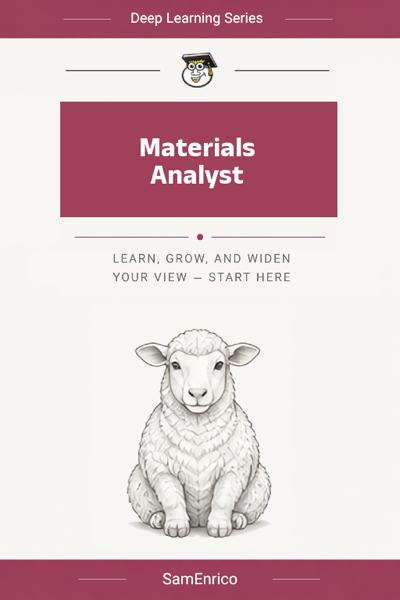
Non-FictionInformativeEducational
Materials Analyst eBook
A Coursebook on Materials Analyst
A Coursebook on Materials Analyst
Formats
Free sample
Chapter 1: The Day the Wing Fell Off--–- The aluminum skin peeled back like a banana. At 24,000 feet, with the Pacific Ocean rushing past at 320 knots, a five-foot-long section of fuselage on Aloha Airlines Flight 243 simply... detached. The cabin depressurized instantly. A flight attendant standing in the aisle was sucked out of the aircraft and fell to her death.
Eight more passengers were seriously injured. The pilots managed to land the crippled Boeing 737 at Kahului Airport, Maui, but when investigators walked around the wreckage, they saw something impossible: the top half of the first-class cabin was simply gone.What kind of event tears a commercial airliner open at cruising altitude? Not a bomb. Not a missile. Not a structural overload from turbulence.A crack.
A crack smaller than a fingernail. A crack that started in a rivet hole and grew, cycle by cycle, flight by flight, until the fuselage could no longer contain the pressure difference between the cabin and the outside air.That crack had been growing for months. Maybe years. And no one saw it coming.This is not a book about airplanes. This is a book about why things break.
And more importantly, this is a book about the person who figures out why things break before they kill people: the Materials Analyst.The Three Questions That Define an Analyst Every day, somewhere in the world, a Materials Analyst sits down at a bench with a broken part, a suspicious test result, or a design drawing and asks three questions:First: Is this material what it is supposed to be? This is the language of QA/QC—Quality Assurance and Quality Control. A shipment of steel arrives at a bridge fabrication plant. Is it really ASTM A572 Grade 50, or did the supplier substitute something cheaper? A batch of aluminum forgings came out of the heat treatment furnace.
Did they reach the proper temper? A hospital receives a shipment of titanium hip implants. Is every single one made from the certified alloy, or is there a counterfeit in the box? These questions sound simple, but the answers can mean the difference between a structure that stands for fifty years and one that collapses in fifty seconds.Second: Does this new material perform better than the old one? This is the language of R&D—Research and Development.
An aerospace company has developed a new aluminum-lithium alloy that promises to be 15% lighter than conventional aluminum. Does it actually resist fatigue better, or does it crack sooner? A battery manufacturer claims their new nickel-manganese-cobalt cathode will last twice as many charge cycles. How do you prove it? A startup has invented a self-healing polymer coating.
When does it stop healing? These questions require not just testing, but testing that is comparative, statistically valid, and replicable.Third: Why did this component fail? This is the language of Failure Analysis. An oil pipeline ruptured, spilling fifty thousand gallons into a river. Was it corrosion?
A weld defect? A manufacturing flaw? A design error? Or all of the above working together? A helicopter rotor hub cracked during routine flight.
The pilot landed safely—this time. But the next one might not. A medical implant fractured inside a patient's femur. Was the titanium alloy defective, or did the surgeon damage it during installation? These questions require forensic thinking, microscopic examination, and the ability to reconstruct a timeline of damage that may have taken years to unfold.There is a fourth question, and it is increasingly important in modern engineering: What material should the designer choose?
This is the language of Design Support. A team of mechanical engineers is designing a new electric vehicle battery enclosure. It needs to be light, stiff, impact-resistant, fire-resistant if the battery overheats, and cheap enough to manufacture by the hundreds of thousands. The engineers know how to shape metal. They do not always know which metal to shape.
The Materials Analyst steps in with Ashby charts, performance indices, and a deep understanding of manufacturing constraints to guide the decision before a single prototype is built.These four questions define the entire professional identity of a Materials Analyst. Everything in this book—every microscope, every tensile test, every fracture surface, every phase diagram—exists to answer one of those questions.But before we look at any tools, we need to understand the mindset that separates a competent technician from a true analyst.The Scientific Method, Applied to Metal A technician runs tests. An analyst runs experiments. The difference is subtle but profound.A technician receives a sample, places it in a machine, presses a button, and records a number. If the number falls within a specification range, they pass the sample.
If not, they reject it. This is valuable work, and it keeps factories running. But it does not require understanding.An analyst starts with a hypothesis. A hypothesis is an educated guess about what is true, stated in a way that can be proven false. Not "maybe the steel is weak," but "the steel has a yield strength below 50,000 psi because the heat treatment was interrupted before the quench." That second statement is testable.
It predicts something specific. And if you test it and find the yield strength is actually 70,000 psi, the hypothesis is falsified, and you move on to the next hypothesis.This is the scientific method applied to materials: observe, hypothesize, predict, test, validate or falsify, repeat.Consider a real example. A manufacturing plant produces thousands of steel shafts per week for automotive transmissions. One week, five percent of the shafts fail during final assembly—they snap when a technician applies a specified torque. The plant manager is frantic.
The production line is stopped. Every hour of downtime costs $50,000.A technician might simply test the failed shafts, find they have low hardness, and report: "Hardness below specification." That tells the plant nothing about why the hardness is low.An analyst asks: what changed? The steel supplier? The heat treatment furnace temperature? The quenching oil?
The tempering time? Each of these is a hypothesis.Hypothesis 1: The steel chemistry is wrong. The analyst pulls samples from the failed shafts and sends them for optical emission spectroscopy (which we will cover in Chapter 4). The carbon content is 0.42%—exactly where it should be for this grade. Chromium, manganese, molybdenum: all within tolerance.
Hypothesis falsified.Hypothesis 2: The austenitizing temperature was too low. The analyst takes a small coupon from a failed shaft, mounts it in conductive resin, grinds and polishes it to a mirror finish, and etches it with nital (a dilute nitric acid solution). Under the optical microscope at 500x magnification, the microstructure shows a mixture of fine pearlite and ferrite—not martensite. The analyst knows from the iron-carbon phase diagram (Chapter 10) that this microstructure means the steel was never fully austenitized before quenching. The temperature was too low, or the soak time was too short.
Hypothesis confirmed.The analyst now has actionable information. The plant checks the heat treatment furnace's thermocouples and discovers one of them is reading 150°F high. The furnace has been running cold for three weeks. The issue is fixed, the next batch of shafts passes, and the production line restarts.The technician would have rejected the parts. The…
This is the end of the free sample. Get the eBook to keep going. Buy now
About this book
Details
- Author
- Billingsley Eustolia
- Publisher
- SamEnrico
- Language
- English
- Genre
- Non-Fiction, Informative, Educational
- Released
- 2026-05-04
- Pages (approx.)
- 159
- Available as
- eBook, Audiobook

Read better in the ZLOADR app
Your eBooks on your phone or tablet. Sign in with your SamEnrico account and start reading.
More by Billingsley Eustolia
 Quadrant Two Focus GuideBillingsley Eustolia$11.99
 Walking Meditation For Cancer RecoveryBillingsley Eustolia$11.99
 Eisenhower Matrix For MeetingsBillingsley Eustolia$11.99
 The Black Dahlia Unsolved ForeverBillingsley Eustolia$11.99
 The Iron Forges of Meroë: Engineering a Golden AgeBillingsley Eustolia$11.99
 How to Start a Drainage of Agricultural or Forestry Land Business (Beginners Guide)Billingsley Eustolia$11.99
 PhD in Rwanda ACE GuideBillingsley Eustolia$12.99
 VAT Exemptions EU GuideBillingsley Eustolia$12.99
 Understanding Richards–rundle SyndromeBillingsley Eustolia$17.99
You may also like
 Hong Kong Handover 1997Dunn Johnnie$11.99
 Zumba For Postnatal Recovery CourseNeal Christian$11.99
 Zumba for BeginnersLadner Nikia$11.99
 YouTube Comment Mining GuideHumes Pandora$12.99
 Worry Box MeditationCarlin Rudy$11.99
 Workplace Stress MeditationNguyen Lynn$11.99
 Workplace Stress and Sleep RepairHawley Ivory$11.99
 Workplace Perfectionism CureDelaney Jeffry$11.99
 Workplace Injustice Anger GuideWallen Isabelle$11.99
 Work Addiction and Burnout LinkGreenwood Ester$11.99
 Women in Yoga and WellnessBeattie Galina$11.99
 Women in Stand Up ComedyChun Evangeline$11.99