
Non-FictionInformativeEducational
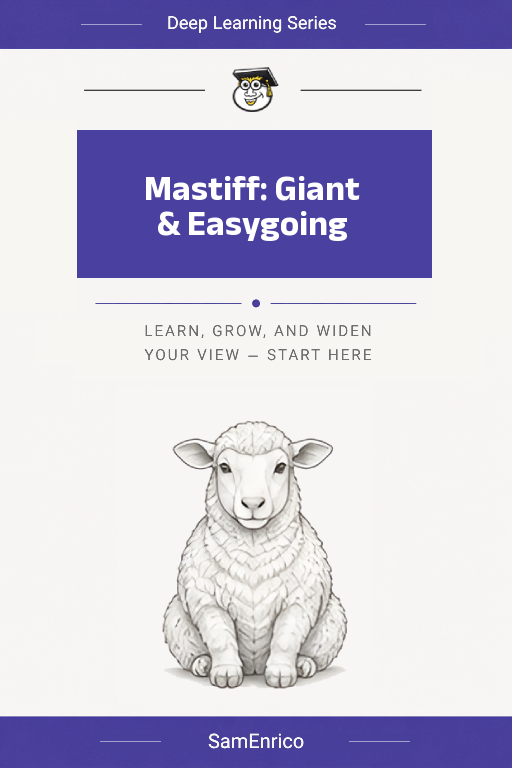
Mastiff: Giant & Easygoing
This publication, published by SamEnrico, covers M
by Upton Tobie
This publication, published by SamEnrico, covers Mastiff: Giant & Easygoing
Formats
About this book
Free sample
Chapter 1: The Gentle Paradox...--The first time a Mastiff leans its full weight against your leg—all 180 pounds of bone, muscle, and an utterly sincere belief that it is a lapdog—you will understand something that no amount of reading can fully prepare you for. This dog does not fit into the categories you know. It is not a guard dog in the way a German Shepherd is a guard dog, bristling with alert suspicion. It is not a companion dog in the way a Golden Retriever is a companion dog, bouncing with eager-to-please energy. The Mastiff occupies a third space, a strange and wonderful contradiction: a predator built to kill wolves that would rather nap in a sunbeam; a guardian so powerful it can knock a grown man flat that would not hurt a child who pulls its ears; a giant that asks for nothing more than a couch, a cool floor, and your presence.This is the gentle paradox.
And understanding it is the difference between owning a Mastiff and truly living with one.The phrase "gentle giant" has become so overused in dog writing that it has lost nearly all meaning. Every large breed from Great Danes to Newfoundlands wears the label. But the English Mastiff—the breed that defines the term "mastiff" in the way that "Kleenex" defines tissues—earned that description through centuries of deliberate, ruthless selection. Unlike the Great Dane, which was bred for the specific task of hunting wild boar (and therefore retained a certain sharpness), or the Newfoundland, bred for water rescue (and therefore developed an almost obsessive work ethic), the Mastiff was bred for a single, paradoxical purpose: to stop a threat without destroying it.English gamekeepers of the sixteenth and seventeenth centuries faced a specific problem. Poachers would enter their lords' estates at night to take deer and game.
The keepers needed dogs powerful enough to pursue, catch, and hold a fleeing human—a human who might be armed and desperate. But they could not use dogs that would maul or kill the poacher. A dead poacher meant a murder investigation…
This is the end of the free sample. Get the eBook to keep going. Buy now
Contents
- Chapter 1
- Chapter 2
- Chapter 3
- Chapter 4
- Chapter 5
- Chapter 6
- Chapter 7
- Chapter 8
- Chapter 9
- Chapter 10
- Chapter 11
- Chapter 12
Details
- Author
- Upton Tobie
- Publisher
- SamEnrico
- Language
- English
- Genre
- Non-Fiction, Informative, Educational
- Released
- 2026-05-11
- Pages (approx.)
- 158
- Available as
- eBook, Audiobook

Read better in the ZLOADR app
Your eBooks on your phone or tablet. Sign in with your SamEnrico account and start reading.
More by Upton Tobie
 Child Loss Anniversary PreparationUpton Tobie$11.99
 Feather Trace EvidenceUpton Tobie$11.99
 Adoptive Parents Infant LossUpton Tobie$11.99
 Rent Original Cast ReunionUpton Tobie$11.99
 Burnout Prevention for Physical TherapistsUpton Tobie$11.99
 The Anaphylaxis CPR GuideUpton Tobie$11.99
 Jonas Savimbi UNITA AngolaUpton Tobie$11.99
 Anki For Language TeachersUpton Tobie$11.99
 The Maori Haka: A Warrior Dance Transformed into Global Art (1860s-1890s)Upton Tobie$11.99
 Euclid's Elements: The Geometry of EternityUpton Tobie$11.99
 How to Produce Screen Printing SqueegeesUpton Tobie$11.99
 How to Start a Commercial Artist Business (Beginners Guide)Upton Tobie$11.99
You may also like
 Hong Kong Handover 1997Dunn Johnnie$11.99
 Zumba For Postnatal Recovery CourseNeal Christian$11.99
 Zumba for BeginnersLadner Nikia$11.99
 YouTube Comment Mining GuideHumes Pandora$12.99
 Worry Box MeditationCarlin Rudy$11.99
 Workplace Stress MeditationNguyen Lynn$11.99
 Workplace Stress and Sleep RepairHawley Ivory$11.99
 Workplace Perfectionism CureDelaney Jeffry$11.99
 Workplace Injustice Anger GuideWallen Isabelle$11.99
 Work Addiction and Burnout LinkGreenwood Ester$11.99
 Women in Yoga and WellnessBeattie Galina$11.99
 Women in Stand Up ComedyChun Evangeline$11.99