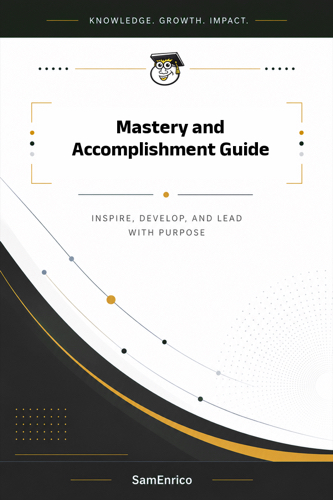
Mastery and Accomplishment Guide eBook
Schedule daily mastery experiences to build self r
by Hale Elsa
Schedule daily mastery experiences to build self respect and emotional resilience against shame and hopelessness.
Formats
Free sample
Chapter 1: The Shame Trap--–- The first time Lena forgot her own birthday, she was thirty-one and sitting on her bathroom floor at 2:17 PM on a Tuesday. She had not been fired. She had not been dumped. She had not received terrible news from a doctor. She was simply there, on the cold tile, because getting up required a sequence of actions—stand, walk, open the refrigerator, chew—and each action felt like climbing a mountain in wet cement.
Her phone buzzed with a calendar reminder she had set six years earlier: “Birthday! Celebrate you!” She stared at it. She had no memory of setting that reminder. That was when she realized: she had not been living. She had been waiting.
Waiting for motivation. Waiting for someone to rescue her. Waiting for the shame to lift so she could finally start being a person.Lena is not real. But she is also not fictional. She is a composite of every reader who will open this book and recognize the particular weight of shame that does not announce itself with a bang but settles in like a slow gas leak—invisible, odorless, and capable of suffocating you before you even notice you are breathing it.
This chapter is about that gas leak. It is about the difference between the shame that drives change and the shame that drives disappearance. It is about why hopelessness is not a feeling you catch but a habit you learn. And it is about the first, most fundamental truth of this entire book: shame is not a character flaw. Shame is a signal of inaction.If you have ever promised yourself you would start exercising tomorrow, and tomorrow came and went, and the promise felt heavier each time you broke it, you know the signal.
If you have ever avoided a phone call for so long that answering it became more terrifying than the news on the other end, you know the signal. If you have ever scrolled social media watching other people live while you sat motionless, thinking “why can’t I just be normal,” you know the signal. That signal is not proof that you are broken. It is proof that you have stopped performing competence. And the only way to turn off the signal is to act.The Three Faces of Inner Darkness: Shame, Guilt, and Hopelessness Before we can dismantle the shame trap, we need to see its architecture clearly.
Most self-help books use “shame,” “guilt,” and “hopelessness” interchangeably, as if they were three shades of the same gray paint. They are not. They are different structures entirely, and confusing them is like trying to fix a leaking roof with a plunger—you might move water around, but you will not stop the damage.Let us borrow from the work of Brené Brown, who spent six years coding thousands of stories of shame and emerged with a definition so precise it can be held like a tool. Shame is the intensely painful feeling that you are bad—not that you did something bad, but that you are something bad. Shame whispers: “I am unworthy of love.” “I am a failure at the core.” “There is something wrong with me that cannot be fixed.” Notice the grammar of shame: it always uses the verb to be.
I am stupid. I am lazy. I am broken. Shame is an identity statement.Guilt, by contrast, is the feeling that you did something bad. Guilt whispers: “I made a mistake.” “I hurt someone.” “I chose poorly.” Guilt uses action verbs: I did something wrong.
I chose poorly. I failed to show up. Guilt is uncomfortable, but it is also useful. Guilt tells you that your behavior misaligned with your values, which means your values are still intact. Guilt is the check engine light of the moral self.
Shame is the mechanic telling you the whole car is a lemon and you should have bought a bicycle.And then there is hopelessness, which is different from both. Hopelessness is not about identity or behavior. Hopelessness is a prediction about the future. It whispers: “Nothing I do matters.” “No matter what I try, the outcome will be the same.” “Why bother?” Hopelessness is the belief that agency does not exist—not that you are bad, and not that you did something bad, but that action itself is useless. This is the most dangerous of the three because it attacks the very possibility of change.
Shame says you are a monster. Guilt says you acted like one. Hopelessness says there is no point in trying to be otherwise.In this book, we will maintain these distinctions rigorously. When you miss a mastery session, you may feel guilt (“I didn’t do my Win today”). That is fine.
That is data. When you conclude that missing a session makes you a failure as a human being, that is shame—and we will treat shame as the enemy. When you stop believing that doing your Win will make any difference at all, that is hopelessness—and we will treat hopelessness as a cognitive distortion, not a truth. You will learn specific tools for each, starting with the most urgent question: how does inaction become a habit?The Neuroplasticity of Passivity: How Inaction Rewires Your Brain For decades, scientists believed that the adult brain was fixed—like concrete that had already dried. You learned something, and that was that.
But neuroplasticity research has overturned that model entirely. Your brain changes with every repeated behavior, every thought you think, every action you take or fail to take. And here is the uncomfortable truth that Martin Seligman’s learned helplessness experiments revealed: the brain can learn to be passive just as easily as it can learn to be active.In the original learned helplessness studies, dogs were subjected to electric shocks they could not escape. After enough repetitions, when the dogs were placed in a new environment where escape was possible, they did not even try. They lay down and whimpered.
They had learned—not intellectually, but neurally—that nothing they did mattered. Their brains had rewired to expect futility. The prefrontal cortex, responsible for initiating action, had been suppressed. The amygdala, responsible for fear and vigilance, had been strengthened. The dogs were not lazy.
They were not stupid. They were neuroplastically passive.Humans are no different. Every time you make a promise to yourself and break it, you are not just disappointing yourself. You are physically strengthening the neural pathway that says “my commitments do not matter.” Every time you avoid a task you said you would do, you are not just procrastinating. You are building a superhighway of passivity in your prefrontal cortex.
Over time, the effort required to start any action increases, because your brain has learned that initiating action leads to nothing—or worse, leads to shame. So it conserves energy. It waits. It scrolls. It stays on the bathroom floor at 2:17 PM.This is not a moral failure.
It is a neurological adaptation. But it is an adaptation that can be reversed by the same mechanism that created it: repeated, small actions that produce evidence of agency. The brain…
This is the end of the free sample. Get the eBook to keep going. Buy now
About this book
Details
- Author
- Hale Elsa
- Publisher
- SamEnrico
- Language
- English
- Genre
- Non-Fiction, Self-Help, DBT, Mastery
- Released
- 2026-06-12
- Pages (approx.)
- 126
- Available as
- eBook, Audiobook

Read better in the ZLOADR app
Your eBooks on your phone or tablet. Sign in with your SamEnrico account and start reading.
More by Hale Elsa
 Bank Robbery HostageHale Elsa$11.99
 Medical Conference Presentation NervesHale Elsa$11.99
 The Exhausted Parent Recovery GuideHale Elsa$11.99
 Deepfake Lip Sync for DubbingHale Elsa$11.99
 The Hollow Crown: The Secret War of the Mayan KingsHale Elsa$11.99
 The Sound of a Revolution: How a Teenager Changed Music ForeverHale Elsa$11.99
 NVIDIA Remote AI InternshipHale Elsa$12.99
 Executive Summary Examples ReferenceHale Elsa$12.99
 Ultimate Handbook Guide to Qinhuangdao : (China) Travel GuideHale Elsa$11.99
 Understanding Bowen's DiseaseHale Elsa$17.99
 Clinical Supply Chain ManagerHale Elsa$11.99