
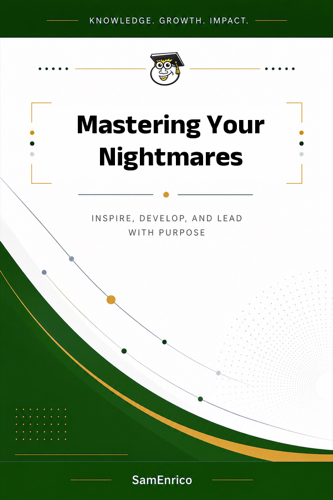
Non-FictionSelf-HelpLucid Dreaming
Mastering Your Nightmares eBook
Take control of distressing dreams using lucid dre
Take control of distressing dreams using lucid dreaming and rescripting techniques.
Formats
Free sample
Chapter 1: The Rehearsal Trap--Your heart is hammering against your ribs. You are drenched in sweat, tangled in sheets that feel like restraints. The bedroom is dark, familiar, utterly safe – and yet every nerve in your body is screaming that you just escaped something real. You glance at the clock. 3:17 AM.
Again. The same time, the same terror, the same damn dream.You tell yourself it was just a nightmare. Just your imagination. Just chemicals in your brain. But that voice in your head offers no comfort because the fear is still in your body, pulsing through your veins like a second heartbeat.
You lie there, afraid to close your eyes, because you know what waits for you on the other side of sleep. The same hallway. The same door. The same monster that never dies, never tires, and never explains why it hunts you.If this sounds familiar, you are not broken. You are not weak.
You are not secretly crazy or haunted or cursed. You are, however, trapped inside one of the most vicious loops the human brain can create – a loop that has been misunderstood for most of human history. This chapter is going to show you exactly how that loop works, why it gets stronger every time you wake up screaming, and why everything you have tried so far to stop your nightmares has probably made them worse.But here is the good news, the kind that actually matters at 3:17 AM: a loop can be broken. Not managed. Not coped with.
Broken. And the first step to breaking it is understanding that your nightmare is not your enemy. It is a misfired alarm system, a smoke detector that goes off when you burn toast. Annoying, terrifying in the moment, but ultimately fixable without burning down the house.Let us begin by understanding exactly what you are dealing with.The Three Faces of Night Terrors Before we can master nightmares, we have to stop calling everything that scares us at night by the same name. Most people use the word nightmare to describe any bad dream, but clinically and experientially, there are three very different phenomena that get lumped together.
Understanding which one you are dealing with is not academic pedantry – it is the difference between using the right tool and hammering a screw.The first category is the ordinary bad dream. Everyone has these. You dream that you show up to work naked, or that your teeth are falling out, or that you are back in high school and forgot to study for a final. You wake up mildly relieved, maybe a little embarrassed, and you go back to sleep within minutes. The emotion lingers like the taste of bad coffee – unpleasant but forgettable.
These are not nightmares. They are the brain’s way of processing minor anxieties, and they require no intervention.The second category is the night terror. This is a parasomnia that typically occurs during non-REM sleep, usually in the first third of the night. Unlike a nightmare, the person experiencing a night terror rarely remembers a coherent narrative. Instead, they wake up screaming, thrashing, with a heart rate that can exceed 160 beats per minute.
They may have no memory of a dream at all – just a wave of pure, unmodified terror that seems to come from nowhere. Night terrors are more common in children and are rarely a sign of psychological distress. They also do not respond to the techniques in this book. If you suspect you have night terrors, see a sleep specialist.The third category – and the subject of this entire book – is the clinical nightmare. A nightmare is a long, elaborate, narrative dream that awakens the sleeper during REM sleep, typically in the second half of the night.
The dreamer remembers a clear and terrifying sequence of events. The emotion is not just fear but often includes helplessness, disgust, grief, or shame. Most critically, the nightmare does not fade upon waking. It leaves a residue – an emotional aftertaste that can last for hours or days. And for people with chronic nightmares, the same dream returns again and again, like a movie you cannot stop watching.If you are reading this book, you already know which category you belong to.
You have the recurring dream. The one with the hallway, or the water, or the faceless figure. The one that has been visiting you for months or years. That is the beast we are going to train.The Evolutionary Gift That Became a Curse Here is something that might surprise you: your nightmare is not a glitch. From an evolutionary perspective, it is a feature – a beautifully designed survival mechanism that has kept your ancestors alive for millions of years.
The problem is that the world has changed, and your brain has not gotten the memo.Imagine a prehistoric ancestor – let us call her Nala. Nala lives on the savanna. Her biggest threat is predators. One day, she escapes a lion by running up a tree. That night, while she sleeps, her brain replays the chase.
Not as a punishment, but as practice. Her amygdala (the brain’s fear center) and her hippocampus (memory storage) work together to simulate the threat again so that Nala’s neural pathways for escape become faster, stronger, more automatic. The next time she sees a lion, she does not have to think – she just runs. The rehearsal saved her life.Fast forward a few thousand generations. You are Nala’s descendant, but you do not run from lions.
You run from deadlines, from social rejection, from the memory of a traumatic event, from the vague dread that something is wrong even when everything is fine. Your brain does not know the difference between a lion and a performance review. It only knows that you were terrified, and so it rehearses the terror. Your amygdala floods your system with cortisol. Your hippocampus encodes every detail.
And your prefrontal cortex – the part of your brain that would logically say "this is just a dream" – goes offline during REM sleep, leaving you defenseless.This is the evolutionary tragedy of the modern nightmare. Your brain is doing exactly what it was designed to do. It is rehearsing threats so that you can survive them. But the threats it rehearses are no longer lions. They are traumas, humiliations, abandonment scenarios, and abstract anxieties that cannot be outrun.
And because you cannot fight or flee from these threats in waking life, the nightmare never gets to complete its loop. It just repeats. Forever.The Rehearsal Trap Every time you wake up from a nightmare in terror, you do something that feels like relief but is actually self-sabotage. You escape. You open your eyes, turn on the light, check your phone, or wake your partner.
You do whatever it takes to remind yourself that you are safe. And in that moment, you feel better.But here is the brutal truth that no one tells you: by waking up, you just strengthened the nightmare.This is the Rehearsal Trap, and it is the single most important concept in this book. Write it down. Put it on your bathroom mirror. Memorize it.
Because until you understand the trap, none of the techniques in later chapters will make sense.Here is how the trap…
This is the end of the free sample. Get the eBook to keep going. Buy now
About this book
Details
- Author
- Gooch Filomena
- Publisher
- SamEnrico
- Language
- English
- Genre
- Non-Fiction, Self-Help, Lucid Dreaming
- Released
- 2026-06-06
- Pages (approx.)
- 130
- Available as
- eBook, Audiobook

Read better in the ZLOADR app
Your eBooks on your phone or tablet. Sign in with your SamEnrico account and start reading.
More by Gooch Filomena
 Wholesaling Buyer ListGooch Filomena$11.99
 Osteoarthritis Joint PracticeGooch Filomena$11.99
 Sales Engineering CreativityGooch Filomena$11.99
 The Diabetic ED GuideGooch Filomena$11.99
 Empathy for the Empathy ChallengedGooch Filomena$11.99
 Morning Person FreelancingGooch Filomena$11.99
 Gaming for LGBTQGooch Filomena$11.99
 The Silk Road Heist: A Digital Gold RushGooch Filomena$11.99
 Big Bertha and the Guns of Verdun: The Birth of Industrial WarfareGooch Filomena$11.99
 The Essential Guide to Traditional CelticGooch Filomena$11.99
 How to Produce Retail Display CasesGooch Filomena$11.99
 How to Produce Face PrimerGooch Filomena$11.99
You may also like
 Hong Kong Handover 1997Dunn Johnnie$11.99
 Zumba For Postnatal Recovery CourseNeal Christian$11.99
 Zumba for BeginnersLadner Nikia$11.99
 YouTube Comment Mining GuideHumes Pandora$12.99
 Worry Box MeditationCarlin Rudy$11.99
 Workplace Stress MeditationNguyen Lynn$11.99
 Workplace Stress and Sleep RepairHawley Ivory$11.99
 Workplace Perfectionism CureDelaney Jeffry$11.99
 Workplace Injustice Anger GuideWallen Isabelle$11.99
 Work Addiction and Burnout LinkGreenwood Ester$11.99
 Women in Yoga and WellnessBeattie Galina$11.99
 Women in Stand Up ComedyChun Evangeline$11.99