
Non-FictionInformativeEducational
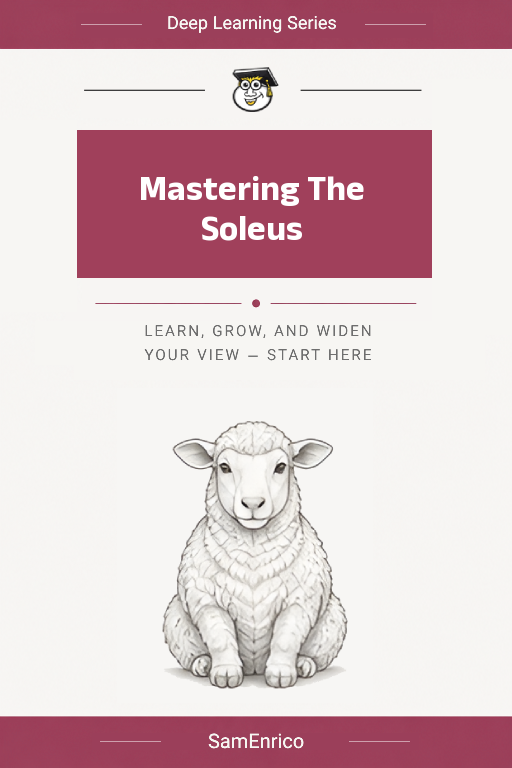
Mastering The Soleus eBook
This publication, published by SamEnrico, covers M
This publication, published by SamEnrico, covers Mastering The Soleus
Formats
Free sample
Chapter 1: The Silent Engine...--–- The email arrived at 3:47 AM on a Tuesday. The subject line read: "It happened again." Attached was a single video file: 14 seconds of a collegiate track athlete collapsing at the 80-meter mark of a 200-meter sprint. No collision. No stumble. His left leg simply stopped working.
The diagnosis later that week would read "gastrocnemius strain, grade 2" – the classic "tennis leg" that sidelines runners for six to eight weeks. But the physical therapist who reviewed the footage noticed something the team doctors missed. Watch the replay in slow motion, and you can see it: four steps before the pop, the athlete's heel whips outward on toe-off. His ankle wobbles. His foot slaps the ground instead of rolling through a smooth gait.
Those aren't symptoms of a weak gastrocnemius. Those are the unmistakable signatures of a soleus that checked out before the race even started.The medical chart would call it a calf injury. But the real story – the one this book will tell you on every single page – is that the athlete's soleus had been failing for months. The pop was just the final surrender.Nearly every person reading this paragraph has a soleus that is, right now, somewhere on the spectrum between asleep and atrophied. You might feel fine.
You might run marathons, squat twice your body weight, or simply walk your dog every evening without pain. And yet, without knowing it, you are probably leaking power, burning more metabolic fuel than necessary, and setting yourself up for a fall that could change your life in an instant. Not because you are weak or lazy or undisciplined. Because no one ever told you about the silent engine buried at the back of your lower leg.This is a book about a muscle you have never thought about. It is also a book about running faster, cycling longer, standing steadier, and aging better.
It is about a venous pump that can lower your blood pressure while you sit at a desk. It is about a metabolic furnace that can burn fat and regulate blood sugar without you breaking a sweat. It is about the single most underrated structure in the entire human body – a flat, broad, deep muscle called the soleus, and the reason you are about to realize that almost everything you know about your lower legs is wrong.Let us begin.The Anatomy of Ignorance: Why You’ve Been Looking at the Wrong Calf Muscle Walk into any gym in any city on any continent. Find the leg press machine, the squat rack, the calf raise station. Watch what people do.
You will see them perform straight-leg calf raises – standing on a step, heels dropping down, then exploding up onto the balls of their feet. You will see them load the seated calf raise machine with more weight than they squat. You will see them chase the diamond-shaped bulge that bodybuilders prize, the twin peaks of the gastrocnemius that look impressive in shorts and appear on magazine covers.What you will not see is anyone training the muscle that actually matters.The gastrocnemius – that showy, two-headed muscle that forms the bulk of what most people call "the calf" – is anatomically designed for flashy, short-duration, high-force movements. It originates above the knee, on the femur, which makes it a two-joint muscle crossing both the knee and the ankle. This design gives it incredible leverage for explosive movements: sprinting, jumping, lunging.
But it also makes the gastrocnemius metabolically expensive, quick to fatigue, and almost useless for the low-grade, sustained work that defines most human movement.The soleus, by contrast, is a masterpiece of engineering for endurance. It originates below the knee, on the back of the tibia and fibula, making it a single-joint muscle that crosses only the ankle. This simplicity is its superpower. The soleus is composed of approximately seventy to eighty-eight percent Type I slow-twitch muscle fibers – the highest proportion of any skeletal muscle in the human body. These fibers are designed to fire for hours, sometimes days, without fatigue.
They are rich in mitochondria, dense with capillaries, and optimized for oxidative metabolism. In plain English: the soleus is built to work all day long without complaining.But the soleus is also hidden. The gastrocnemius sits on top of it like a bulky sweater, obscuring the real engine underneath. You cannot see the soleus flex in a mirror. You cannot show it off at the beach.
And so the fitness industry – which sells aesthetics above all else – has spent decades teaching people to train the wrong muscle. Seated calf raises? Ignored. Bent-knee isometrics? Never mentioned.
The metabolic benefits of sustained soleus activation? Buried in academic journals that most personal trainers will never read.This book exists to correct that imbalance. Not because the gastrocnemius is useless – it is essential for sprinting and jumping. But because the soleus is essential for everything else. And for the vast majority of people, "everything else" is what determines whether they run without injury, stand without falling, and live without chronic pain.The Second Heart: Why Your Lower Legs Hold the Key to Your Circulation Here is a fact that sounds like fiction until you see the data: your soleus muscles – left and right combined – contain approximately the same volume of blood as your heart.
And unlike your heart, which pumps only when it contracts, your soleus can pump blood back to your upper body every single time it fires.This is not a metaphor. The soleus is literally a venous pump.Your circulatory system faces a gravitational problem that engineers would call "a design flaw." Your heart sits roughly at the level of your armpits. It pumps oxygenated blood down to your feet through arteries – a task that gravity assists. But that same gravity fights against the return trip. Deoxygenated blood must travel from your toes, up through your legs, through your abdomen, and back to your heart, all while flowing upward against gravity.
Your heart cannot do this alone. It needs help.That help comes from your skeletal muscles. When a muscle contracts, it squeezes the veins running through it, pushing blood upward past a series of one-way valves. This is called the skeletal muscle pump, and your soleus is the most powerful contributor to this system in your entire body. Every step you take, every time you lift your heel, every subtle seated contraction you perform – your soleus is squeezing blood up toward your chest like a second heart beating in your lower leg.The clinical implications of this are staggering.
Patients with chronic venous insufficiency – a condition where blood pools in the lower legs, causing swelling, pain, and skin changes – are often prescribed compression stockings and told to elevate their feet. But the real solution, the one that addresses the root cause, is soleus activation. A soleus that contracts regularly and forcefully will push blood upward more effectively than any external compression device.For office workers who sit eight to ten hours per day, the problem is even more acute. Seated posture places the knee in a bent position, which relaxes the gastrocnemius but actually positions the soleus for optimal contraction. But if…
This is the end of the free sample. Get the eBook to keep going. Buy now
About this book
Details
- Author
- Saavedra Arie
- Publisher
- SamEnrico
- Language
- English
- Genre
- Non-Fiction, Informative, Educational
- Released
- 2026-06-02
- Pages (approx.)
- 136
- Available as
- eBook, Audiobook

Read better in the ZLOADR app
Your eBooks on your phone or tablet. Sign in with your SamEnrico account and start reading.
More by Saavedra Arie
 The Sunshine DVD EvidenceSaavedra Arie$11.99
 Reconstruction of Drug Lab ExplosionsSaavedra Arie$11.99
 Early Retirement Reduction GuideSaavedra Arie$11.99
 Separation Anxiety DreamsSaavedra Arie$11.99
 Peg System For World CapitalsSaavedra Arie$11.99
 Anglo Irish War IndependenceSaavedra Arie$11.99
 Pomodoro for ResearchersSaavedra Arie$11.99
 Dream Journaling for DepressionSaavedra Arie$11.99
 Mozart: The Divine Fire of Musical GeniusSaavedra Arie$11.99
 The Whitechapel Shadow: Jack the Ripper’s Forgotten PredecessorSaavedra Arie$11.99
 How to Produce Pots and PlantersSaavedra Arie$11.99
 How to Produce DrinkwareSaavedra Arie$11.99
You may also like
 Hong Kong Handover 1997Dunn Johnnie$11.99
 Zumba For Postnatal Recovery CourseNeal Christian$11.99
 Zumba for BeginnersLadner Nikia$11.99
 YouTube Comment Mining GuideHumes Pandora$12.99
 Worry Box MeditationCarlin Rudy$11.99
 Workplace Stress MeditationNguyen Lynn$11.99
 Workplace Stress and Sleep RepairHawley Ivory$11.99
 Workplace Perfectionism CureDelaney Jeffry$11.99
 Workplace Injustice Anger GuideWallen Isabelle$11.99
 Work Addiction and Burnout LinkGreenwood Ester$11.99
 Women in Yoga and WellnessBeattie Galina$11.99
 Women in Stand Up ComedyChun Evangeline$11.99