
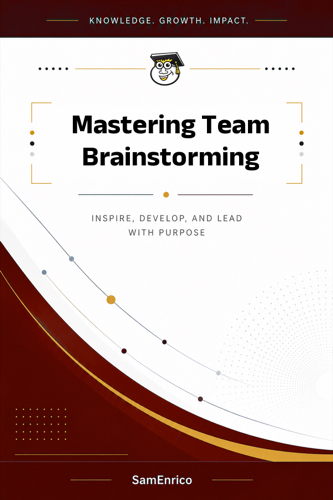
Non-FictionSelf-HelpCreative Thinking
Mastering Team Brainstorming eBook
Teaches specific techniques to generate, capture,
by Lu Eleonor
Teaches specific techniques to generate, capture, and refine ideas without losing momentum.
Formats
Free sample
Chapter 1: The Brainstorming Lie--–- Every weekday morning, in conference rooms around the world, well-intentioned managers commit the same act of creative violence. They gather a team, write a problem on a whiteboard, and say the seven words that guarantee failure: "Let's just throw some ideas out there."What follows is a ritual so familiar that no one questions it. The extroverts speak first and most. The senior person's half-formed thought becomes an anchor that drags the entire conversation. The quietest person in the room—often the one with the most valuable perspective—says nothing at all.
After forty-five minutes of polite interruption and meandering tangents, someone volunteers to "capture the key takeaways" on a laptop. Those takeaways are never seen again. The meeting ends. Everyone returns to their desks, relieved it's over, and nothing changes.This scene plays out an estimated 11 million times per day across corporate America alone. According to research from the Harvard Business Review, the average professional spends nearly 23 hours per month in brainstorming meetings.
Seventy-two percent of those professionals say brainstorming is the single most overrated meeting type they attend. And yet, we keep doing it. We keep gathering people in rooms. We keep saying "no bad ideas." We keep wondering why the output is so mediocre.The problem is not that brainstorming is a bad idea. The problem is that most people have been taught a version of brainstorming that was never designed to work the way they use it.
The original technique, developed by advertising executive Alex Osborn in the 1940s, was a specific, structured, four-step method. What survived was a caricature: "get people together and shout ideas." That caricature has failed so consistently and for so long that many executives have quietly concluded that group creativity is a myth.They are wrong. Group creativity is not a myth. But it is also not automatic. It is a process—a specific, learnable, repeatable process with rules, phases, and mechanics.
And the first step to mastering that process is to unlearn almost everything you think you know about brainstorming.The Productivity Loss Effect: Why Your Brainstorms Feel Broken In 1958, Yale University researcher Donald Taylor conducted a landmark experiment that should have ended the era of unstructured brainstorming forever. He asked one group of participants to brainstorm individually and another group to brainstorm in traditional face-to-face groups. He then measured the number and quality of ideas generated by each condition.The results were devastating for the advocates of group brainstorming. The individuals working alone generated nearly twice as many ideas as the groups. When researchers replicated the study with larger samples, the gap widened.
The phenomenon became known as the Productivity Loss Effect—the consistent finding that groups generate fewer and lower-quality ideas than the same number of individuals working alone and then combining their results.Why does this happen? Three specific mechanisms are at work, and understanding them is the first step to defeating them.Production Blocking: The Turn-Taking Trap The most powerful force behind the Productivity Loss Effect is something researchers call production blocking. Here is what happens: while one person is speaking, everyone else must listen. They cannot generate their own ideas while also processing someone else's. Worse, when they finally get a turn, their own train of thought has been interrupted.
Good ideas are forgotten. Connections are lost.In a traditional brainstorm, a team of six people will spend roughly 80 percent of their time not generating ideas. They are waiting to speak. They are listening. They are politely nodding.
During that waiting time, the brain's creative networks are idling. When the spotlight finally swings to them, the pressure to perform often triggers anxiety, which further suppresses creative output.Production blocking is why the loudest voice in the room seems to generate the most ideas. They are not more creative. They simply block others less often and get blocked themselves less often. The introvert in the corner is not less creative either.
They are simply production-blocked into silence.Evaluation Apprehension: The Fear of Looking Stupid The second mechanism is evaluation apprehension—the anxiety that comes from knowing that others are judging your ideas in real time. Osborn's original rule "no bad ideas" was specifically designed to combat this. But saying "no bad ideas" does not actually remove the social consequences of proposing a bad idea.Humans are exquisitely sensitive to social evaluation. When you propose an idea and someone's eyebrow twitches, when you speak and the room goes silent, when you offer a thought and a senior colleague says "interesting" in that particular tone—your brain registers all of this as social threat. The amygdala activates.
Cortisol rises. And the creative networks in your prefrontal cortex begin to shut down.The research is clear: the presence of an evaluative audience reduces creative output by as much as 40 percent. This is not a character flaw. It is a neurological fact. Your brain is designed to prioritize social safety over creative risk.
Unstructured brainstorming, by its very nature, makes social safety impossible to achieve.Social Loafing: The Diffusion of Responsibility The third mechanism is social loafing—the tendency for individuals to exert less effort when working in a group than when working alone. In a traditional brainstorm, it is easy to hide. You can nod along without contributing. You can repeat someone else's idea with slightly different wording. You can wait for others to fill the silence.Social loafing is not laziness.
It is a rational response to a poorly designed system. When accountability is diffuse—when no single person is responsible for a specific output—the brain conserves energy. Why strain to generate a brilliant idea if someone else might generate it? Why take the risk of proposing something unconventional if the group will probably move in a conventional direction anyway?The Productivity Loss Effect is not a conspiracy against creativity. It is the inevitable result of three predictable psychological mechanisms.
And the solution is not to try harder or hire more creative people. The solution is to redesign the process itself.The Myth of "No Bad Ideas"If you have ever attended a brainstorming session, you have heard the phrase: "Remember, there are no bad ideas." This phrase has become the sacred incantation of group creativity, repeated at the start of every session like a prayer for protection against judgment.Here is the truth: there are absolutely bad ideas. Some ideas are illegal. Some are physically impossible. Some would bankrupt the company.
Some are simply stupid. Pretending otherwise does not help anyone. In fact, the "no bad ideas" rule has probably damaged more brainstorming sessions than it has helped.Alex Osborn never intended the phrase to mean "all ideas are equally good." In his original 1948 book Your Creative Power, Osborn laid out four rules for brainstorming:No evaluation (separate generation from judgment)Go for quantity (more ideas increase the odds of good ones)Encourage wild ideas (unusual perspectives can trigger useful connections)Build on others' ideas (combination and improvement)Notice what is missing. Osborn never said "there are no bad ideas." He said defer judgment. He said separate generation from evaluation.
These are process instructions, not philosophical statements. They mean: during the generation phase, do not evaluate. During the evaluation phase…
This is the end of the free sample. Get the eBook to keep going. Buy now
About this book
Details
- Author
- Lu Eleonor
- Publisher
- SamEnrico
- Language
- English
- Genre
- Non-Fiction, Self-Help, Creative Thinking
- Released
- 2026-06-06
- Pages (approx.)
- 142
- Available as
- eBook, Audiobook

Read better in the ZLOADR app
Your eBooks on your phone or tablet. Sign in with your SamEnrico account and start reading.
More by Lu Eleonor
 Medication Dispenser GuideLu Eleonor$11.99
 Loneliness in HomelessnessLu Eleonor$11.99
 NYC Pop Up PermittingLu Eleonor$11.99
 Workload Prioritization SystemLu Eleonor$11.99
 Nonviolent CommunicationLu Eleonor$11.99
 Morning Routine ChallengeLu Eleonor$11.99
 Grit for PilotsLu Eleonor$11.99
 The Siege of Manila: Blood in the Streets of the Philippines (1898)Lu Eleonor$11.99
 Scythian Surgeons: The Hidden Healers of the SteppeLu Eleonor$11.99
 How to Produce Video Game Arcade CabinetsLu Eleonor$11.99
 How to Produce Lawn and Garden ProductsLu Eleonor$11.99
 Clubhouse Shortcut GuideLu Eleonor$12.99
You may also like
 Hong Kong Handover 1997Dunn Johnnie$11.99
 Zumba For Postnatal Recovery CourseNeal Christian$11.99
 Zumba for BeginnersLadner Nikia$11.99
 YouTube Comment Mining GuideHumes Pandora$12.99
 Worry Box MeditationCarlin Rudy$11.99
 Workplace Stress MeditationNguyen Lynn$11.99
 Workplace Stress and Sleep RepairHawley Ivory$11.99
 Workplace Perfectionism CureDelaney Jeffry$11.99
 Workplace Injustice Anger GuideWallen Isabelle$11.99
 Work Addiction and Burnout LinkGreenwood Ester$11.99
 Women in Yoga and WellnessBeattie Galina$11.99
 Women in Stand Up ComedyChun Evangeline$11.99