
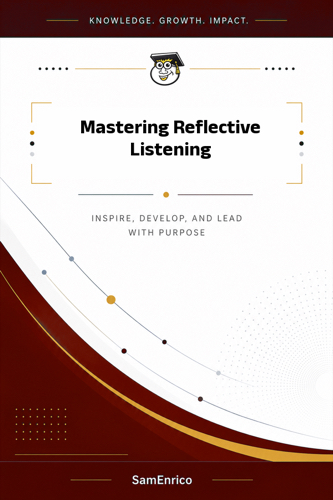
Mastering Reflective Listening
Teaches how to mirror emotions and content back to
Teaches how to mirror emotions and content back to speakers to validate their experience and build trust.
Formats
About this book
Free sample
Chapter 1: Why We Fail--–- The conference room was silent except for the hum of the projector. Sarah had just finished explaining why the project was behind schedule—a cascade of vendor delays, budget cuts, and a key team member’s unexpected departure. She stood there, vulnerable, having done exactly what leadership asked: she told the truth.Her boss nodded thoughtfully. Then he said, “Here’s what you should have done differently.”Sarah felt her chest tighten. She had just spent ten minutes explaining what actually happened.
He hadn’t addressed a single point she made. He hadn’t asked a single question. He had simply decided that her job was to present a problem and his job was to solve it. She walked out of that room feeling not heard, but managed. Dismissed.
Small.That night, she didn’t think, “My boss gave me useful advice.” She thought, “He doesn’t get it. He never will.”This is not a story about a bad boss. It is a story about a universal human failure: the failure to listen. Every day, in every relationship—romantic, parental, professional, friendly—millions of people walk away from conversations feeling exactly what Sarah felt. Not misunderstood.
Worse. Unheard. And the tragedy is that almost no one is doing it on purpose. No one wakes up thinking, “Today I will make my spouse feel invisible.” We fail at listening not because we are cruel, but because we are human. Our brains are wired for efficiency, not empathy.
We listen to reply, not to understand. And until we understand why we fail, we cannot begin to master the art of reflective listening.This chapter is not yet about how to listen. It is about the anatomy of listening failure. It is the diagnostic before the prescription. Because you cannot fix what you cannot see, and you cannot see what you have spent a lifetime practicing without awareness.
By the end of this chapter, you will be able to name the four bad habits that sabotage nearly every conversation you have. You will understand the ego-driven forces…
This is the end of the free sample. Get the eBook to keep going. Buy now
Contents
- Chapter 1
- Chapter 2
- Chapter 3
- Chapter 4
- Chapter 5
- Chapter 6
- Chapter 7
- Chapter 8
- Chapter 9
- Chapter 10
- Chapter 11
- Chapter 12
Details
- Author
- Stclair Doretha
- Publisher
- SamEnrico
- Language
- English
- Genre
- Non-Fiction, Self-Help, Empathy Training
- Released
- 2026-06-08
- Pages (approx.)
- 136
- Available as
- eBook, Audiobook

Read better in the ZLOADR app
Your eBooks on your phone or tablet. Sign in with your SamEnrico account and start reading.
More by Stclair Doretha
 Journalist Deadline StressStclair Doretha$11.99
 DBT For Graduate StudentsStclair Doretha$11.99
 The Email Harassment CasebookStclair Doretha$11.99
 The First Pedal to Glory: How a 19th-Century Cyclist Launched the Tour de France DreamStclair Doretha$11.99
 Marina DockhandStclair Doretha$11.99
 How to Become a Confectionery-drops-machine OperatorStclair Doretha$11.99
 India Green Credit System GuideStclair Doretha$12.99
 Summer Pop Up GuideStclair Doretha$12.99
 Understanding Telangiectasia Ataxia Variant V1Stclair Doretha$17.99
You may also like
 The Empathetic Stress ResponseWalton Velma$11.99
 EQ Empathy Development GuideWeis Beula$11.99
 The Empathy Development HandbookRitter Vannesa$11.99
 The Empathy Anger AntidoteGreco Miesha$11.99
 The Empathy Deficit and LonelinessLee Delores$11.99
 Empathy Development EQ WorkbookMccann Neta$11.99
 Empathy Building Practical GuideKunz Cheryll$11.99
 Empathic Listening NVC WorkbookBoynton Belia$11.99