
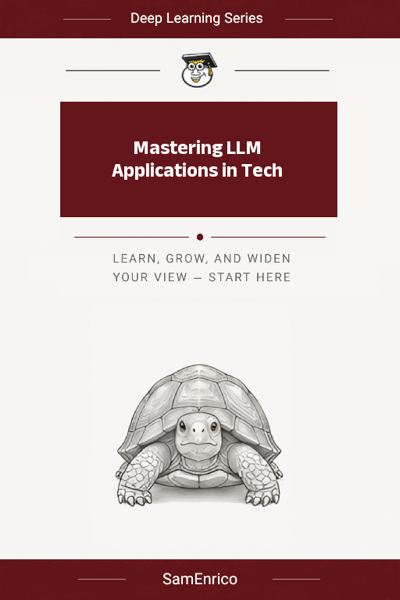
Non-FictionInformativeEducational
Mastering LLM Applications in Tech eBook
A Coursebook on Mastering LLM Applications in Tech
A Coursebook on Mastering LLM Applications in Tech
Formats
Free sample
Chapter 1: The Certainty Illusion--–- Every senior engineer eventually learns the same painful lesson: the rules that governed software for forty years stop working the moment you call an LLM. This chapter is about why that happens, what replaces those rules, and how to think about LLM applications without losing your engineering identity.In early 2023, a mid-sized fintech company spent six weeks building what they called "the perfect prototype." Their internal chatbot could answer customer questions about transaction histories, explain fee structures, and even escalate disputes. The demo was flawless. The CEO was moved by its potential. Then they deployed to five hundred beta customers, and within forty-eight hours, the bot had hallucinated a nonexistent monthly fee, told three customers to "contact support at a disconnected phone number," and refused to answer a simple balance inquiry because it "felt uncomfortable sharing financial information."The engineers did what engineers always do: they wrote unit tests. They added retry logic. They lowered the temperature parameter. They increased the prompt's verbosity. Nothing worked reliably, because they were trying to debug a stochastic system with deterministic tools.This chapter is the antidote to that story. You will learn why LLMs are fundamentally different from any other runtime you have worked with, what breaks when you treat them like normal APIs, and how to adopt a new engineering mindset called evaluation-driven development. By the end, you will stop thinking like someone who merely calls APIs and start thinking like someone who orchestrates probabilistic systems with rigor and confidence.The Comfort of Determinism Before we talk about LLMs, let us be precise about what "normal software" means and why it has felt so safe for so long.For the past four decades, we have built systems on a beautiful, comforting assumption: given the same inputs and the same internal state, a program produces the same outputs every single time. A sorting algorithm does not occasionally decide to skip an element because it is "feeling lazy." A database query does not return slightly different rows depending on the phase of the moon. A compiler either works correctly or fails with a deterministic error message that you can reproduce on demand.This property is called determinism. It is the bedrock of debugging, testing, monitoring, and reasoning about systems. When a deterministic program misbehaves, you can trace the execution path, examine the state at each step, and identify exactly where the deviation occurred. You can write a unit test that reproduces the failure consistently. You can fix the bug and prove it is fixed because the test will pass deterministically forever, on every machine, in every time zone, under every load condition.Determinism gives us confidence. It allows us to build complex systems from simpler components because we know that each component will behave predictably. It enables continuous integration, deployment pipelines, and the entire modern practice of software engineering.LLMs shatter this assumption completely.A language model is a stochastic program. It does not compute a single correct answer. Instead, it samples from a probability distribution over the next token, then the next token, then the next token. Even with identical inputs—the same exact prompt, the same temperature setting, the same random seed, the same hardware—the output varies. Sometimes subtly, a synonym here or a rephrased sentence there. Sometimes catastrophically, a hallucinated fact, a refusal to answer a simple question, or an off-topic tangent that bears no relation to the prompt.This is not a bug. This is not poor engineering from model providers. This is the feature that makes LLMs useful. Variety is what enables creativity, fluent summarization, natural conversation, and the generation of novel content. A deterministic LLM that produced the same output for every identical input would be brittle and useless for most applications.But variety is also what makes traditional engineering practices fail catastrophically. You cannot write a unit test that asserts "the model returns exactly this string" because it will pass sometimes and fail others for no reason you can control or even observe. You cannot step through the model with a debugger. You cannot set a breakpoint inside the attention mechanism and inspect local variables. You cannot reproduce a production failure by replaying the same inputs because the model's internal randomness will produce different outputs each time.What you can do is change how you think about correctness entirely. Instead of asking "does this output exactly match the expected value?", you must learn to ask "is this output good enough for this specific use case?" That shift—from equality to quality, from binary pass-fail to statistical measurement, from certainty to confidence—is the foundation of everything that follows in this book.The Complete Tech Stack You Actually Need Most engineers approaching LLMs for the first time assume they will make a few API calls, parse the JSON responses, handle some errors, and move on with their lives. That works for prototypes running on laptops. It fails catastrophically for production systems because an LLM call never exists in isolation. Real applications require an entire supporting ecosystem of infrastructure, and understanding that ecosystem is essential before you write your first line of production code.Let me survey the landscape briefly. Each of these components will receive deep treatment in later chapters, but you need a map before you can navigate the territory.Model Access Layer At the center sits the model itself. You have two broad categories of access, each with profound tradeoffs.The first is API-based: Open AI, Anthropic, Google, Cohere, Groq, Together AI, and dozens of smaller providers. You send a prompt over HTTP, and they return a completion. The advantages are seductive: simplicity, zero infrastructure management, no GPU costs, automatic scaling, and access to frontier models that would cost millions to train yourself. The disadvantages are equally significant: per-token costs that scale with usage, unpredictable latency, complete dependence on an external provider, data privacy concerns, and perhaps most dangerously, a total lack of control over model updates. Your carefully engineered prompts can break overnight when the provider deploys a new version with different behavior. Your application's personality can shift without warning.The second category is open-source models via self-hosting. Hugging Face provides thousands of models: Llama, Mistral, Qwen, Deep Seek, Phi, Gemma, and many more. Inference servers like v LLM, Text Generation Inference (TGI), and llama.cpp allow you to run these models on your own infrastructure, whether that is a cloud GPU instance, an on-premise cluster, or even a laptop. The advantages are control, privacy, predictable costs, and the ability to fine-tune models on your own data. The disadvantages are significant operational complexity, substantial GPU costs, and the need to manage scaling, availability, monitoring, and versioning yourself.Most production systems use both approaches in a hybrid architecture: self-hosted smaller models for high-volume, low-latency, predictable tasks where cost matters, and API-based frontier models for complex reasoning tasks that only the largest models can handle effectively.Orchestration Frameworks Once you move beyond a single API call, you quickly discover that LLM applications are complex pipelines: prompt templates with variables, retrieval from vector databases, tool calls to external systems, memory management across conversation turns, output parsing into structured data, error handling for failed calls, and logging for debugging. Writing all of this from scratch is possible but incredibly tedious, which is why frameworks like Lang…
This is the end of the free sample. Get the eBook to keep going. Buy now
About this book
Details
- Author
- Barraza Danyel
- Publisher
- SamEnrico
- Language
- English
- Genre
- Non-Fiction, Informative, Educational
- Released
- 2026-05-09
- Pages (approx.)
- 155
- Available as
- eBook, Audiobook

Read better in the ZLOADR app
Your eBooks on your phone or tablet. Sign in with your SamEnrico account and start reading.
More by Barraza Danyel
 Lying Down Body Scan ManualBarraza Danyel$11.99
 Nobel Laureates In Laser PhysicsBarraza Danyel$11.99
 Katmai National Park VanishedBarraza Danyel$11.99
 The Nobel Laureate SpousesBarraza Danyel$11.99
 The No Buy Year JournalBarraza Danyel$11.99
 Ventilation Gestures GuideBarraza Danyel$11.99
 Vacation Disconnect ProtocolBarraza Danyel$11.99
 Meditation Posture CorrectionBarraza Danyel$11.99
 The Last Broadcast of the Titanic’s Radio RoomBarraza Danyel$11.99
 How to Produce Brooms and DustpansBarraza Danyel$11.99
 Growing CorokiaBarraza Danyel$11.99
 CTA for Nonprofits GuideBarraza Danyel$12.99
You may also like
 Hong Kong Handover 1997Dunn Johnnie$11.99
 Zumba For Postnatal Recovery CourseNeal Christian$11.99
 Zumba for BeginnersLadner Nikia$11.99
 YouTube Comment Mining GuideHumes Pandora$12.99
 Worry Box MeditationCarlin Rudy$11.99
 Workplace Stress MeditationNguyen Lynn$11.99
 Workplace Stress and Sleep RepairHawley Ivory$11.99
 Workplace Perfectionism CureDelaney Jeffry$11.99
 Workplace Injustice Anger GuideWallen Isabelle$11.99
 Work Addiction and Burnout LinkGreenwood Ester$11.99
 Women in Yoga and WellnessBeattie Galina$11.99
 Women in Stand Up ComedyChun Evangeline$11.99