
Non-FictionSelf-HelpTime ManagementCareer
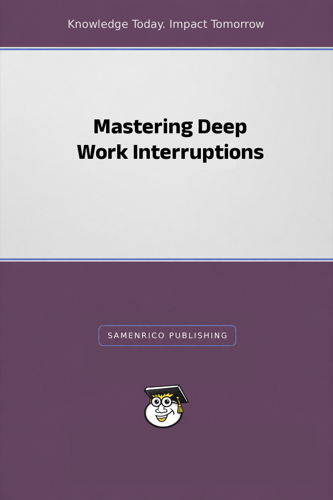
Mastering Deep Work Interruptions eBook
Implement proven methods to protect your most prod
Implement proven methods to protect your most productive hours from unexpected pings, calls, and coworkers.
Formats
Free sample
Chapter 1: The 23-Minute Heist--–- Sarah’s Tuesday died at 10:17 AM. Not with a bang, but with a ping.She had opened her laptop at 8:30 AM with a clear mission: finish the Q3 forecast narrative by noon. The document was open. Her coffee was hot. Her calendar was clear.
For seventeen glorious minutes, she wrote. Then her phone buzzed. A Slack message from a colleague in Dublin: “Quick question on the Euro numbers?” Sarah answered in eleven seconds. It seemed harmless. By 10:17 AM, she had answered four more messages, checked email twice, and lost her narrative thread entirely.
She spent the next hour re-reading what she had already written, trying to remember the insight she’d had at 8:47 AM. It never came back. At 5:32 PM, she emailed the incomplete forecast to her boss with an apology. She worked until 7:00 PM to finish what should have taken three hours. She missed dinner with her kids.
And she never once blamed the ping.This book exists because Sarah’s story is your story. It is the story of every knowledge worker who has ever felt exhausted at 5:00 PM but unable to name a single thing they finished. The tragedy is not that we are interrupted. The tragedy is that we have normalized interruption. We have learned to accept the ping, the knock, the “quick question,” the email chime, the Slack badge, the drive-by colleague, the “do you have a second?” as the weather of modern work—unpleasant but unavoidable.They are not unavoidable.
And they are not weather. They are theft.The Math That Changes Everything Most people believe a quick interruption costs only the minute it takes. This belief is not just wrong. It is catastrophically wrong—off by a factor of twenty-three.Let me say that again. If someone interrupts you for one minute, you do not lose one minute.
You lose twenty-three minutes.This is not a productivity hack. It is not an opinion. It is the settled science of attention residue, a phenomenon studied extensively by cognitive psychologists and popularized by Cal Newport in Deep Work and Chris Bailey in Hyperfocus. The research is consistent and replicable: after a distraction, the human brain requires an average of twenty-three minutes to return to the same depth of focus it enjoyed before the interruption.Twenty-three minutes.Let that number land. A colleague asks a “quick question” that takes forty-five seconds to answer.
You are now functionally offline for nearly half an hour. A Slack notification flashes on your screen. You glance at it for two seconds. Twenty-three minutes. Your phone buzzes with a text from your spouse asking about dinner.
You respond with “sure.” Twenty-three minutes.The mechanism behind this astonishing cost is called attention residue. When you are deeply focused on a task, your brain constructs a complex neural network—a temporary “scaffolding” of associations, data points, and partial solutions. This scaffolding is delicate. When you switch to a different task (like answering a message), your brain does not simply abandon the first scaffolding. Instead, it keeps a ghost of it running in the background.
Part of your cognitive capacity remains tied to the original task while the rest struggles with the new one. You are not fully present in either. You are split. And when you try to return to the original task, your brain must not only rebuild the scaffolding—it must also suppress the ghost of the interruption.That rebuilding process takes, on average, twenty-three minutes.The range is wide—some people recover in twelve minutes, others take thirty-eight. But the average is devastatingly consistent.
And the cost compounds. Each subsequent interruption within that twenty-three-minute window resets the clock. If you are interrupted four times in an hour, you may never recover at all. You simply bounce from distraction to distraction, shallow task to shallow task, feeling busy while producing nothing of value.The Interruption Tax: Your Personal Reckoning Before we go any further, I want you to calculate your personal interruption tax. This exercise will change how you see every ping, knock, and “quick question” for the rest of your life.For the next two working days, carry a small notebook or open a notes app.
Every time you are interrupted—by a person, a notification, a phone call, an email that pulls you away from your current task—write down:What you were doing before the interruption What the interruption was How long the interruption lasted (in minutes)At the end of the second day, count how many interruptions you logged. Multiply that number by 23. That is how many minutes of deep work capacity you lost to interruption over two days.Now divide by 60. That is how many hours.Now multiply by 5. That is your average weekly loss.Now multiply by 48.
That is your annual loss in hours.Now divide by 2080 (the number of working hours in a standard year). That is the percentage of your professional life that interruption theft has stolen from you.Most knowledge workers log between fifteen and twenty interruptions per day. Let us use fifteen. Fifteen interruptions per day times twenty-three minutes equals 345 minutes—five hours and forty-five minutes—of lost cognitive capacity per day. Over a five-day week, that is nearly twenty-nine hours.
Over a year, that is more than thirteen hundred hours. That is sixty-five percent of your working life. You are spending the majority of your cognitive capacity not on doing your job, but on recovering from the interruptions that prevent you from doing your job.And you have been told this is normal.The Hidden Architecture of Distraction Here is what makes interruption theft so insidious: it hides in plain sight. Unlike a mugging or a burglary, an interruption leaves no visible wound. You do not feel the twenty-three minutes draining away.
You only feel tired. You only feel behind. You only feel that vague, nameless frustration of having worked all day and accomplished nothing.The reason you do not feel the cost is that your brain is remarkably good at hiding its own inefficiencies. When attention residue is present, you experience it as “trying to focus” or “getting back into the swing of things.” You do not perceive the minutes as lost. You perceive them as the normal friction of work.
But they are not normal. They are not friction. They are the residue of a theft you did not notice happening.Consider the following experiment, conducted by researchers at the University of California, Irvine. They placed knowledge workers in a controlled environment and tracked their focus continuously. The results were staggering: after a one-second interruption (a glance at a notification), workers took an average of twenty-five minutes to return to their original task with the same level of cognitive performance.
The one-second glance cost nearly half an hour.But here is the detail that should terrify you: the workers did not know they had been interrupted. When asked at the end of the day to account for their time, they could not explain where the hours had gone. They reported feeling “busy” and “productive.” The objective data showed otherwise. Their brains had erased the memory of the cost while still suffering its effects.This is…
This is the end of the free sample. Get the eBook to keep going. Buy now
About this book
Details
- Author
- Hadley Ludivina
- Publisher
- SamEnrico
- Language
- English
- Genre
- Non-Fiction, Self-Help, Time Management, Career
- Released
- 2026-06-10
- Pages (approx.)
- 132
- Available as
- eBook, Audiobook

Read better in the ZLOADR app
Your eBooks on your phone or tablet. Sign in with your SamEnrico account and start reading.
More by Hadley Ludivina
 1031 Exchange Deferred Sales TrustHadley Ludivina$11.99
 Suicide Loss Prolonged GriefHadley Ludivina$11.99
 The 30 Day Morning ChallengeHadley Ludivina$11.99
 Cave Sanctuary RetreatHadley Ludivina$11.99
 Memory for PilotsHadley Ludivina$11.99
 Bill Gates Think Week MethodHadley Ludivina$11.99
 Immigrant Laundromat Chain SuccessHadley Ludivina$11.99
 NVC For ActivismHadley Ludivina$11.99
 The Great Cookie Heist: How a Baking Empire Fell to PiecesHadley Ludivina$11.99
 The Mathematician Who Defied the Stars: Apollonius of Rhodes and the African SkyHadley Ludivina$11.99
 Tangaroa’s Tide: The God Who Shaped the PacificHadley Ludivina$11.99
 Ultimate Handbook Guide to Ngerulmud : (Palau) Travel GuideHadley Ludivina$11.99
You may also like
 Hong Kong Handover 1997Dunn Johnnie$11.99
 Zumba For Postnatal Recovery CourseNeal Christian$11.99
 Zumba for BeginnersLadner Nikia$11.99
 YouTube Comment Mining GuideHumes Pandora$12.99
 Worry Box MeditationCarlin Rudy$11.99
 Workplace Stress MeditationNguyen Lynn$11.99
 Workplace Stress and Sleep RepairHawley Ivory$11.99
 Workplace Perfectionism CureDelaney Jeffry$11.99
 Workplace Injustice Anger GuideWallen Isabelle$11.99
 Work Addiction and Burnout LinkGreenwood Ester$11.99
 Women in Yoga and WellnessBeattie Galina$11.99
 Women in Stand Up ComedyChun Evangeline$11.99